For decades, science fiction has dangled the universal translator in front of us — a device that instantly dissolves language barriers and lets humans communicate with anyone, anywhere. Earpieces whispering seamless translations in Star Trek. The Babel fish in The Hitchhiker’s Guide to the Galaxy. The promise was always just around the corner, always just out of reach.
Google just turned that corner.
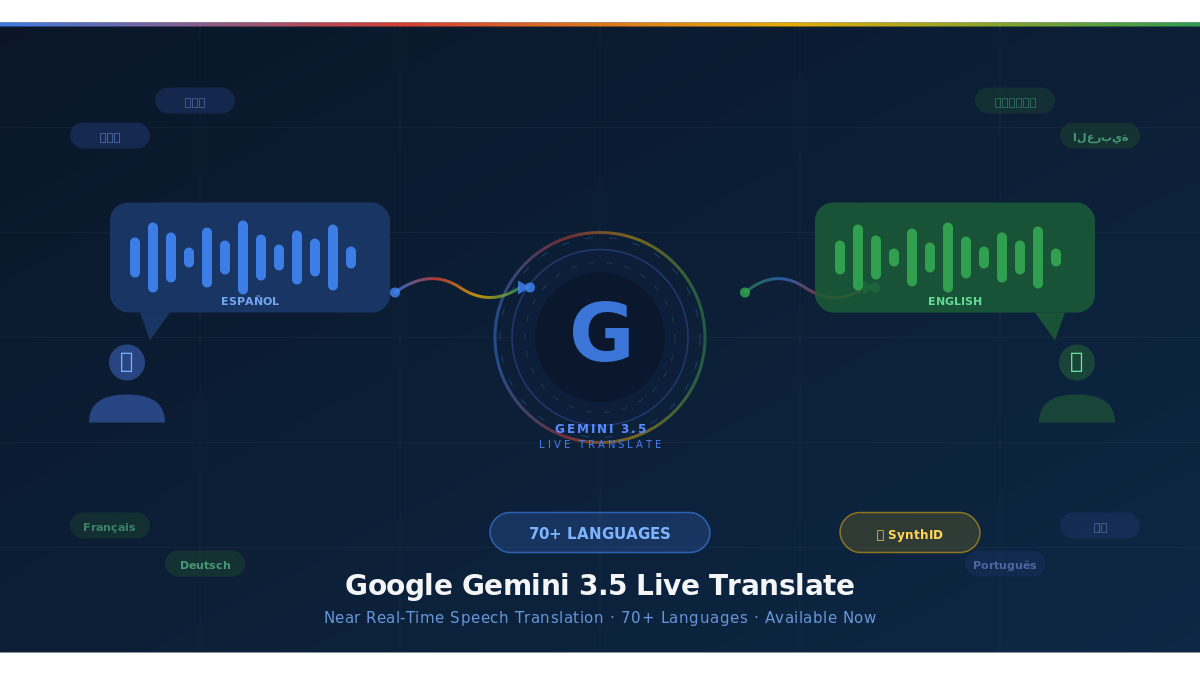
On June 9, 2026, the company released Gemini 3.5 Live Translate, an AI audio model that delivers near real-time speech-to-speech translation across more than 70 languages. It’s not a parlor trick. It preserves the speaker’s intonation, pacing, and pitch. It doesn’t wait for you to finish your sentence before it starts translating. And it’s already rolling out across Google’s consumer apps and enterprise products — free, no sign-up required.
This is one of the most significant leaps in human communication technology in a generation.
What Makes This Different
Translation software has existed for years. Google Translate celebrated its 20th anniversary recently, and the product has processed over a trillion words per month for billions of users. But existing solutions — including earlier versions of live translation in Google Meet — have always had a fundamental problem: they’re turn-based.
Traditional systems wait for a speaker to stop talking, process the entire utterance, and then produce a translation. The result is a stilted, choppy experience. You say your piece, you wait, the translation comes. Then your conversation partner does the same. It’s functional, but it kills the natural rhythm of conversation. You’re not really talking to someone — you’re taking turns firing at a wall.
Gemini 3.5 Live Translate processes speech as it streams. The model listens continuously, staying just a few seconds behind the speaker. There are no awkward pauses. The conversation flows. When you speak, the translated audio flows out on the other side almost immediately, preserving not just your words but your voice — the warmth or urgency or humor encoded in how you say something, not just what you say.
That shift from turn-based to streaming is deceptively important. It’s the difference between reading a letter and having a conversation.
Noise Robustness and Automatic Language Detection
Two additional technical achievements make this practically useful rather than just theoretically impressive.
First, the model is noise-robust. Real conversations don’t happen in recording studios. They happen at airport gates, in kitchens with the TV on, in busy restaurant lobbies. Gemini 3.5 Live Translate is engineered to handle unpredictable, loud environments without losing accuracy — a prerequisite for any tool meant to be used in the real world.
Second, the model automatically detects which language is being spoken. Users don’t need to configure anything. Speak Spanish, get English back. Speak Tagalog, switch to Japanese, mix in some French — the model adapts. In a meeting with participants speaking multiple languages, the system handles over 2,000 language pair combinations simultaneously. That’s not a feature; it’s a different paradigm.
Where It’s Available Right Now
Google has rolled out Gemini 3.5 Live Translate across several surfaces simultaneously:
Google Translate (Android and iOS): The model is live globally in the Google Translate app. When you activate the Live Translate feature, you can connect headphones to hear natural translations that mirror the speaker’s tone. For Android users, Google is also rolling out a new “listening mode” — you hold your phone to your ear like a regular phone call, and translated audio streams directly through the earpiece. No headphones needed. No one around you needs to know you’re translating.
Google Meet (Enterprise Private Preview): Business users on Google Workspace are getting access through a private preview this month, with a broader rollout later in 2026. The upgrade is substantial: the previous Meet translation feature supported only five languages. With Gemini 3.5 Live Translate, that expands to 70+. The previous system could only translate to and from English; the new one supports 2,000+ language pair combinations within a single meeting.
Google AI Studio and Gemini Live API (Developer Preview): Developers can access the model in public preview via the Gemini Live API and Google AI Studio, building their own real-time translation products without managing complex media streaming infrastructure.
Real-World Deployment: Grab
Google’s announcement included a notable real-world partnership. Grab, the Southeast Asian super-app operating across ride-hailing, food delivery, and financial services, is testing Gemini 3.5 Live Translate to enable multilingual communication between drivers and travelers at pickups. Those users — speaking a wide range of Southeast Asian languages — make over 10 million voice calls per month through Grab.
That deployment context is important. Southeast Asia is one of the most linguistically diverse regions on Earth, with hundreds of languages and dialects. Grab’s adoption isn’t a PR move — it’s a stress test under conditions that would expose any weakness in coverage or reliability. The early results appear positive.
Other platform partners including Agora, LiveKit, Pipecat, Fishjam, and Vision Agents are integrating the Gemini Live API to help developers build and deploy voice translation applications without reinventing the infrastructure wheel.
SynthID Watermarking: Safety by Design
One detail in the announcement deserves more attention than it’s gotten: all audio generated by Gemini 3.5 Live Translate is watermarked with SynthID, Google DeepMind’s imperceptible audio watermarking technology.
The watermark is embedded directly into the audio output. It cannot be heard, but it can be detected by systems designed to look for it. This means that AI-translated audio is, in principle, traceable as AI-generated — even after distribution, even after re-recording.
This matters because a sufficiently capable real-time translation model could also, theoretically, be used to impersonate someone in another language — to put words in a person’s mouth in a tongue they don’t speak. SynthID doesn’t eliminate that risk, but it creates an accountability layer. If AI-generated audio is used in a misleading context, the watermark creates a basis for detection. It’s a meaningful commitment to responsible deployment of a powerful technology.
The Bigger Picture
The release lands in a broader context worth noting. 2026 has been the year AI moved from chatbots into infrastructure — into the tools people use to do the most basic things in their professional and personal lives. Communication is as basic as it gets.
Language barriers have always been structural inequality in disguise. Access to global trade, education, medical care, legal systems, and human relationships has historically required either linguistic fluency or the financial ability to hire translators. That’s not a minor inconvenience — for hundreds of millions of people, it’s a ceiling.
A real-time translation system that’s free, mobile, and works across 70+ languages with natural voice quality doesn’t just improve existing workflows. It removes a barrier. The nurse who can speak to an immigrant patient in their own language. The small business owner who can negotiate with a supplier across twelve time zones without hiring an interpreter. The traveler who can have an actual conversation with a local instead of pointing at a phrasebook.
Google has been building toward this for 20 years. With Gemini 3.5 Live Translate, it looks like they’ve arrived.
Getting Started
For consumers: update the Google Translate app on Android or iOS and look for the Live Translate feature. No additional setup is required.
For developers: Gemini 3.5 Live Translate is available in public preview via the Gemini Live API and Google AI Studio.
For enterprise: Google Workspace customers can expect invitations to the private preview of speech translation in Google Meet starting this month.
The universal translator is no longer science fiction. It’s in your pocket.


