Linus Torvalds officially tagged Linux kernel 7.1 stable on June 14, 2026, releasing it a few hours ahead of his usual Sunday evening schedule — blaming an upcoming long-haul flight. The early drop aside, the release is anything but rushed. With more than 2,000 contributing developers (over 300 of them first-timers) and a development cycle spanning seven release candidates, Linux 7.1 lands as one of the most consequential point releases in recent memory.
The headline? A completely rewritten NTFS driver that finally gives Linux users a production-quality, native path to Windows-formatted storage — and marks a significant milestone in the decade-long effort to make Linux a seamless partner to the world’s dominant desktop operating system.
The NTFS Driver: Four Years in the Making
If you have ever dual-booted Linux alongside Windows, accessed an external USB drive formatted in NTFS, or wrestled with the limitations of the ntfs-3g userspace driver, you will understand why this change matters. NTFS — the New Technology File System developed by Microsoft and default on Windows since Windows NT 3.1 — has historically been a pain point on Linux. The old ntfs3 kernel driver was capable but rough around the edges, while ntfs-3g, the popular FUSE-based alternative, carried performance overhead by virtue of running in userspace.
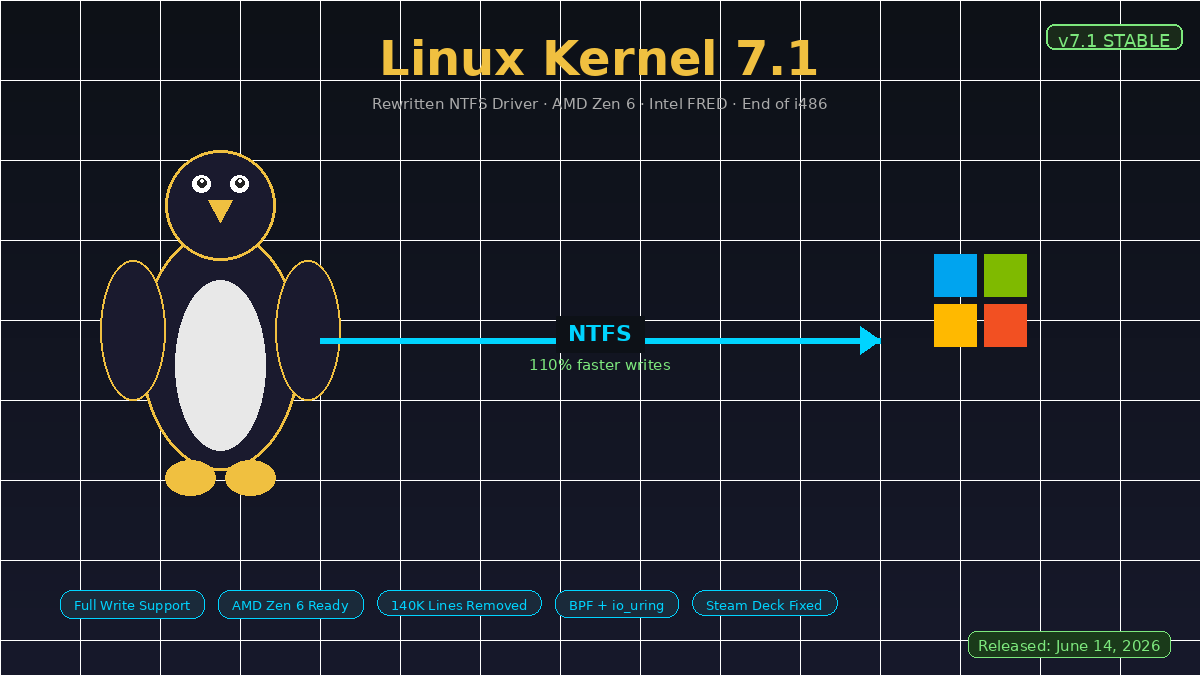
The new driver, the result of four years of sustained effort by developer Namjae Jeon, is a ground-up rewrite built on the kernel’s iomap infrastructure. It supports full, safe write access to NTFS volumes and eliminates the architectural overhead that made its predecessors frustrating. Early benchmarks tell a compelling story: multi-threaded write performance improves by approximately 110 percent over the previous ntfs3 driver in representative workloads, and volumes mount noticeably faster on large storage devices.
For practical purposes, this means that a Linux machine sharing an external drive with a Windows laptop — a scenario common in creative production environments, legal firms, and IT departments — now handles that drive without compromise. Files transfer faster, no third-party daemon is required, and the driver benefits from the same security review and maintenance cycle as the rest of the kernel.
This is particularly meaningful as Microsoft’s own ecosystem continues to blur boundaries. The Windows Subsystem for Linux (WSL) runs Linux workloads on top of NTFS. Azure virtual machines routinely bridge Windows and Linux. Corporate environments increasingly run mixed fleets. A robust, native NTFS implementation in the Linux kernel is not just a convenience — for enterprise administrators, it is a foundation.
AMD Zen 6, Intel Panther Lake, and the Hardware Horizon
Beyond storage, Linux 7.1 arrives ready for silicon that has not yet shipped. AMD’s Zen 6 architecture, expected to reach consumers later in 2026, has received early kernel support via updated headers and initial code paths. When the hardware hits store shelves, Linux distributions will not need a kernel update to recognize it — the groundwork is already in place.
On the Intel side, FRED (Flexible Return and Event Delivery) is now enabled by default. FRED is a microarchitectural mechanism designed to reduce overhead during privilege-level transitions — the constant mode-switching between user-space applications and the kernel that underlies virtually every system call. Intel’s upcoming Panther Lake processors are designed to take full advantage of FRED, and enabling it by default in 7.1 ensures that distribution kernels will extract that benefit automatically when Panther Lake machines begin shipping.
Graphics users also see meaningful updates. Intel Arc Battlemage GPUs receive optimizations, older AMD Radeon hardware gets performance tuning, and the new DRM-RAS framework allows GPU and accelerator drivers to expose error counters and reliability data to userspace — a feature relevant to anyone running NVIDIA or AMD compute workloads in production environments.
For laptop and handheld users, two long-awaited fixes stand out. Linux 7.1 resolves a Steam Deck OLED audio regression that had persisted in the mainline kernel for two years, forcing users on standard distributions to apply Valve’s internal patches manually. Apple Silicon MacBooks receive improved battery and power monitoring through the Apple SMC driver, alongside better fan controls for Lenovo Legion Go and Yoga devices.
Cleaning House: 140,000 Lines and the End of the i486
Every kernel release involves some code removal, but 7.1 treats legacy cleanup as a first-class goal. The most symbolic departure is support for the Intel i486 architecture — specifically, the M486, M486SX, and AMD Elan subarchitectures. These chips date to the early 1990s; maintaining kernel support for them in 2026 meant preserving code paths that had not been tested on real hardware in years and that complicated compiler optimizations for every modern user.
The i486 removal is symbolic precisely because the Linux kernel spent its early years on that hardware. Torvalds built the first versions of Linux on a 386 in 1991. Dropping i486 support in 2026 is the kernel declaring, officially and without ambiguity, that it has moved on.
Beyond the architecture change, the 7.1 release purges more than 140,000 lines of obsolete code — ancient ISDN networking stacks, legacy PCMCIA host controllers, old bus mouse drivers, and networking protocols that have not seen meaningful traffic in decades. The result is a smaller, simpler attack surface. Security researchers have fewer obscure code paths to audit; compiler maintainers face fewer edge cases; and distributions carry less dead weight in their packages.
IPv6 Is Now Non-Negotiable
A quieter but significant policy change: IPv6 can no longer be compiled as a loadable kernel module. It must either be built directly into the kernel or disabled entirely. This formalizes what has been true in practice for years — modern networks depend on IPv6, and treating it as optional created configuration fragility without providing meaningful flexibility. Enterprise deployments, cloud providers, and ISPs running Linux will not be surprised by this change, but it clarifies the kernel’s stance for the long term.
The AI Bug Report Problem
Kernel development is public and email-driven, which makes it vulnerable to volume attacks. During the 7.1 development cycle, maintainers documented a significant increase in bug reports generated by large language models — automated submissions that lacked the context, reproducibility steps, and verification that human reporters typically provide. Many were false positives; others described issues in vague, difficult-to-triage terms.
The response was a rewrite of the kernel’s security disclosure policies to require human validation as a prerequisite for serious consideration of vulnerability reports. This is a precedent worth watching. As AI-assisted security tooling becomes more capable and more accessible, the open-source community’s challenge is not just using AI to find bugs — it is ensuring that the humans responsible for fixing those bugs are not overwhelmed by noise.
Torvalds acknowledged the situation with characteristic directness in the release announcement, noting that sorting useful signal from LLM-generated submissions had added meaningful overhead to the cycle. The new policy does not ban AI-assisted reports, but it raises the bar for what counts as an actionable submission.
Filesystem and Memory Improvements
Away from the headlines, 7.1 delivers a collection of filesystem and memory management refinements that matter for servers and power users. Btrfs’ shutdown operation, previously marked experimental, is now stable — a meaningful signal for administrators running Btrfs on production systems with containers or virtual machines. ExFAT gains fallocate() support, allowing applications to pre-allocate space on ExFAT volumes, which improves performance for write-heavy workloads on SD cards and flash storage. The CIFS client adds O_TMPFILE support for temporary file handling on network shares.
Memory management improvements center on the swap subsystem, which has been modernized with the removal of the old swap map — a legacy data structure that carried efficiency penalties and memory overhead in environments with active swapping. The result is lower memory usage under pressure, which benefits cloud instances with limited RAM and embedded systems alike.
BPF gains the ability to replace io_uring‘s main dispatch loop, enabling fine-grained, programmable I/O scheduling that system architects can tune for their specific workloads. This extends the already broad reach of eBPF as a kernel customization layer.
What This Means for the Year Ahead
Linux 7.1 is not a flashy release. There is no single feature that will dominate keynote slides. Instead, it represents the kernel community doing what it does best when given space to focus: cleaning up technical debt, shipping hardware readiness before hardware ships, and solving a long-standing interoperability problem — the NTFS driver — that has frustrated users for years.
The NTFS rewrite, in particular, should not be underestimated. As Linux continues to gain ground in enterprise environments — on servers, in containers, on developer workstations, and increasingly on the desktop — the ability to interact cleanly with Windows-formatted storage removes a real friction point. It is the kind of change that does not generate press releases but quietly makes Linux a more viable choice for organizations that straddle both worlds.
Rolling-release distributions including Arch Linux and openSUSE Tumbleweed will receive Linux 7.1 first. Point-release distributions are expected to follow over the coming weeks. The 7.2 merge window opens imminently, with Torvalds noting that his travel schedule may make the early stages of that cycle somewhat irregular.
*Linux kernel 7.1 is available for download at kernel.org. The full release announcement from Linus Torvalds is available on the Linux Kernel Mailing List.*