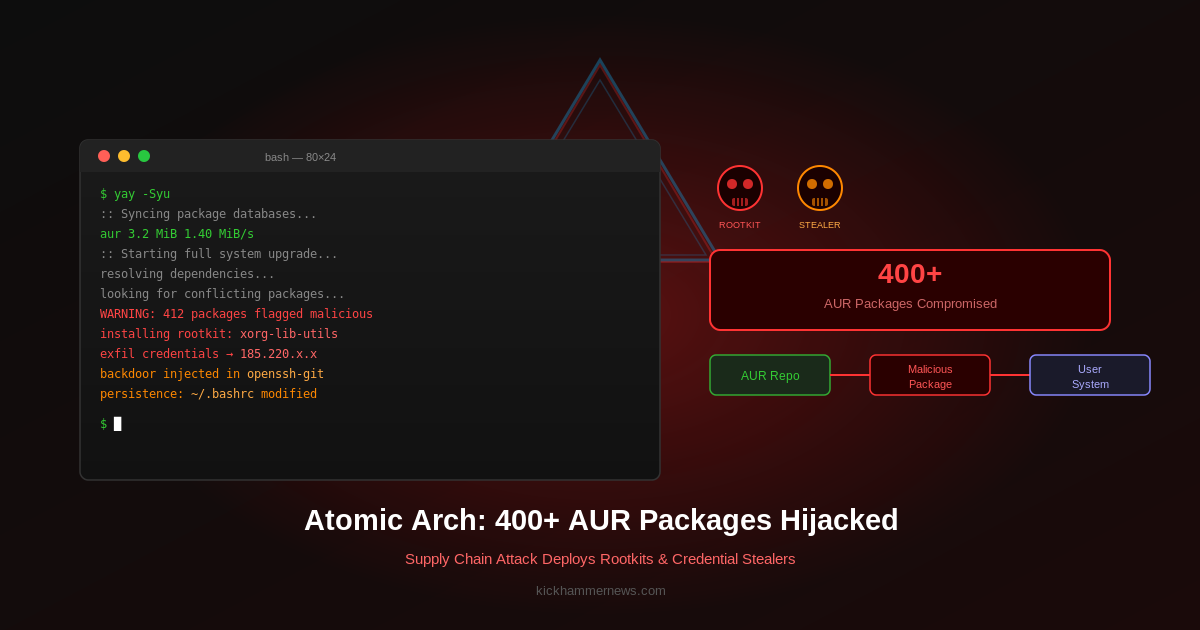
When Arch Linux users install community packages, they typically trust a system built on reputation and voluntary maintainership. That trust became a weapon last week when researchers disclosed “Atomic Arch,” one of the most sweeping supply chain attacks ever to strike the Linux ecosystem — and a stark warning for developers and enterprises everywhere.
What Is the Arch User Repository?
The Arch User Repository (AUR) is a community-driven collection of build scripts — called PKGBUILDs — that allow Arch Linux users to compile and install software not found in the official repositories. Unlike the curated [core], [extra], and [multilib] repos, the AUR is largely self-governing. Thousands of volunteers maintain packages for everything from obscure CLI utilities to niche developer tools.
One of AUR’s key policies is orphan adoption: when a maintainer abandons a package, any registered AUR user can claim it and take over maintenance. The intention is to keep useful software alive. But it also means that a patient attacker with a new account can quietly inherit a package with hundreds or thousands of existing users — along with all the trust they’ve built up over years.
That’s exactly what the Atomic Arch attackers did.
The Attack: Hijacking Orphaned Packages at Scale
Disclosed on June 11, 2026, the Atomic Arch campaign was identified by researchers at Sonatype and the broader AUR community. Attackers systematically adopted more than 400 orphaned community packages — legitimate, functional tools that had simply been abandoned by their original maintainers. Once in control, they modified each package’s PKGBUILD to silently fetch and execute two malicious npm packages: atomic-lockfile (version 1.4.2) and js-digest.
The modification was deceptively minimal. From the outside, the packages still installed the software they were supposed to. The malicious logic ran in the background during the build process, which AUR helpers like yay and paru execute on the user’s own machine with their own privileges.
No binary files were swapped. No obvious warning appeared in the terminal. The poison was baked into the build itself.
By June 11, some estimates placed the number of compromised packages above 1,500 when including follow-on modifications and variants. The Arch Linux security team moved quickly: it suspended new AUR account registrations, reverted the malicious PKGBUILD commits, and published a detailed list of affected packages for the community to cross-reference.
What the Malware Does
Once the malicious npm packages executed, they deployed a multi-stage payload written in Rust — a language chosen for its speed, small footprint, and cross-platform portability.
The credential stealer targeted a comprehensive range of high-value assets:
- Browser data — saved passwords, session cookies, and autofill entries from Chromium and Firefox-based browsers
- SSH private keys — enabling direct lateral movement to remote servers and cloud infrastructure
- Developer tokens — GitHub, npm, and other API keys commonly stored in environment variables or dot files
- Collaboration tool sessions — Slack, Discord, and Teams authentication tokens
- Cloud credentials — AWS, GCP, and Azure access keys, plus HashiCorp Vault tokens and Docker/Podman configs
- Cryptocurrency wallets — local wallet files and seed phrases
All exfiltrated data was sent to a command-and-control server accessible over the Tor network, making attribution difficult and takedown challenging.
On systems where the malicious code ran with elevated privileges, the payload went further: it deployed an eBPF-based rootkit capable of hiding its processes from standard monitoring tools like ps, top, and htop. Extended Berkeley Packet Filter technology, long a favorite for legitimate system observability, has increasingly been co-opted by threat actors precisely because it operates at the kernel level and bypasses many conventional endpoint detection tools.
Why This Goes Well Beyond Arch Linux
The immediate blast radius of Atomic Arch is technically limited to Arch Linux and Arch-derivative distributions like EndeavourOS and Manjaro — as well as Windows developers running Arch under WSL2, a surprisingly common setup among developers who want a Linux toolchain on Windows without dual-booting.
But the implications extend far beyond the Arch community.
The malware wasn’t targeting consumer data or ransomware victims. It went straight for developer credentials: GitHub tokens, cloud access keys, and Vault secrets. Those are the exact keys that unlock CI/CD pipelines, production deployments, and cloud infrastructure across organizations of every size. A single compromised developer laptop — even one running Arch in a WSL2 window — can become the entry point for a much larger breach.
Researchers at StepSecurity noted that Atomic Arch mirrors a growing pattern across ecosystems. Typosquatting packages with lookalike names is noisy and easily detected. Quietly inheriting trusted, abandoned packages is much harder to catch — and the same playbook works on npm, PyPI, and GitHub Actions, where inactive maintainers or social engineering can hand an attacker a ready-made distribution channel.
The Structural Problem With Community Repositories
The Atomic Arch incident exposes a fundamental tension in open-source software supply chains. The AUR’s orphan-adoption model is genuinely useful — it has kept thousands of packages alive that would otherwise disappear. But it also means any user with a new account and enough patience can inherit significant trust almost for free.
This isn’t unique to Arch. Homebrew, npm, PyPI, and RubyGems all have analogous mechanisms. Projects become unmaintained. Namespaces get abandoned. Attackers wait.
The Arch Linux team’s rapid response — publishing affected package lists, suspending new account registrations, and reverting malicious commits within hours of disclosure — is commendable. But the structural risk will return unless community repositories implement stronger vetting requirements for orphan adoptions, mandatory review windows before new maintainers can push changes to packages above a certain install threshold, and automated anomaly detection on PKGBUILD diffs.
What Affected Users Should Do
If you run Arch Linux or an Arch-based distribution and regularly install AUR packages, the Arch security team’s guidance is clear:
- Run
pacman -Qmto list all foreign packages and cross-reference against the published list of compromised packages - Audit any AUR packages installed between June 9–12, 2026
- Immediately rotate all credentials on any affected machine: SSH keys, GitHub tokens, npm tokens, cloud API keys, and browser session data
- On any system where the malicious code may have run as root, treat the machine as fully compromised and rebuild from clean media
- Enable PKGBUILD review prompts in your AUR helper and review build scripts before executing them
For enterprises, the key question is whether any developer workstations or self-hosted CI runners use Arch or Arch-based images. If the answer is yes — or even maybe — this warrants an immediate inventory audit.
A Canary for the Broader Ecosystem
Atomic Arch will likely be remembered as a pivotal moment in open-source supply chain security — not because it was the first attack of its kind, but because of its scale, sophistication, and the clarity with which it exposed the trust assumptions underpinning community repositories.
The attackers didn’t need a zero-day. They didn’t need to compromise a server or bribe an insider. They filled out a form, waited for a package to be orphaned, and clicked “Adopt.” The rest was just patience.
As long as open-source ecosystems allow trust to accumulate without corresponding accountability mechanisms, that form will remain one of the most powerful attack vectors in software security.
Sources: Sonatype, StepSecurity, Cyber Security News, Arch Linux Security Advisory


