June 21, 2026
Two seismic shifts happened at Oracle last week — one measured in dollars, the other in silence — and together they mark one of the most consequential moments in enterprise technology history.
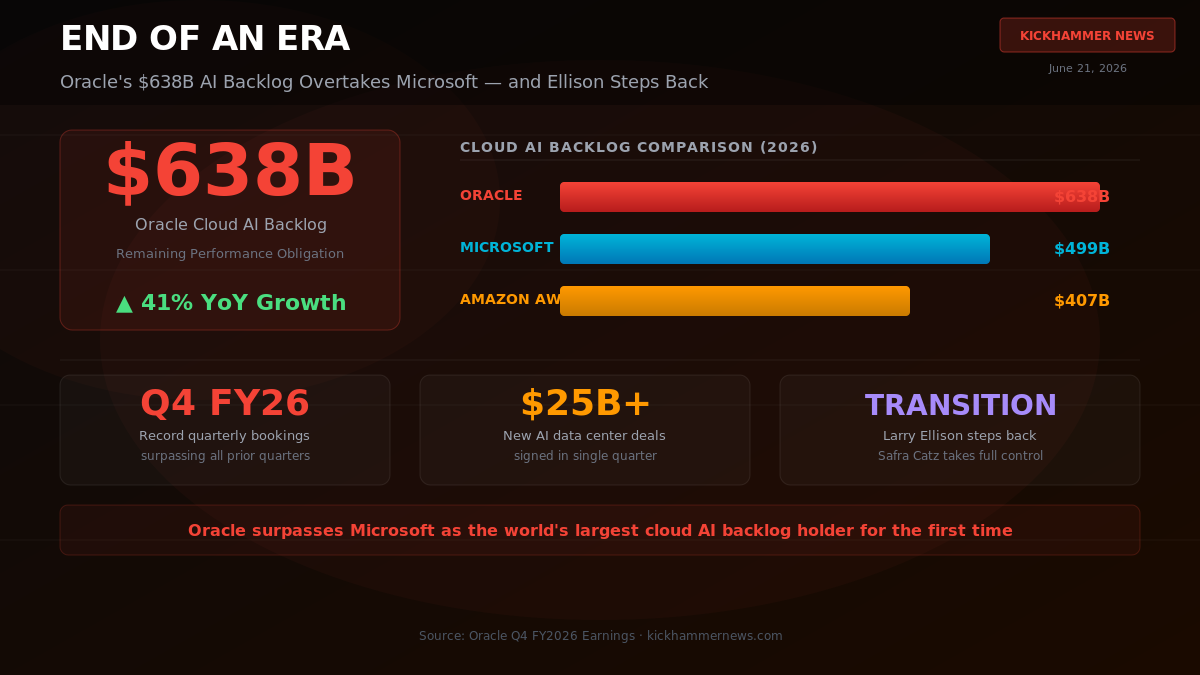
The first: Oracle closed its fiscal year 2026 with a Remaining Performance Obligation (RPO), essentially its contracted future revenue backlog, of $638 billion. That number is not just large. It is the largest backlog in the history of any business, anywhere. It surpasses Microsoft’s most recently reported RPO of $627 billion. And it grew 363% year-over-year.
The second: On Oracle’s Q4 FY2026 earnings call, for the first time in 40 years, Larry Ellison said nothing. He wasn’t even on the call.
The silence was deafening — and intentional.
The $638 Billion Number That Changes Everything
Oracle’s RPO figure demands careful unpacking, because the scale is almost difficult to comprehend. A year ago, Oracle’s backlog was a fraction of this size. The 363% year-over-year surge reflects something more than strong quarterly performance — it reflects a fundamental repositioning of Oracle in the global AI and cloud marketplace.
To put the comparison in starker terms: Oracle’s current cloud revenue of approximately $9.9 billion per quarter is still only about one-fifth the size of Microsoft’s Azure and cloud services business, which clocked in at $54.5 billion last quarter. Yet in terms of contracted future business, Oracle has now pulled level with — and narrowly eclipsed — its much larger rival.
How is this possible?
The answer lies in AI infrastructure. Over the past 18 months, Oracle has secured a string of massive, long-term contracts from hyperscalers, sovereign governments, and large enterprises that need GPU-dense AI data centers at a scale only Oracle has been willing and able to build. Customers have either prepaid for GPU access or contributed their own hardware to Oracle’s infrastructure, creating an unprecedented wave of committed spending that flows directly into the RPO metric.
Oracle’s backlog also towers over Amazon Web Services, whose most recent backlog stood at $364 billion — meaning Oracle’s contracted pipeline is now 75% larger than AWS’s despite Oracle generating less than a third of AWS’s quarterly revenue. Oracle’s 363% RPO growth rate dwarfs AWS’s 49% growth over the same period.
Chairman Larry Ellison’s mantra — “AI changes everything” — has become Oracle’s tagline and, evidently, its business thesis. Enterprises that once defaulted to AWS, Azure, or Google Cloud are now signing long-term infrastructure commitments with Oracle, betting that its purpose-built AI data centers offer density, price-performance, and reliability that hyperscalers cannot match.
The Two New CEOs Taking the Wheel
The earnings call that revealed these extraordinary numbers was run entirely by Oracle’s two co-CEOs: Clay Magouyrk, who oversees cloud infrastructure, and Mike Sicilia, who leads applications and industry verticals. Former CEO Safra Catz, who handed over the chief executive role last year, has also largely stepped back from public-facing appearances.
Magouyrk and Sicilia walked analysts through the numbers methodically: $9.9 billion in cloud revenue, record operating margins, and — the headline — $638 billion in RPO. They fielded questions about capacity expansion, capital expenditure plans, and the competitive dynamics of AI infrastructure contracting with calm authority.
The call went well. Oracle’s results were strong. But for longtime observers of the enterprise technology industry, something felt profoundly different.
The voice that had defined Oracle’s public narrative for four decades was absent.
Forty Years of Ellison on the Record
From Oracle’s IPO in 1986 through 160 consecutive quarterly earnings calls, Larry Ellison used the platform to do what no other technology executive did quite so effectively: shape the way the entire industry understood where technology was headed, where Oracle fit into that future, and why competitors were fundamentally wrong about nearly everything.
He was provocateur, visionary, and showman simultaneously. He coined the phrase “the Oracle Database is the center of the universe” long before cloud computing existed. He predicted the death of the on-premises software model when most enterprise customers still ran their mission-critical systems on-site. He challenged Amazon’s cloud business when Oracle was considered a decade behind in the cloud race. He advocated for AI-native database architectures before most organizations had a coherent AI strategy at all.
His commentary was not always tactful, often contentious, and occasionally wrong. But it was never boring, and it was almost always forward-pointing in ways that proved prescient in the years that followed.
That Ellison chose to step entirely off Oracle’s earnings calls — not just reducing his remarks but removing himself from the call entirely — signals that the succession planning begun last year is now essentially complete. Oracle’s new leadership is not a transition in progress. It is a transition that has landed.
What Comes Next: Microsoft’s Q4 and the Backlog Race
Oracle’s pole position in the RPO rankings may be short-lived. Microsoft is expected to report its fiscal Q4 results at the end of June or early July 2026. Analysts expect Microsoft’s Azure business to report another strong quarter of cloud revenue growth, and its own RPO figure — inflated by the inclusion of its OpenAI commitments — could once again surpass Oracle’s when the numbers come in.
But that possibility only underscores how compressed and competitive the AI infrastructure race has become. A year ago, the notion that Oracle would be in the same conversation as Microsoft, let alone ahead of it in contracted AI and cloud business, would have seemed implausible to most industry analysts. Today it is the reality they are trying to explain.
The companies sitting below Oracle and Microsoft in the cloud rankings have also noticed. Google Cloud’s own backlog growth has accelerated sharply. AWS is investing at record levels in AI infrastructure. The $638 billion figure Oracle posted is not just a metric — it is a strategic signal that the AI infrastructure market is consolidating around a small number of players capable of building at planetary scale.
Oracle, led by Magouyrk and Sicilia, apparently intends to be one of them.
A Legacy in the Background
Ellison himself has not disappeared from Oracle’s world. He was recently seen appearing by video at Oracle’s FY27 internal sales kickoff events, sharing his perspectives on the company’s direction and the AI market. His involvement in product strategy and high-stakes deal-making is understood to continue behind the scenes. In two months he will turn 82.
The $638 billion backlog that now defines Oracle’s competitive position is, in many ways, the culmination of bets Ellison placed years ago: on AI-native infrastructure, on massive data center construction, on competing directly with the giants of cloud computing when conventional wisdom said Oracle had missed the wave entirely.
His voice may no longer echo through the quarterly earnings calls that defined enterprise technology commentary for a generation. But the numbers he built toward are speaking loudly enough on their own.
*Sources: Cloud Wars — Oracle Surges to #1 in AI and Cloud Backlog, Cloud Wars — Larry Ellison’s Last Call, Oracle Q4 FY2026 Press Release*