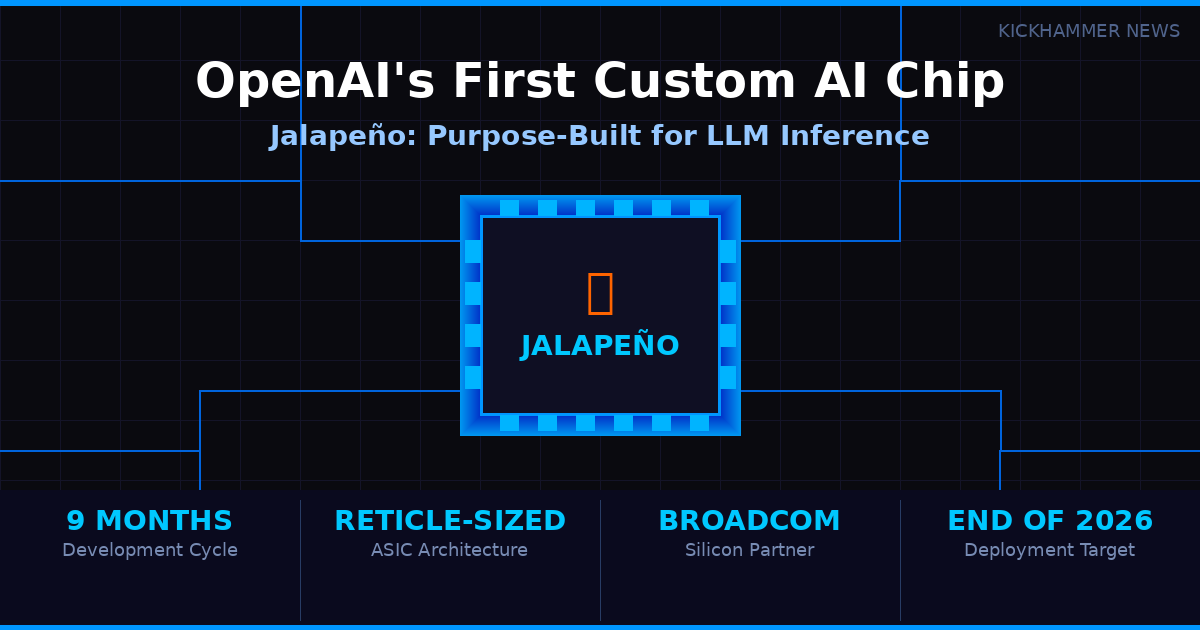
OpenAI has spent years as the most visible beneficiary of Nvidia’s GPU dominance. Now, in a move that signals a fundamental shift in how the company thinks about its own future, it is striking out on its own. On June 24, 2026, OpenAI and Broadcom unveiled Jalapeño — OpenAI’s first custom-built AI inference chip. It is a significant moment, not just for OpenAI, but for the entire AI infrastructure landscape.
Why Build a Custom Chip?
To understand the significance of Jalapeño, you have to understand the economics of running AI at scale. Every time someone types a message into ChatGPT, asks an agent to write code, or uses any of OpenAI’s products, the company spends money on compute. Those inference costs — the cost of running a pre-trained AI model to generate a response — are enormous. They are, arguably, the single biggest variable in whether AI companies can survive as businesses.
For years, Nvidia’s GPUs have been the only real option for companies running AI workloads at the frontier. They are powerful, extremely well-supported, and backed by decades of software tooling. But they are also extraordinarily expensive, and they are not designed with any one company’s specific workload in mind. That mismatch matters. A GPU built for general-purpose AI computation is good at everything — but it is not optimal for the particular patterns of attention, memory access, and token generation that OpenAI’s large language models require at runtime.
This is exactly the problem Jalapeño is designed to solve. Unlike a general-purpose AI accelerator, Jalapeño is a purpose-built inference ASIC — an Application-Specific Integrated Circuit engineered from the ground up around the specific computational patterns of OpenAI’s LLMs. It is not a training chip. It is not a repurposed architecture. It is built to do one thing extremely well: serve OpenAI’s models to users as cheaply and quickly as possible.
The Fastest ASIC Development Cycle on Record
The technical achievement here is not just the chip itself — it is how quickly it was built. According to Tom’s Hardware, Jalapeño went from initial design to manufacturing tape-out in just nine months. Industry experts have described this as potentially the fastest ASIC development cycle ever achieved in high-performance advanced semiconductors. That speed is remarkable in a field where custom chip development often takes several years.
The secret weapon? OpenAI used its own AI models to help design the chip. By applying the same models that power ChatGPT and Codex to the problems of hardware design and optimization, the company dramatically accelerated the engineering process. This is a striking example of AI eating its own tail in a productive way — the intelligence of the software helping to shape the silicon that will run future versions of itself.
OpenAI President Greg Brockman shed light on the strategic rationale in an in-house podcast episode shortly after the Broadcom partnership was announced last October. “We have a deep understanding of the workload,” Brockman said. “We’ve really been looking for specific workloads that are underserved — how can we build something that will be able to accelerate what’s possible?”
What Jalapeño Actually Does
Jalapeño is a massive, reticle-sized ASIC — meaning it pushes up against the physical limits of what can be produced in a single silicon die. It is designed specifically around the inferencing bottlenecks of large language models: the memory bandwidth constraints, the attention computation patterns, and the latency requirements of real-time conversational AI.
Early testing results are promising. OpenAI says Jalapeño delivers significantly better performance-per-watt than current state-of-the-art alternatives. For a company whose inference bills likely run into the hundreds of millions of dollars annually, even modest improvements in power efficiency translate to enormous cost savings.
The company has been particularly focused on optimizing for coding use cases. In its announcement, OpenAI emphasized Jalapeño’s low operating cost when running real-time coding models — a nod to the growing importance of products like Codex and the broader agentic AI ecosystem the company is building. As AI agents take on more complex, longer-horizon tasks, the volume of inference required per user interaction grows dramatically. Getting inference costs under control now is not just a short-term efficiency play; it is a prerequisite for making the next generation of AI products economically viable.
A Multi-Generation Bet
OpenAI is framing Jalapeño not as a one-off experiment but as the first chip in a multi-generation compute platform. The company plans to deploy it by the end of 2026, with further generations to follow. Broadcom is contributing its silicon implementation expertise, networking technology, and connectivity infrastructure — areas where the company has deep expertise from serving hyperscale cloud customers for years.
The strategic logic is straightforward, if ambitious. “OpenAI is not only developing frontier models or building products on top of them; it is designing the infrastructure underneath them: chip architecture, kernels, memory systems, networking, scheduling, deployment systems, and product experience,” the company wrote in its official announcement. “Because OpenAI operates across the stack, each layer can be optimized around the same goal: making its models faster, more reliable, and more affordable for users.”
This kind of vertical integration is exactly what Google did with its Tensor Processing Units (TPUs), which have powered Google’s AI workloads for nearly a decade. Amazon followed with its Trainium and Inferentia chips. Microsoft has invested in custom silicon for its Azure AI infrastructure. In every case, the rationale was the same: to reduce dependence on third-party hardware suppliers and optimize the full stack for the company’s specific workloads.
The Nvidia Question
The elephant in the room is Nvidia. OpenAI has been one of Nvidia’s largest customers, and any shift toward custom silicon is implicitly a bet against the status quo that has enriched both companies. To be clear, Jalapeño will not replace Nvidia hardware overnight — or perhaps ever, entirely. Pre-training frontier models at scale still requires the raw computational density of Nvidia’s H100 and Blackwell chips, and OpenAI is likely to remain a significant Nvidia customer for years.
But inference is a different story. As OpenAI deploys more models, serves more users, and builds more agentic products, the inference-to-training compute ratio will continue to shift. Each Jalapeño chip deployed for inference is a dollar not spent on Nvidia’s highest-margin product. Multiply that across millions of users and billions of API calls, and the economics become transformative.
The market has noticed. Broadcom’s stock moved on the announcement, and analysts immediately began reassessing the implications for Nvidia’s dominance in the custom chip space.
What This Means for the Industry
OpenAI’s move into custom silicon is part of a broader pattern that will define the next phase of the AI industry. The companies that can control their own compute stack — from the physics of silicon to the abstractions of the API — will have enormous structural advantages in cost, performance, and the ability to ship novel capabilities that third-party hardware simply cannot support.
Jalapeño is OpenAI’s declaration that it intends to be one of those companies. Whether the chip delivers on its early promise, and whether subsequent generations can close the gap with Nvidia’s purpose-built accelerators, remains to be seen. But the ambition is clear: this is not a company that wants to be a software layer renting compute from someone else. OpenAI wants to own the full stack — and Jalapeño is the first proof that it is building toward it.
The AI chips race just got a new, very spicy entrant.


