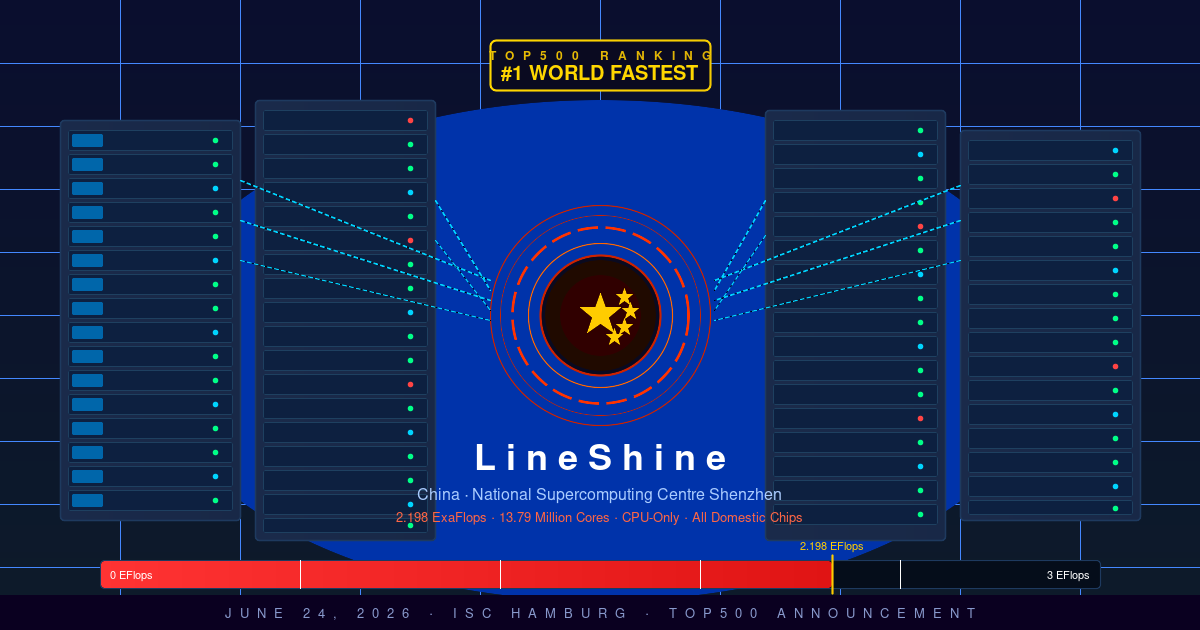
For the first time since 2017, China sits atop the global supercomputing rankings. On Tuesday, at the International Supercomputing Conference (ISC) in Hamburg, Germany, the TOP500 list was updated to reflect a seismic shift in high-performance computing: China’s LineShine system, housed at the National Supercomputing Centre in Shenzhen, has displaced America’s El Capitan as the world’s most powerful supercomputer — and it did so without a single foreign chip.
LineShine achieved a benchmark score of 2.198 exaflops of double-precision (FP64) floating-point performance, nearly 22% faster than the previous champion El Capitan at Lawrence Livermore National Laboratory, which clocked in at 1.809 exaflops. More remarkably, LineShine is the first machine in TOP500 history to surpass the two-exaflop threshold using only CPUs — no GPUs, no accelerator cards, no NVIDIA hardware of any kind.
The Technology Behind LineShine
At the heart of the system are LX2 processors — semi-custom 304-core chips based on the ARMv9 instruction set architecture, running at 1.55 GHz. The developer of the LX2 is officially undisclosed, but analysts and hardware researchers widely attribute it to Huawei. Each processor houses two compute chiplets and organizes its 304 cores into eight clusters of 38 cores each.
Every core includes ARM’s Scalable Vector Extension (SVE) and Scalable Matrix Extension (SME) units, enabling acceleration of both scientific computing and AI workloads across FP64, FP32, BF16, FP16, and INT8 data formats. Perhaps most impressively, the LX2 pairs 32 GB of on-package HBM memory delivering up to 4 TB/s of bandwidth with up to 256 GB of external DDR5 memory — a hybrid memory architecture that prioritizes both bandwidth and capacity.
The full LineShine system comprises 20,480 compute nodes, with two LX2 processors per node, yielding approximately 13.79 million total cores. The machine consumes 42.2 megawatts of power and communicates across nodes using China’s proprietary LingQi interconnect fabric.
Every major component — processors, interconnects, storage, and software — is domestically designed and manufactured.
Why No GPUs?
The absence of GPUs in LineShine is not a design choice born of preference — it is a direct consequence of U.S. export controls. Since 2022, the United States has progressively tightened restrictions on the export of advanced semiconductor manufacturing equipment and high-performance AI chips to China. NVIDIA’s most powerful data center GPUs — the H100, H200, and the newer Blackwell and Rubin architectures — are all barred from Chinese sale.
China has spent the intervening years developing domestic alternatives with mixed results. Huawei’s Ascend AI chips have shown promise but still lag behind NVIDIA’s top offerings in raw AI throughput. Rather than rely on a workaround that might invite additional sanctions scrutiny, the LineShine team appears to have leaned into the CPU-only approach, optimizing at the architectural level to extract unprecedented performance from ARM-based silicon.
The result is paradoxical: U.S. export controls, designed to preserve America’s computational edge, may have inadvertently forced China to develop a novel class of supercomputer that achieves exaflop performance entirely through CPU parallelism — a path that, until now, the world had not seen demonstrated at this scale.
What This Means for the Global Computing Race
The TOP500 list now features five exascale-class systems for the first time:
1. LineShine (China) — 2.198 exaflops
2. El Capitan (USA, Lawrence Livermore) — 1.809 exaflops
3. Frontier (USA, Oak Ridge) — 1.353 exaflops
4. Aurora (USA, Argonne) — 1.012 exaflops
5. Jupiter Booster (Germany, Jülich) — 1.0 exaflops
The United States retains three of the top five spots, but losing the number-one position carries symbolic and strategic weight. Supercomputing leadership is closely tied to national security priorities — nuclear weapons simulation, climate modeling, drug discovery, and increasingly, large-scale AI training. The question is now whether LineShine’s CPU-only architecture can actually compete in AI workloads, where GPU-heavy systems like El Capitan and Frontier hold significant advantages in throughput per watt.
Some analysts are skeptical. As one report noted, the race for raw FP64 performance “is not geared for AI work.” GPU-based systems can handle AI matrix multiplication far more efficiently due to specialized tensor cores. LineShine’s ARM SVE/SME units provide some acceleration, but may not match the throughput of a system packing tens of thousands of NVIDIA H100s.
Still, for pure scientific computing — simulations, weather prediction, materials science — LineShine is unambiguously the new world leader.
A Technological Sovereignty Statement
Beyond benchmarks, LineShine represents a deliberate and successful assertion of technological sovereignty. The system was built with zero reliance on Western semiconductor supply chains — a goal China has been pursuing with increasing urgency since the U.S. began ratcheting up chip export controls.
That China achieved this milestone using Huawei-attributed processors built on ARMv9 — a licensed architecture from the UK-based ARM Holdings — does introduce one caveat. ARM licenses are currently not subject to the same U.S. export controls as chip fabrication equipment, but that could change. For now, the LX2 architecture represents the pinnacle of what China can do with commercially licensed instruction set architectures combined with domestically developed physical design.
The manufacturing question is equally significant. While performance numbers are confirmed, the fabrication node and yield details for the LX2 chip remain undisclosed. Building 47,000+ CPUs at the required performance level suggests either impressive domestic fab capability or a quiet engagement with non-U.S. aligned foundries.
The Bigger Picture
LineShine’s debut arrives at a moment of acute tension in the global technology competition between the United States and China. Washington has invested billions in domestic semiconductor manufacturing through the CHIPS Act, while simultaneously trying to starve China’s AI industry of the hardware it needs. Beijing has channeled comparable resources into a domestic semiconductor ecosystem — with results now visible in the TOP500 rankings.
For the AI industry, the implications are nuanced. LineShine is not a training cluster — it cannot replace the GPU farms that train foundation models. But it demonstrates that China is building genuine world-class computational infrastructure using homegrown components, a capability that will compound over time as domestic chip design and fabrication mature.
For geopolitics, the message is stark: chip export controls are shaping, not stopping, China’s technological development. They are forcing a different path — one that, as LineShine demonstrates, can still reach the summit.


