For years, the idea of Linux conquering the enterprise desktop felt like a perpetual prediction — the kind of forecast that tech optimists make every January, only to watch it quietly fade by December. But something is different in 2026. The conditions that once kept Linux confined to server rooms and developer workstations have quietly shifted, and organizations that once dismissed the idea are now running active pilots, deploying distros on employee hardware, and rethinking assumptions that have gone unquestioned since the early days of Windows XP.
The enterprise Linux desktop moment may have finally arrived — not with a bang, but with the quiet inevitability of a deadline no one can ignore.
Windows 10’s Exit Forces a Long-Overdue Decision
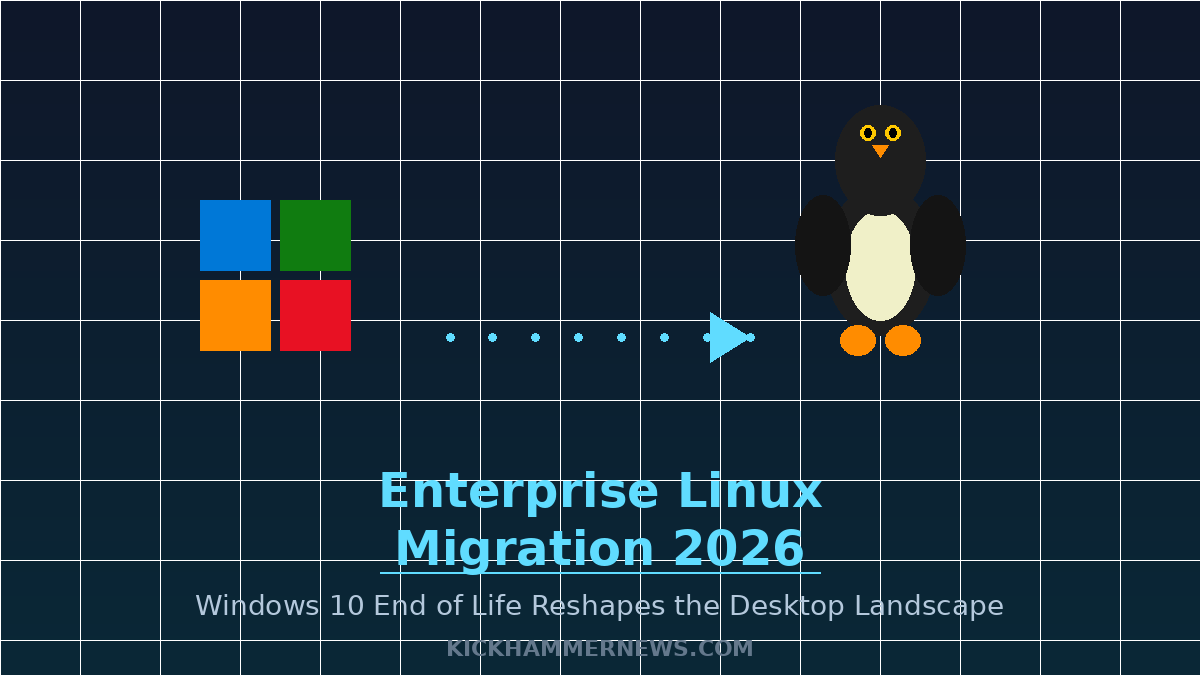
The catalyst that most analysts point to is the October 2025 end-of-life for Windows 10. Microsoft officially ceased mainstream support, leaving organizations that hadn’t upgraded facing an unpleasant set of choices: pay for Extended Security Updates (ESU), endure the costs and complexity of a Windows 11 hardware refresh, or explore alternatives they’ve never seriously evaluated before.
Windows 11 added insult to injury with its strict TPM 2.0 and CPU compatibility requirements. Millions of devices that ran Windows 10 perfectly well were suddenly deemed incompatible — hardware that was otherwise functional, capable, and fully amortized. For IT departments already stretched thin, the prospect of a forced hardware refresh was a budget conversation no one wanted to have.
Linux, which runs reliably on hardware dating back well over a decade, suddenly looked like a compelling answer to a question that Microsoft’s own upgrade policy had forced organizations to ask.
“The end of Windows 10 created a hard deadline for millions of devices,” noted analysis from TechTarget published earlier this year. “Organizations must choose between Windows 11 upgrades, paid Extended Security Updates, hardware replacement, or alternatives such as ChromeOS or Linux.”
Market Share is Moving — Slowly but Unmistakably
The numbers reflect a quiet but steady shift. Global Linux desktop market share grew from approximately 2.76% in 2022 to roughly 4.7% by 2025 — a more than 70% increase in just three years. The United States crossed the 5% threshold for the first time in mid-2025, a milestone that would have seemed far-fetched just a few years ago.
StatCounter data from April 2026 showed Linux at approximately 3% globally, with methodologies varying depending on how mobile browsing and embedded devices are counted. Either way, the trajectory is upward, and in specific verticals — software development, DevOps, AI/ML, and public sector — the numbers are considerably higher. A Statista survey from 2023 found Linux running on 43% of PCs used for software development worldwide.
More telling than aggregate market share are the specific deployment patterns now emerging at the enterprise level. Government agencies, financial institutions, and manufacturing firms that had historically been Windows-only shops are now running Ubuntu and Fedora pilots on subsets of their workforce, quietly gathering data before any public commitment.
The Privacy and Sovereignty Argument
One driver that rarely gets enough credit in mainstream coverage is the growing importance of data sovereignty and privacy. A wave of regulations — from Europe’s continued GDPR enforcement to sector-specific compliance mandates in healthcare and finance — has put IT leaders under increasing pressure to account for where data goes and how operating systems handle telemetry.
Windows 11 has not helped Microsoft’s case here. Microsoft’s telemetry and data collection practices continue to draw scrutiny from European regulators, and the forced introduction of Microsoft accounts for consumer versions has made some enterprise IT staff uneasy about the direction of the platform.
Linux distributions offer something Windows cannot easily match: full transparency and control. Under the GPL, organizations can audit what their OS is doing, disable unwanted data collection, and retain genuine control over their systems. For organizations subject to data residency requirements or sensitive workloads, that’s not a minor benefit — it’s a compliance necessity.
Germany’s state of Schleswig-Holstein provided one of the most high-profile demonstrations of this logic when it announced a full migration from Microsoft tools to Linux and LibreOffice for public sector offices. France’s national gendarmerie now operates more than 103,000 machines on GendBuntu, a custom Ubuntu derivative. These aren’t fringe experiments — they’re large-scale deployments with real governance and security requirements.
SaaS Changed the Equation
Perhaps the most underappreciated structural change enabling enterprise Linux adoption is the wholesale migration of productivity software to the web. When enterprise computing meant running Word, Excel, and Outlook natively, the case for Windows was nearly airtight. Linux’s app compatibility story was full of asterisks.
That world has mostly dissolved. Most knowledge workers now spend the bulk of their day inside a browser tab — Google Workspace, Microsoft 365 (which runs fine in Chrome on Linux), Salesforce, Slack, Zoom, GitHub, Jira, ServiceNow. The OS underneath has become progressively less relevant to the daily workflow of anyone who isn’t running specialized native software.
This SaaS shift doesn’t eliminate app compatibility concerns — line-of-business applications, legacy software, and certain specialized creative tools remain genuine friction points. But for a substantial portion of enterprise workloads, the compatibility problem that once made Linux migration impractical has effectively been solved by the cloud.
Choosing the Right Distribution
For IT departments moving from planning to deployment, the distribution question is one of the first practical decisions to make. The landscape has consolidated meaningfully around a few enterprise-grade options.
Ubuntu Desktop (specifically the 24.04 LTS release, with 26.04 LTS previews generating early attention) remains the most widely deployed choice for enterprise workstations. Canonical offers commercial support contracts, a large driver compatibility database, and certified hardware lists covering systems from Dell, Lenovo, and HP.
Red Hat Enterprise Linux for Workstations serves organizations where RHEL is already the established server platform. Fedora Workstation, closely aligned with RHEL, offers a more cutting-edge alternative for developer-heavy environments.
Linux Mint continues to earn praise from IT managers for its Windows-like interface — a meaningful advantage when retraining end users with no Linux background.
SUSE Linux Enterprise Desktop rounds out the major options, with particular strength in regulated industries and organizations that prioritize long-term vendor support commitments.
Hardware certified for Linux has expanded substantially. Dell’s Latitude series and Lenovo’s ThinkPad lineup both offer official Ubuntu certification. Framework and System76 have built entire product lines around Linux compatibility, catering to the growing enterprise demand for repairable, upgradeable hardware — an alignment with ESG and sustainability initiatives that increasingly factor into IT procurement decisions.
What’s Still Standing in the Way
None of this is to say the transition is seamless. Migration friction is real, and enterprise IT leaders are right to approach it with clear-eyed pragmatism.
Custom line-of-business applications built for Windows remain the most significant technical barrier. Organizations running legacy ERP installations, specialized manufacturing software, or niche industry tools that have no Linux equivalent will need workarounds — whether through Wine/Proton compatibility layers, virtual machines, or in some cases, a hybrid environment where Linux handles general-purpose work while a small number of Windows machines remain for specific applications.
Staff training is another genuine cost. Help desk and desktop support teams need Linux expertise that doesn’t appear overnight. Canonical, Red Hat, and third-party training providers offer certification programs, but building organizational competency takes time and budget.
And there’s the straightforward reality that change management in enterprise IT is slow. Decision-makers who grew up on Windows and have decades of institutional knowledge embedded in Windows-specific processes are not going to flip a switch. Linux migrations that succeed in 2026 will be measured, methodical, and typically limited to specific user populations before any broader rollout.
The Inflection Is Real
Despite the friction points, something has clearly shifted. The combination of Windows 10’s end of life, Windows 11’s hardware demands, the cloud-first reorientation of enterprise software, growing regulatory pressure around data sovereignty, and the sustainability case for extending hardware lifecycles has produced a genuinely different conversation than the one IT organizations were having three years ago.
Linux desktop market share is rising. Enterprise pilots are running. Government deployments at scale are proving the concept. The hardware and software ecosystem has matured. And for the first time, a meaningful portion of enterprise IT leadership is asking not “should we consider Linux?” but “how do we actually do this?”
The answer is proving to be more achievable than the industry’s long history of failed Linux desktop predictions would suggest. 2026 may not be the year Linux wins the enterprise desktop — but it increasingly looks like the year the outcome stopped being a foregone conclusion.