July 1, 2026 — The date has been circled on IT budgets and procurement calendars for months. As of today, Microsoft’s sweeping Microsoft 365 price increases are officially live, affecting enterprise customers across Office 365 and Microsoft 365 commercial suites worldwide. For most organizations, the bill goes up at their next renewal — but for those renewing today, the new rates are immediate.
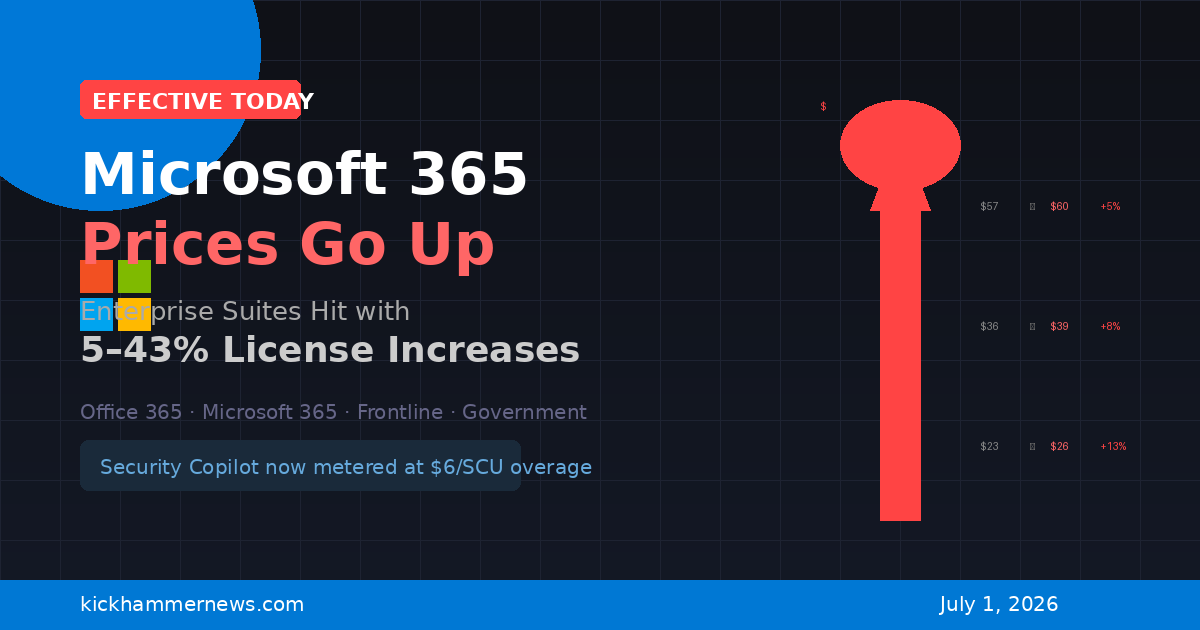
The headline numbers: Office 365 E3 climbs 13%, from $23 to $26 per user per month. Microsoft 365 E3 rises 8%, from $36 to $39. Microsoft 365 E5 goes up 5%, from $57 to $60. Frontline workers on the F1 and F3 plans face even steeper increases — as much as 25% to 43% in some configurations. And while Microsoft frames these as modest adjustments tied to meaningful new capabilities, the reality for enterprises is more complicated.
The True Cost Is Bigger Than the List Price
The reason this moment deserves serious executive attention goes beyond the license line items. Microsoft 365 pricing touches nearly every corner of an enterprise technology budget, and the ripple effects are substantial.
For companies on Microsoft Unified Support — the support tier required for most large enterprise agreements — pricing is calculated as a percentage of eligible Microsoft product spend. That means when the M365 license cost rises, the support cost rises automatically with it, without any additional negotiation or action required. Finance teams that only modeled the direct license delta are already underestimating the July 1 impact.
The same logic applies to Azure. Organizations that have structured their Azure consumption commitments around Microsoft 365 productivity and security workloads may find their baseline assumptions drift upward. Add to that the new Security Copilot metered overage model — bundled into E5 at 400 security compute units (SCUs) per 1,000 licensed users per month — and the picture becomes significantly more complex.
Copilot Is No Longer Optional
Perhaps the most significant structural change embedded in this price update is the permanent integration of Copilot capabilities into the Microsoft 365 lineup. What began as a promotional add-on has now been baked into the suite. Microsoft is adding Microsoft Defender for Office 365 Plan 1, Intune Remote Help, and Advanced Analytics to E5 plans, with Security Copilot capacity rolling out fully by August 1, 2026.
For enterprises already purchasing those capabilities as standalone add-ons, the bundle math might actually work in their favor — if they do the accounting carefully. But for organizations that were not using those tools, the update represents a forced upgrade to capabilities they may not need or be prepared to adopt.
The Security Copilot SCU model is where the real budget risk lives. An SCU is not a user seat or a simple prompt count. It is a measure of computational intensity — how demanding a query is, how many plugins are involved, how much data is being processed. Security teams running heavy investigation workflows, automated promptbooks, or integrated threat-hunting pipelines can burn through 400 SCUs per 1,000 users faster than initial estimates suggest. Once the allocation is exhausted, additional usage comes at $6 per SCU, charged as a pay-as-you-go overage, with 30 days’ notice before the meter turns on.
Enterprises that do not proactively model their Security Copilot consumption before usage accelerates risk mid-year budget surprises that are difficult to absorb.
What Changed for Each Major Plan
Here is the full picture of the enterprise SKU increases effective July 1, 2026, for plans that include Microsoft Teams:
| Plan | Previous Price | New Price | Increase |
|---|---|---|---|
| Office 365 E3 | $23.00/user/mo | $26.00/user/mo | +13% |
| Office 365 E5 | $38.00/user/mo | $41.00/user/mo | +8% |
| Microsoft 365 E3 | $36.00/user/mo | $39.00/user/mo | +8% |
| Microsoft 365 E5 | $57.00/user/mo | $60.00/user/mo | +5% |
For suites sold without Teams — common in regions where regulatory bundling restrictions apply — the increases run slightly higher: Office 365 E3 without Teams rises 14%, and Microsoft 365 E3 without Teams climbs 11%.
Microsoft 365 E7 pricing itself is not changing, but E7 customers are receiving the same packaging changes applied to E5, including the Security Copilot SCU capacity limits. That means E7 organizations are not immune to the metering risk even if their base license cost holds steady.
Government and Education Exceptions
Not every segment takes the full hit on July 1. Government customers in certain categories — including US AGC and education pricing tiers — are excluded from this round of increases. For government plans in GCC, GCC High, DoD, and NCOE environments where increases exceed 10%, Microsoft has agreed to phase the changes in over multiple years in accordance with federal procurement rules.
Education pricing remains unchanged for this update cycle. For K-12 districts and higher education institutions navigating tight IT budgets, that is a meaningful reprieve.
How the Industry Is Responding
The reaction from enterprise IT and procurement circles has been measured but pointed. Many organizations that were aware of the July 1 deadline scrambled to accelerate their renewals before the end of June, locking in current pricing for another cycle. Microsoft’s own channel partners were encouraged to drive those conversations, with volume discounts on the Copilot enterprise add-on expiring on June 30.
The deeper frustration in enterprise circles centers on the compounding nature of the increase. Large organizations that negotiate volume discounts under Enterprise Agreements — and who have seen the removal or reduction of some EA-level concessions in recent years — are experiencing effective increases closer to 15% to 20% when the full cost stack is modeled. That gap between the published list-price delta and the real budget impact is where the tension with Microsoft’s “value expansion” framing is most acute.
Several independent Microsoft support providers have positioned the July 1 moment as an opportunity for enterprises to challenge their Unified Support costs, arguing that third-party support alternatives can offset a meaningful portion of the M365 price increase. Whether or not organizations pursue that path, the argument reflects a broader shift in how enterprise buyers are approaching Microsoft renewal negotiations — with more discipline, more competitive data, and more willingness to push back.
The Bottom Line for IT and Finance Leaders
The July 1 price increase is live, and for organizations renewing their Microsoft agreements in the second half of 2026, the new rates are the new reality. The question is not whether to pay more — most enterprises will — but whether they pay more intelligently.
That means auditing license assignments before renewal, identifying dormant and underused SKUs, building a full cost model that includes support fees and Azure consumption, and treating Security Copilot as a metered resource that requires proactive capacity planning. Enterprises that approach the renewal with that level of preparation will navigate the increase with fewer surprises. Those that don’t will find out what Microsoft’s new pricing really costs them after the invoice arrives.
Sources: Microsoft Licensing Resources, US Cloud, Velosio, Infonaligy, ChatForest