While the world’s attention has been fixed on the latest large language models and chatbot rivalries, South Korea just made the boldest statement yet about where the real AI race will be decided: not in the algorithms, but in the silicon.
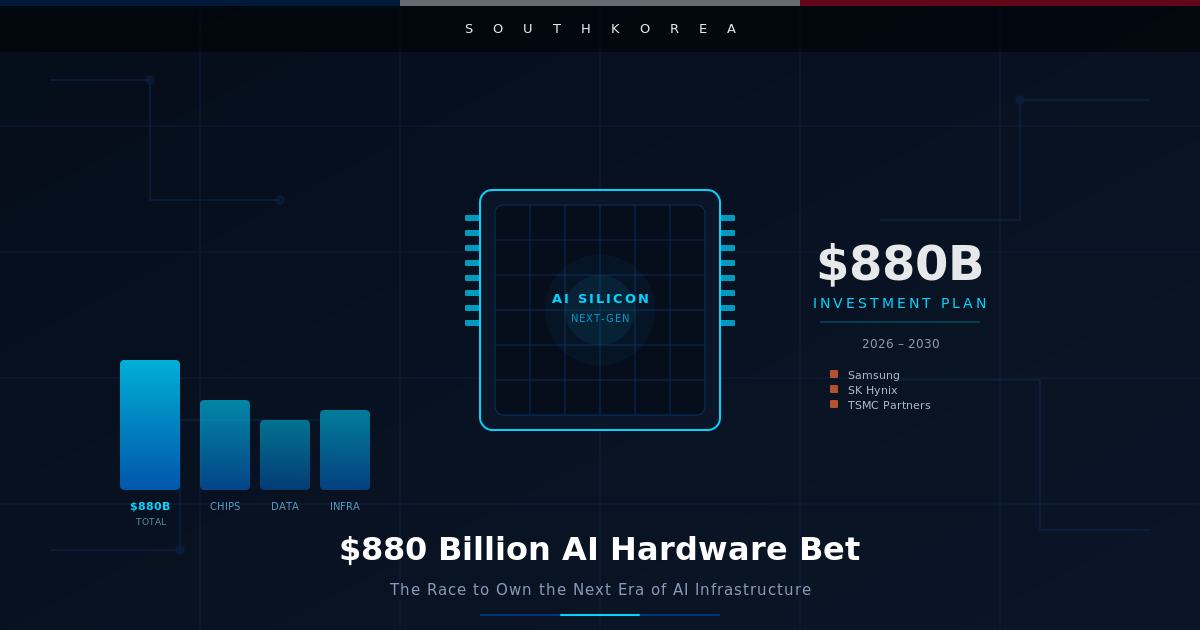
Last week, President Lee Jae-myung announced a jaw-dropping 1,350 trillion won — roughly $880 billion — national investment plan targeting semiconductors, AI data centers, and robotics over the next decade. It is, by nearly every measure, the largest single national technology investment commitment in history. And it signals a fundamental shift in how governments around the world are thinking about artificial intelligence competitiveness.
The Hardware Thesis
The premise behind South Korea’s massive bet is straightforward, even if its implications are enormous: the next frontier of AI won’t be defined by who writes the best model weights, but by who controls the physical infrastructure needed to run them.
For years, AI competition has been framed primarily as a software race — a contest between OpenAI, Google DeepMind, Anthropic, and China’s top labs to train the most capable models. But as those models have grown exponentially more powerful, the bottleneck has shifted. You can write the best code in the world, but if you don’t have the chips to run it or the data centers to host it, you simply can’t compete.
South Korea has read that shift correctly, and it’s moving early and aggressively.
What $880 Billion Actually Buys
The investment breaks down into three major pillars.
The largest chunk — 800 trillion won, or about $518 billion — goes to semiconductor manufacturing. Samsung Electronics and SK Hynix, already two of the most important chip companies on the planet, will anchor the effort, each building two new state-of-the-art chip fabrication sites in South Korea’s southwest. Their suppliers are expected to co-invest alongside them, creating an entire domestic ecosystem rather than just isolated factories.
The second pillar is AI data center infrastructure: 550 trillion won ($356 billion) earmarked for massive compute capacity, led by SK Group, GS Group, and Naver. South Korea’s target is 8.4 gigawatts of AI data center capacity by 2029 and an additional 10 gigawatts by 2035. For context, that would make South Korea one of the top AI compute nations on the planet, rivaling the ambitions of the United States and China simultaneously.
The third pillar is robotics — a bet that the physical AI revolution will be as important as the digital one. The government has set an audacious goal: growing South Korea’s share of the global humanoid robot market from its current 1% to 20% within the decade, with the state itself as an anchor buyer for education, defense, and disaster response applications.
The Memory Angle Nobody Is Talking About
South Korea’s strategic position in this race is stronger than most outsiders realize, and it centers on a single product category: high-bandwidth memory, or HBM.
SK Hynix is the world’s dominant supplier of HBM chips — the specialized memory that sits directly on top of AI accelerators like NVIDIA’s H-series and Blackwell GPUs and allows them to feed data to the compute cores fast enough to actually use their full power. Without HBM, even the most advanced AI chips become bottlenecked. Without SK Hynix, there is no HBM supply chain at any meaningful scale.
Samsung has been fighting to close SK Hynix’s HBM lead, with mixed results, but South Korea’s bet is that the combined force of both companies — plus the suppliers, packaging specialists, and substrate makers clustered around them — creates a hardware moat that no other nation can easily replicate.
That moat is why this announcement deserves to be taken seriously. It isn’t a country building generic chip capacity from scratch. It’s a country that already controls a critical choke point in the global AI supply chain deciding to double, triple, and quadruple down on that position.
Geopolitical Stakes
South Korea’s announcement doesn’t exist in a vacuum. It arrives in a world where the United States and China are locked in an escalating technology war, export controls on advanced chips are shifting every few weeks, and every major economy is scrambling to reduce its dependence on a supply chain that runs through a handful of choke points.
For South Korea, this creates both opportunity and risk. The country sits at the center of that supply chain but is geographically sandwiched between its largest trading partner (China) and its primary security guarantor (the United States) — two powers increasingly at odds. The $880 billion plan is, in part, a hedge: a way to make South Korea so indispensable to global AI infrastructure that no geopolitical reshuffling can afford to cut it out.
It is also a direct response to the U.S. CHIPS Act and China’s own massive domestic semiconductor programs. The global chip race has become a multi-front national security competition, and South Korea is refusing to be a bystander.
What This Means for AI Development Globally
The immediate beneficiaries of South Korea’s plan are the companies and governments that need AI compute at scale. More chip capacity means more supply, which over the medium term means better pricing and availability for the AI accelerators and memory that power everything from cloud LLMs to enterprise AI deployments.
But the longer-term implication is more structural. If South Korea succeeds — and the involvement of Samsung and SK Hynix gives the plan more credibility than a government announcement alone would carry — it accelerates a world where AI capability is as much a function of national hardware policy as it is of model research. That has profound consequences for how AI talent, investment, and geopolitical leverage are distributed in the years ahead.
The AI labs racing to release the next frontier model are competing on one dimension. South Korea just announced it intends to own the foundation underneath all of them.
A Bet Worth Watching
$880 billion over ten years is an enormous number, and execution will be the real test. Building chip fabs at this scale takes years, requires extraordinary engineering talent, and carries significant economic risk if demand shifts unexpectedly. The robotics ambitions, in particular, will face stiff competition from Japan, the U.S., and China’s own rapidly maturing humanoid programs.
But the strategic logic is hard to argue with. The AI era runs on silicon, and the countries that control the best silicon will hold enormous leverage over how that era unfolds. South Korea isn’t just betting on its own economy. It’s betting on the thesis that hardware — chips, memory, data center infrastructure — is the durable competitive advantage in a world where software can be copied, retrained, or open-sourced in weeks.
If that thesis proves correct, the $880 billion won’t look like an extravagance. It will look like the smartest infrastructure investment of the decade.
Sources: TechSpot, Bloomberg, Al Jazeera, Asia Tech Review, The Information, GuruFocus


