For more than two decades, the rhythm of enterprise security has been set by Patch Tuesday — that second-Tuesday-of-the-month cadence when vendors coordinated their vulnerability disclosures and IT departments cleared their calendars. It was a truce of sorts: attackers knew when fixes were coming, defenders knew when to brace themselves, and organizations built entire patch management workflows around the predictability of that monthly drumbeat.
Adobe is about to break that rhythm — and the reason why reveals how profoundly AI has altered the security landscape.
The Announcement That Signals a Turning Point
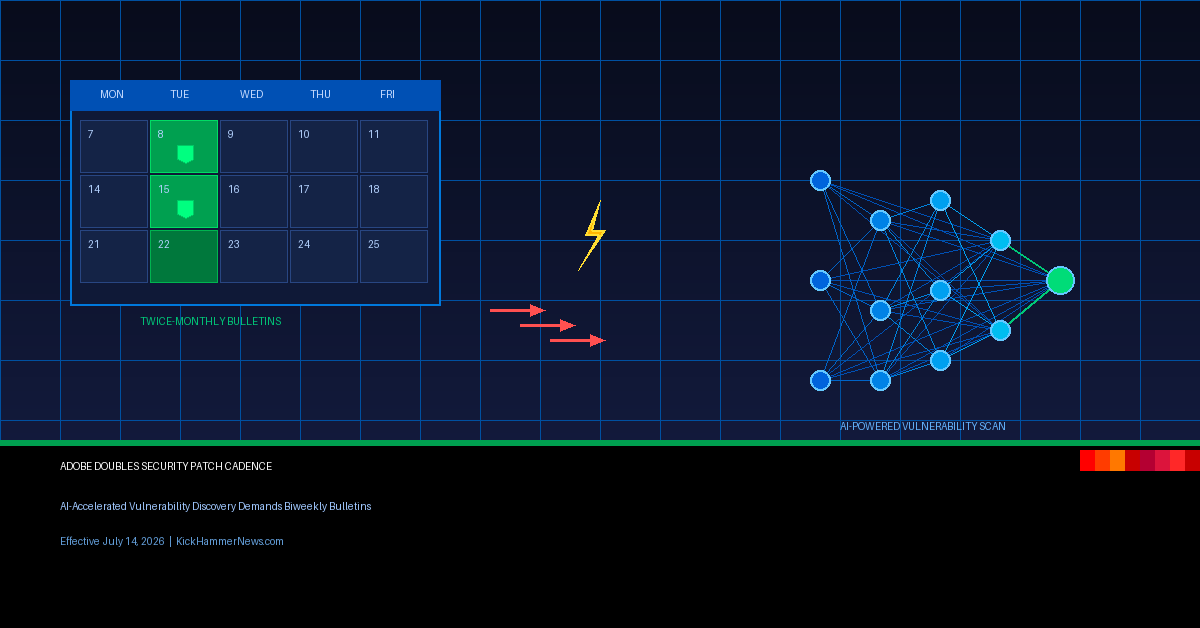
On June 25, 2026, Aanchal Gupta, Adobe’s VP of Trust and Security, quietly published a blog post that will reshape how millions of enterprise IT teams plan their patch cycles. Effective July 14, 2026, Adobe is moving from monthly to twice-monthly publication of Adobe Security Bulletins and Advisories — every second and fourth Tuesday of the month. The change applies to every bulletin and advisory containing a formally published CVE that requires customer action.
The policy shift is not the result of a single embarrassing breach or a regulatory mandate. Adobe’s rationale is more unsettling: the company’s own AI-powered vulnerability discovery is surfacing critical flaws faster than a monthly schedule can responsibly handle.
“Frontier AI models and agentic analysis tooling now uncover flaws across large codebases far faster than traditional methods could,” Gupta wrote. “Adobe is applying those same capabilities continuously to help accelerate vulnerability discovery across our products at machine scale, and ahead of adversaries.”
In plain terms: Adobe is finding bugs faster because AI helps it look everywhere at once. And since attackers have access to the same AI capabilities, the window between public disclosure and active exploitation has compressed from days to hours.
The AI Arms Race Arrives in Vulnerability Research
To understand why this matters, consider what AI-assisted vulnerability research actually looks like at scale. Traditional security audits relied on human researchers manually reviewing code, tracing data flows, and reasoning about attack surfaces — a process measured in weeks per product. Modern AI tools can analyze entire codebases in hours, automatically generating test harnesses, identifying memory safety issues, tracing injection paths, and producing proof-of-concept exploits.
Adobe says it is running these capabilities “continuously” across its product portfolio. The output is a sustained pipeline of discovered vulnerabilities that no longer fits neatly into a once-a-month publication window.
The evidence is visible in Adobe’s recent patch history. In July alone, the company released emergency fixes for seven maximum-severity (CVSS 10.0) vulnerabilities in ColdFusion and Adobe Campaign Classic — with at least one ColdFusion flaw actively exploited within hours of its disclosure. That kind of exploit speed was once the domain of nation-state actors with pre-positioned knowledge. Now it reflects the democratized power of frontier AI tools available to any sophisticated adversary.
What Changes on July 14
The new cadence is straightforward in structure: bulletins ship on the second and fourth Tuesday of each month. Organizations that currently align their Adobe patching to Patch Tuesday will now see a mid-month bulletin cycle added roughly two weeks after the familiar one.
Several key details remain unchanged. Adobe’s out-of-band response process for actively exploited zero-day vulnerabilities stays in place — meaning critical emergency patches can still ship any day when the threat level demands it. CVE disclosure standards, vulnerability severity ratings, and bulletin formatting are also preserved. Adobe is accelerating delivery, not cutting corners on transparency.
For customers, Adobe recommends adjusting planning cycles to the new twice-monthly schedule before July 14. The company’s free security notification service, available at adobe.com, sends email alerts for every new bulletin and advisory — making it the most straightforward way for IT teams to stay current without manual checking.
Enterprise IT Implications: A Workflow Reckoning
The practical challenge for security and IT operations teams is real. Monthly patch cycles have been optimized over years: testing windows are pre-allocated, change advisory boards meet on fixed schedules, and risk assessments are batched. A twice-monthly Adobe bulletin cadence means either accelerating that entire workflow on a two-week cycle or accepting a higher exposure window during the gaps.
Organizations running 30-day patch cycles were already structurally mismatched to the threat landscape — the July ColdFusion exploit made that painfully visible when teams following monthly schedules found themselves exposed for weeks after a CVSS 10.0 vulnerability became public. Adobe’s announcement formalizes a new expectation: enterprise software security now demands a biweekly rhythm, at minimum.
The broader industry implication is difficult to ignore. If Adobe — a company with mature security practices and substantial resources — cannot responsibly contain its AI-discovered vulnerabilities within a monthly release window, other vendors will face the same pressure. Microsoft already ships regular out-of-band patches for critical Windows and Office flaws. Google’s Project Zero has long argued that 90-day disclosure timelines are insufficient. Adobe’s formalized twice-monthly cadence may be the clearest signal yet that the industry’s Patch Tuesday model is approaching structural obsolescence.
Rethinking Patch Management for the AI Era
Security teams that want to stay ahead of this shift should treat Adobe’s announcement as a prompt to audit their patch management architecture more broadly. The questions worth asking now:
How quickly can your organization test and deploy a critical patch when the next bulletin drops two weeks after the last one? Does your patch management tooling support flexible scheduling or only calendar-aligned cycles? Are your monitoring and alerting systems configured to flag unpatched Adobe products on the day a new bulletin publishes, not weeks later? And critically — are you subscribed to Adobe’s notification service so you receive immediate alerts rather than discovering bulletins through secondhand channels?
Adobe has also signaled that this is not a temporary adjustment but a structural response to the AI era: “AI accelerates discovery, but resilience still rests on the fundamentals: visibility, layered controls, continuous monitoring, and the discipline to ship fixes quickly once they are found.”
The Bigger Picture
Adobe’s move to twice-monthly bulletins is a concrete, operational response to a shift that the security industry has been anticipating in the abstract for years: AI making vulnerability discovery so efficient that existing patch management rhythms become inadequate. The threat model has changed. The discovery model has changed. Now the delivery model is changing to match.
For enterprises, the message is straightforward even if the operational execution is demanding: the organizations that fare best in this environment will be those that treat patching not as a scheduled maintenance window but as a continuous, rapid-response capability. The twice-monthly Adobe bulletin cadence, effective July 14, is a good forcing function to start building that muscle now — before the rest of the industry follows suit.
Sources: Adobe Security Blog, BleepingComputer, The Hacker News, Application Security Standards


