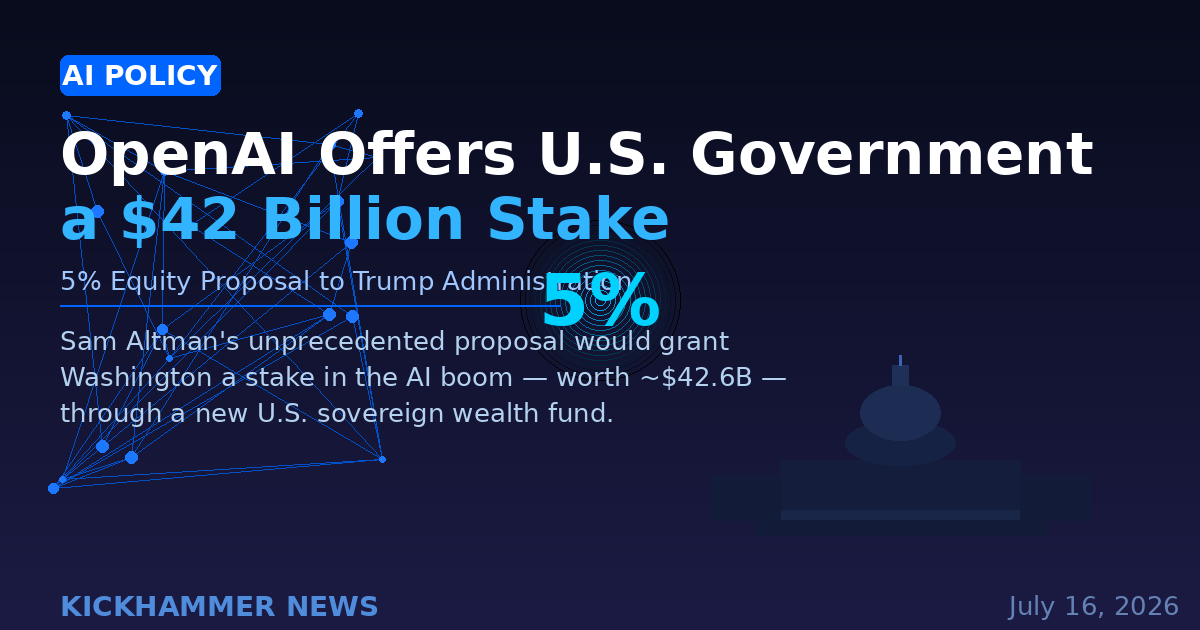
In a move that would have seemed unthinkable even two years ago, OpenAI CEO Sam Altman has reportedly pitched the Trump administration on one of the most audacious proposals in the history of the technology industry: handing the U.S. government a 5 percent equity stake in the company — a slice worth roughly $42.6 billion at OpenAI’s current $852 billion valuation.
If it comes to pass, the arrangement would mark the first time a major private tech company has proactively offered a direct ownership stake to the federal government, blurring the lines between Silicon Valley and Washington in ways that would reshape how Americans think about artificial intelligence, public wealth, and the role of the state in the tech economy.
The Pitch
According to reporting from the Financial Times, Altman has engaged directly with President Donald Trump, Commerce Secretary Howard Lutnick, and Treasury Secretary Scott Bessent in “conceptual” talks about the proposal. The idea: OpenAI — and potentially other major AI companies like Anthropic, Google, and Meta — would cede similar stakes to the U.S. government through a newly created sovereign wealth fund vehicle.
The structure Altman has in mind is modeled loosely on the Alaska Permanent Fund, the state-run investment vehicle established in 1976 to capture and distribute Alaska’s oil windfall. Under that model, investment returns flow back to ordinary citizens in the form of annual dividends. Altman’s version would apply the same logic to AI: if the technology is going to generate trillions in economic value over the coming decades, why should all of that upside accrue exclusively to private investors?
“Sam Altman argued that giving the public a financial interest in the company is the best way to share the upside of AI,” according to the FT report, which noted that the idea has been floated in one form or another since early 2025.
What’s Driving the Proposal
The timing of the proposal is not accidental. OpenAI is under enormous pressure from multiple directions simultaneously.
Public trust in the AI industry has eroded sharply. Polls conducted in 2025 and early 2026 consistently show that a majority of Americans believe AI will do more harm than good, and protests against new data center construction have slowed several high-profile projects. OpenAI’s breakneck commercialization — including its move away from nonprofit governance — has drawn sustained criticism from researchers, ethicists, and lawmakers on both sides of the aisle.
There is also a political dynamic at play. The Trump administration has made AI competitiveness a centerpiece of its economic agenda, but it has also sent mixed signals to Silicon Valley, alternating between enthusiasm for deregulation and pressure on companies to comply with national security directives. Granting the government a financial stake in OpenAI could, in theory, align incentives and insulate the company from regulatory or political interference.
As CNBC reported, the donation would be meant partly “to secure good relations with the administration and to address political blowback.” In other words, it is as much a political maneuver as a philanthropic gesture.
A Bipartisan Idea With Very Different Goals
One of the most striking aspects of the proposal is that the idea of public ownership of AI has found supporters across the political spectrum — though they want it for very different reasons.
Senator Bernie Sanders has called for a far more sweeping intervention, advocating for the U.S. government to hold something closer to 50 percent of the capital of major AI companies. For Sanders and progressives, the goal is democratic control: ensuring that AI’s enormous economic power is not concentrated in the hands of a few billionaires and institutional investors.
Altman’s 5 percent proposal is, by contrast, conceived primarily as a value-sharing mechanism rather than a control mechanism. A 5 percent stake gives the government a financial interest in OpenAI’s success without granting it any meaningful influence over corporate governance, research direction, or product decisions.
Critics have been quick to point this out. “A 5 percent stake with no voting rights or board representation isn’t public ownership — it’s a PR move dressed up as one,” one AI policy researcher told TechCrunch.
Still, the proposal has attracted genuine interest in Washington. Officials have reportedly been discussing the concept of government equity stakes in AI companies for more than a year, and the idea has backers in both chambers of Congress. Whether it can survive the legislative process — which the FT suggests would likely be required for any formal action — is another matter entirely.
What It Would Mean for the AI Industry
If OpenAI’s proposal goes forward, the ripple effects on the broader AI industry could be significant.
For one thing, it would establish a precedent. If the U.S. government holds equity in OpenAI, it becomes harder for Anthropic, Google DeepMind, Meta AI, and other major players to resist similar arrangements. Altman’s proposal reportedly envisions other companies ceding analogous stakes, suggesting he sees it as an industry-wide framework rather than a one-off deal.
It would also change the regulatory calculus in subtle but important ways. A government with a financial interest in the success of AI companies has an inherent incentive to support — or at least not harm — those companies’ bottom lines. That could soften regulatory ambitions, or it could create new conflicts of interest if regulators are simultaneously stakeholders in the entities they oversee.
There is also the question of what it signals about the future of AI governance globally. China has already signaled it may restrict overseas access to its most advanced AI models — a mirror image of U.S. export controls on advanced chips. Against that backdrop, a U.S. government equity stake in OpenAI would send an unmistakable message: Washington views AI as a strategic national asset, not merely a commercial product.
The Unanswered Questions
The talks remain preliminary, and the proposal is still more concept than concrete plan. Major questions remain unanswered. Would the stake come with voting rights? Who would manage the sovereign wealth fund, and how would returns be distributed? Would Congress need to authorize the arrangement, and could a bill actually pass? What happens if a future administration disagrees with OpenAI’s research direction — can a government shareholder exert pressure?
These questions are not merely technical. They go to the heart of how democratic societies want to relate to a technology that its own creators describe as potentially transformative at a civilizational scale.
What is clear is that the era of AI as purely a private-sector affair — governed by market forces and, at most, light-touch regulation — may be drawing to a close. Whether Altman’s 5 percent proposal becomes a landmark moment in that transition, or simply a footnote in the lobbying history of the 2020s, will depend on choices that are still being made in the halls of Congress and the West Wing.
For now, the mere fact that these conversations are happening signals that AI has graduated into a different category of national concern — one where the government wants not just oversight, but a seat at the table, and a share of the returns.
Sources: Financial Times, CNBC, TechCrunch, Forbes, Axios, Time


