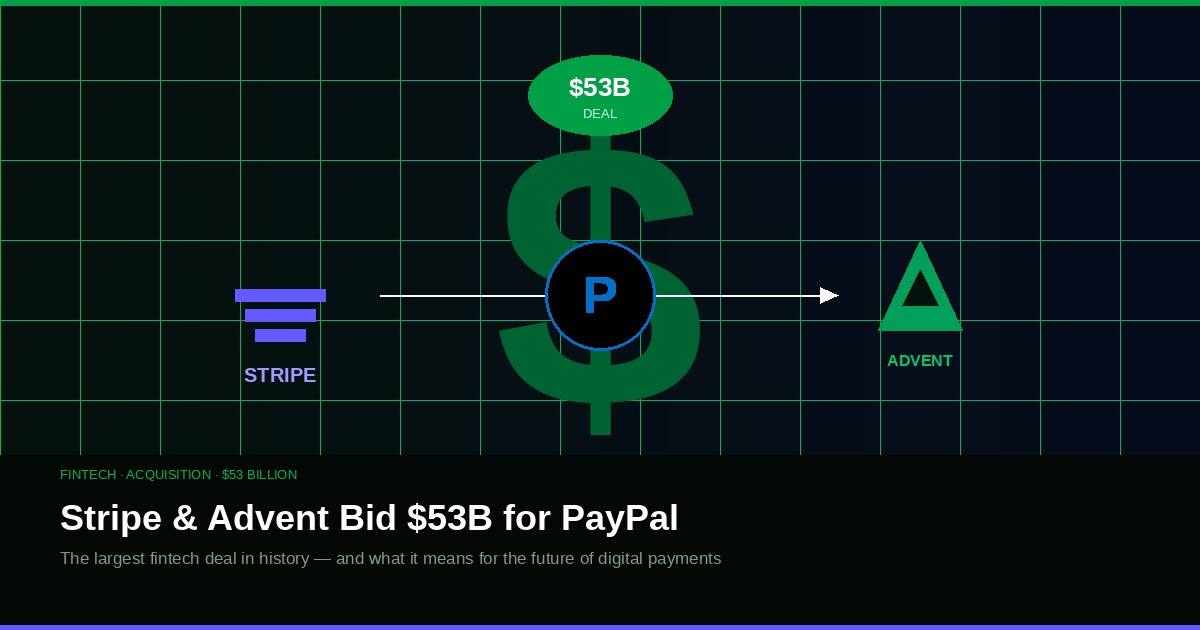
The fintech world is reeling from a bombshell announcement: Stripe, the privately held payments infrastructure giant, and private equity firm Advent International have submitted a joint offer to acquire PayPal for more than $53 billion. If the deal closes, it would represent the largest fintech acquisition in history — and one of the most consequential reshaping of digital payments since PayPal itself split from eBay in 2015.
The bid values PayPal at $60.50 per share, a premium of roughly 28% over its previous closing price of $47.37. Banks have reportedly committed approximately $50 billion in financing, and the two firms have signaled they are pushing to move talks forward over the coming weeks. Stripe and Advent would hold equal ownership stakes if a transaction proceeds.
PayPal has not yet publicly responded to the offer.
From Rivals to Potential Merger
The pairing of Stripe and PayPal is, in many ways, the story of two generations of payments infrastructure. PayPal was the internet’s first mass-market digital wallet, launched in 1999 and instrumental in making e-commerce feel safe for millions of consumers. It grew into a behemoth — processing over $1.5 trillion in payment volume annually, operating the Venmo peer-to-peer platform, and serving 439 million active accounts worldwide.
Stripe arrived a decade later, founded by brothers Patrick and John Collison in 2010, with an entirely different philosophy. While PayPal targeted consumers and small merchants with a checkout button, Stripe built for developers — offering clean APIs, modular tools, and infrastructure that quickly became the default plumbing beneath some of the world’s fastest-growing companies. Today Stripe powers payments for Amazon, Google, Shopify, Lyft, and thousands of SaaS businesses.
The two companies have long occupied different parts of the payments stack. But the deal would merge Stripe’s AI-driven Link wallet and developer-focused infrastructure with PayPal’s unmatched consumer reach, Venmo’s social payments network, and PayPal’s entrenched position in the checkout flows of millions of merchants. The combination could create a payments network with no meaningful peer in the Western world.
Why Now?
PayPal has spent the past several years in a difficult transition. The company’s stock soared during the pandemic-era e-commerce boom, briefly crossing a market capitalization of $300 billion in 2021. But it has struggled since, facing intensifying competition from Apple Pay, Google Pay, Shopify Payments, and fintech startups chipping away at its merchant and consumer base.
A string of strategic missteps — including an abortive attempt to acquire Pinterest for $45 billion in 2021 — drained investor confidence. New CEO Alex Chriss, who took over in 2023 from Dan Schulman, has pushed a turnaround built around profitability and AI-powered checkout improvements, including Fastlane, a one-click checkout that uses PayPal’s data to pre-fill payment forms across merchant sites. The turnaround has shown early signs of progress, but the stock remains far below its peak.
For Stripe, the rationale is more expansive. The company has been preparing for an eventual public offering for several years. A PayPal acquisition would give Stripe an immediate consumer brand, a massive installed base, and a global regulatory footprint across dozens of markets — all of which would otherwise take years to build organically. Stripe’s Link wallet, which stores payment credentials and supports one-click checkout, overlaps strategically with PayPal’s core consumer proposition, but PayPal’s 439 million users would give it a scale Stripe cannot reach independently.
Advent International, one of the world’s largest private equity firms with more than $90 billion in assets under management, brings deal expertise, financial engineering, and a track record of complex technology carve-outs. Its participation suggests the transaction could involve separating or restructuring parts of PayPal’s business — potentially spinning off Venmo or divesting PayPal’s buy-now-pay-later operations to streamline the combined entity.
The Regulatory Gauntlet Ahead
A deal of this size would face intense regulatory scrutiny in the United States, European Union, and the United Kingdom. Antitrust regulators would examine whether combining Stripe’s infrastructure position with PayPal’s consumer dominance would harm competition in online payments.
The argument for regulators accepting the deal is that the payments landscape has fragmented dramatically. Apple Pay, Google Pay, Amazon Pay, and Shopify Payments have all gained share. Card networks Visa and Mastercard remain far larger than any standalone payments processor. The idea that Stripe plus PayPal would constitute an unacceptable monopoly is harder to sustain when Apple is routing billions of dollars in transactions through its wallet and Shopify has effectively become a payments network for its 2 million merchants.
The argument against is that Stripe’s developer infrastructure is embedded so deeply in the web that combining it with PayPal’s consumer data and merchant relationships could create an information advantage that smaller rivals simply cannot match. Any combined entity would have access to payment patterns, merchant conversion data, and consumer behavior at a scale that rivals Google and Amazon’s own data advantages.
Ripple Effects Across Fintech
The bid has already sent tremors through financial technology markets. Shares of PayPal jumped sharply on the news, and analysts are now re-evaluating the valuations of adjacent players including Adyen, Block, and Klarna.
The deal would also mark a historic moment for Stripe. Valued at approximately $91 billion in its most recent funding round, Stripe has remained private longer than almost any comparably sized technology company. An acquisition of PayPal would likely require Stripe to raise additional equity capital or pursue a public offering to retire debt — effectively forcing the IPO that Stripe has long deferred.
For Advent, the transaction represents a bet that the next phase of digital payments will be dominated by AI-native infrastructure rather than legacy consumer brands. Stripe’s investment in machine learning for fraud detection, underwriting, and checkout optimization puts it years ahead of traditional payment processors. Adding PayPal’s data and consumer relationship could accelerate that advantage considerably.
What Comes Next
PayPal’s board will now deliberate on whether to engage with the offer. Sources suggest initial outreach was made as early as April 2026, meaning the two sides have had months to size up the opportunity. The public disclosure of the $53 billion figure suggests Stripe and Advent are prepared to escalate if PayPal does not move quickly to the negotiating table.
The deal timeline will depend on PayPal’s response, regulatory preparation, and Stripe’s financing structure. Major transactions of this complexity typically take six to eighteen months to close even when both parties are willing.
What is already clear is that the bid has changed the conversation about where digital payments are headed. A Stripe-PayPal combination would not just be the largest fintech deal ever — it would be a signal that the era of fragmented payments infrastructure is ending, and that the companies capable of operating at internet scale are beginning to consolidate the pipes that move money across the global economy.
Sources: CNBC, Reuters, Axios, MarketWatch, CoinDesk, FF News


