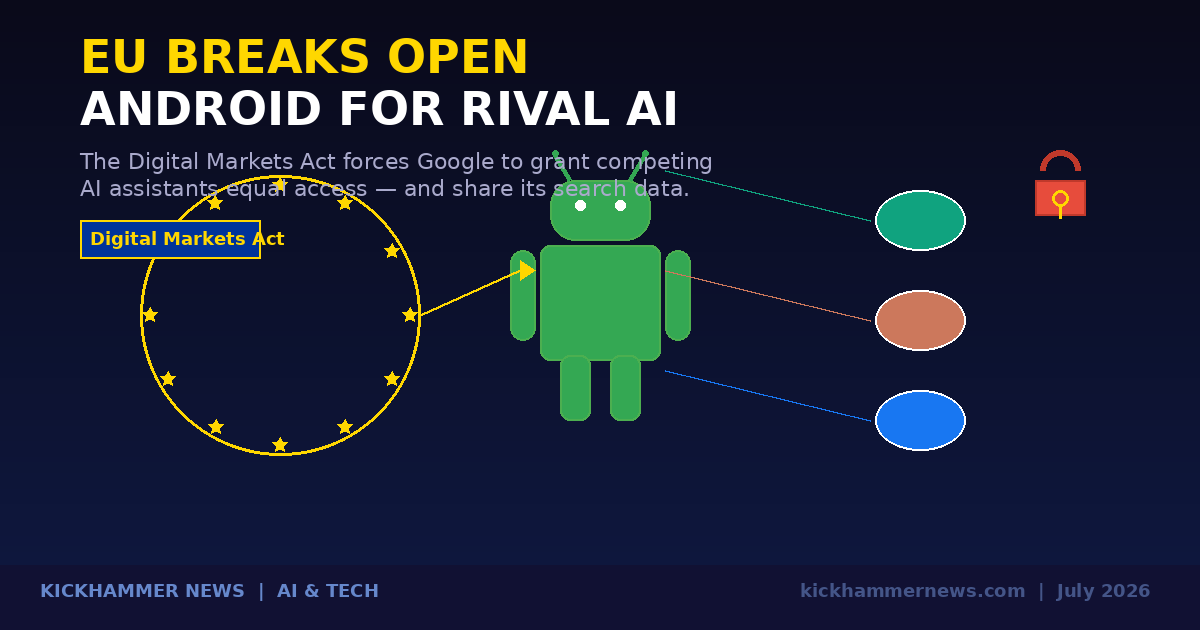
The European Commission has issued two landmark decisions under the Digital Markets Act that could fundamentally reshape the AI assistant market on Android phones and break open access to Google’s search empire.
In a move long anticipated by regulators and competitors alike, the European Commission on July 16, 2026, issued two sets of binding specification measures to Alphabet’s Google under the Digital Markets Act (DMA). Together, they require Google to give rival AI assistants — think ChatGPT, Claude, and others — the same deep access to Android that it currently reserves for its own Gemini AI. Google must also open up its search data to competing search engines and AI chatbots. The decisions don’t just set new rules for Europe. They signal a broader power struggle over who controls the AI layer on the world’s most widely used mobile operating system.
The Android Lockout
To understand why the EU acted, you have to understand how Android’s AI access actually works — or rather, how it didn’t.
Google’s own Gemini assistant has always had privileged access to the Android operating system: full control over the microphone, camera, screen context, and app integrations. A third-party assistant like Claude or ChatGPT, by contrast, was locked out of most of those features. You could open them as standalone apps, but you couldn’t set them as your default “Hey Google” replacement and have them truly operate on your behalf across the phone.
That asymmetry mattered more as AI assistants began moving from answering questions to actually doing things — booking rides, drafting replies, pulling context from your recent activity. When AI becomes agentic, a restricted assistant is a crippled one.
The Commission’s first specification measure addresses this head-on. Google must allow any EU user to choose a preferred AI assistant and activate it via voice, just as they can say “Hey Google” to wake Gemini. That assistant must then have the same ability to act inside apps — booking a taxi, suggesting a reply in a messaging app, answering questions about a place you recently visited. Google has until July 2027 to make these changes available to users.
“Third-party AI assistants are therefore limited in how they can offer their innovative services, making them less attractive to 60% of EU users who have an Android device,” the Commission wrote in its decision, noting that the current state of affairs prevented rivals from competing on equal terms.
Opening the Search Vault
The second decision is arguably even more consequential in the long run.
Google Search collects data at a scale that is essentially impossible to replicate. Every query, every click, every refinement a user makes feeds back into ranking signals, autocomplete models, and the underlying infrastructure that makes Google Search so accurate. Rivals — whether search engines or AI chatbots trying to build retrieval-augmented generation systems — don’t have access to that feedback loop.
Under the new requirements, Google must share that same data with eligible third parties, subject to strict anonymization. AI chatbots that offer search functionalities are explicitly included, meaning companies like Perplexity, OpenAI, or Anthropic can apply to receive the data that Google uses to tune its own systems. Data sharing begins in January 2027.
The Commission worked with internal and external privacy experts to design a multi-layered anonymization process. Records with rare or sensitive details would be suppressed. Users would be grouped into bundles of at least 1,000 to prevent re-identification. Unique identifiers would be stripped. Google retains a limited right to refuse data to any firm it can demonstrate poses serious security or data protection risks, though that determination would be subject to independent audit.
The price Google can charge for access is also set by a formula the Commission describes as “fair,” removing Google’s ability to price rivals out of the market.
Google Pushes Back
Google was quick to object — not for the first time, and almost certainly not the last.
Kent Walker, the company’s president of global affairs, said the decisions “risk undermining vital privacy and security guardrails for millions of Europeans.” He warned that “Europeans’ private searches would be exposed to unfamiliar companies, without adequate anonymisation… without user knowledge or consent,” and that the changes would “weaken citizens’ privacy, risk business trade secrets, and endanger national security.”
These arguments echo the positions Google has taken in prior DMA proceedings. The Commission, for its part, is confident its anonymization scheme is robust and says Google’s right to flag bad-faith applicants is a sufficient safeguard.
There’s more than privacy at stake for Google, of course. Google Search is among the most profitable businesses in corporate history, and the AI arms race is increasingly tied to search quality. If rivals can close the data gap, one of Google’s most durable competitive moats begins to erode.
A Pattern of Pressure
The July 16 decisions fit into a sustained pattern of EU enforcement under the DMA, which came fully into force in 2023. Brussels has already ordered Meta to strip addictive design features from its platforms and compelled Google to open its Play store to rival app distribution services. Regulators have also scrutinized Google’s Android choice screens — the prompts that ask users to pick a default browser or search engine — following concerns that they were designed to nudge users toward Google products.
Non-compliance carries real financial consequences. The DMA allows the Commission to fine a gatekeeper up to 10% of its global annual turnover, rising to 20% for repeat violations. For a company with Google’s revenues, that translates to tens of billions of dollars.
There’s an international dimension as well. The Trump administration has been vocal in its view that the DMA unfairly targets American companies, and EU officials are navigating those diplomatic headwinds as they enforce the law. Google’s deadline of July 2027 for the Android changes is actually longer than the runway Apple received — the Commission has required Apple to make Siri compliant with DMA interoperability requirements before it can launch certain AI features at all in the European Union.
What It Means for AI Competition
For consumers, the DMA decisions could eventually mean a meaningfully different experience on Android phones. Imagine waking up an AI assistant of your choosing with a single voice command and having it read your calendar, draft a message in any app, check your order status on a retailer’s platform, and navigate you to a meeting — all without touching Google’s own apps.
For AI companies outside Google, the decisions represent a potential inflection point. Access to system-level Android features is what separates a capable chatbot from a true ambient assistant. And access to Google’s search data could dramatically improve the quality of retrieval and grounding for models that are trying to give accurate, current answers.
Neither change happens overnight. The timelines run into 2027, and Google will almost certainly mount legal challenges that could delay implementation further. But the EU has signaled clearly that it views AI assistant access and search data as core competitive levers — and that it intends to pry them open.
For the first time, Gemini may have to compete on a level field in the market where it lives.
Sources: European Commission Digital Markets Act announcement, July 16, 2026; The Next Web; The Register; Google official blog.


