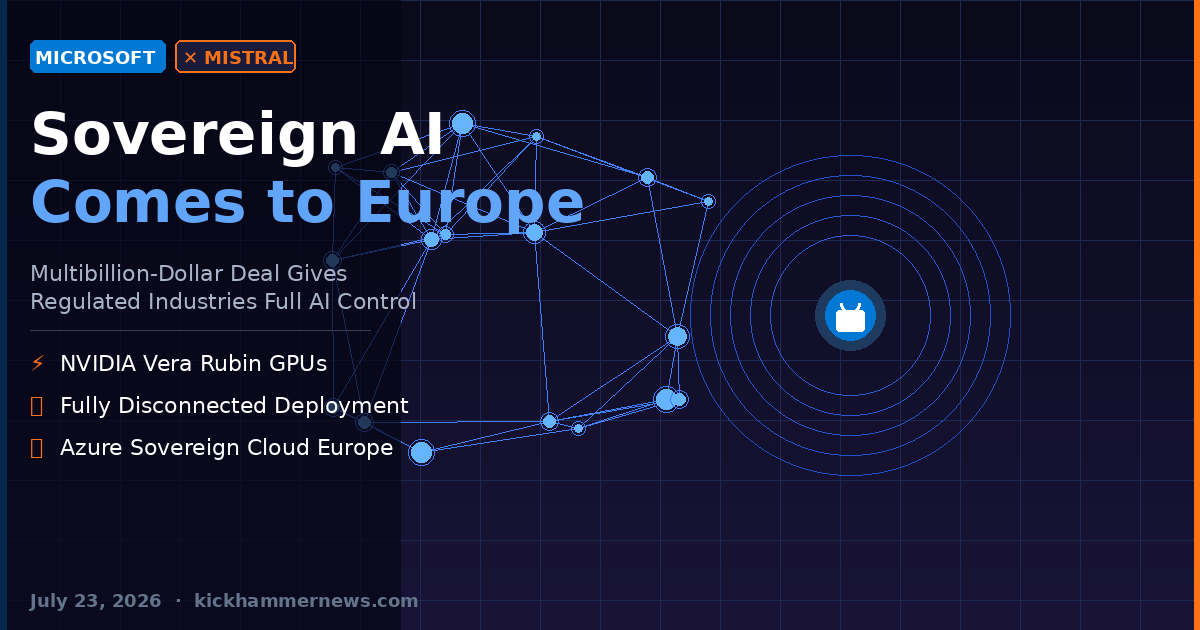
A sweeping new partnership between the Seattle tech giant and the French AI startup aims to give regulated industries across Europe frontier AI capabilities they can deploy on their own terms — including in environments completely cut off from the internet.
The deal, announced July 21, 2026, signals a significant shift in how big tech is approaching the European market: not just as a customer base, but as a sovereignty-conscious ecosystem that demands something fundamentally different from what Silicon Valley has historically offered.
The Partnership at a Glance
Microsoft and Mistral have deepened a strategic relationship that was first established in 2024, now committing to a multibillion-dollar agreement with three main pillars. First, Microsoft will leverage Mistral’s expanding European GPU infrastructure — powered by thousands of NVIDIA’s latest Vera Rubin systems — to increase compute capacity across the region for both AI development and cloud services delivery. Second, Mistral’s newest models, including Medium 3.5 and OCR 4, are now integrated into Microsoft Foundry and Copilot Studio. Third, and perhaps most consequentially, the partnership gives enterprise customers the ability to run Mistral models not just in Azure’s cloud, but in fully disconnected environments where no external connectivity is required.
That last point is the crux of the deal’s strategic importance.
Why “Disconnected” Matters
For most consumer and startup AI applications, full cloud connectivity is a given. But European regulated industries — think defense contractors, national health services, nuclear operators, financial clearinghouses — have always operated under a different calculus. Data can’t leave certain networks. Systems must remain operational even if internet access is severed. Regulators in Berlin, Paris, and Brussels have rules that make straightforward cloud AI deployment legally fraught or outright impossible.
Microsoft calls this its “Sovereign Cloud” approach, and with this partnership it is extending that concept explicitly to Mistral’s frontier models. Under the deal, organizations can deploy through three distinct operating models: standard Azure cloud, “cloud-connected” Azure Local environments that talk to Azure when needed but maintain local control, and fully disconnected Azure Local deployments that run entirely on-premise and off-network.
Brad Smith, Microsoft’s Vice Chair and President, framed the ambition plainly: “Europe should have access to the world’s most capable AI without compromising control over their data, operations or digital future.”
Mistral’s Strategic Position
Mistral, headquartered in Paris and founded in 2023 by former DeepMind and Meta researchers, has carved out a distinctive niche in the global AI landscape by championing open-weight models and European technological independence. The company has grown rapidly, and this partnership with Microsoft represents both a major commercial milestone and a strategic validation of its approach.
Mistral CEO Arthur Mensch described the partnership as an extension of the company’s core mission. “Our models reach enterprises and public institutions at global scale — delivered through a platform trusted for the most demanding, regulated workloads and available everywhere our customers operate,” he said.
The expanded agreement also reflects Mistral’s bet on European GPU infrastructure. Rather than relying entirely on existing hyperscaler capacity, Mistral is building out its own compute base powered by NVIDIA Vera Rubin systems — a next-generation GPU architecture designed for AI workloads at scale. Microsoft, under this new agreement, will leverage a significant portion of that capacity to meet its own surging European demand.
NVIDIA VP Ian Buck confirmed the significance of the hardware layer: “Agentic AI is driving unprecedented demand for high-performance, energy-efficient AI infrastructure. By deploying NVIDIA Vera Rubin systems at scale, Mistral and Microsoft will give customers the computing foundation they need to build and run the next generation of AI across Europe and beyond.”
What’s Actually Available Today
The announcement wasn’t purely forward-looking. Mistral’s Medium 3.5 model — an open-weight model optimized for enterprise workloads — is now live in Microsoft Foundry, giving developers immediate access to a capable frontier model within a managed Azure environment. OCR 4, Mistral’s document processing model, is also available in Foundry, targeting structured document pipelines and agentic workflows that are common in finance, legal, and healthcare contexts.
Mistral Medium 3.5 has also landed in Copilot Studio, Microsoft’s low-code platform for building custom AI-powered business applications. This gives non-developer enterprise teams the ability to build internal tools using Mistral’s models without writing a line of code, while still benefiting from Azure’s compliance and security stack underneath.
The Agentic Angle
The timing of this partnership aligns with a broader industry shift toward agentic AI — systems that don’t just answer questions but take sequences of actions autonomously. Agentic applications place especially high demands on infrastructure: they run longer, consume more compute, and interact with more data sources than simple chat interfaces.
The ability to run agentic AI in a fully disconnected environment is particularly meaningful for sectors like defense and critical infrastructure, where an autonomous agent operating on sensitive data simply cannot be allowed to make API calls to a remote cloud without explicit human review. Microsoft and Mistral are marketing this partnership directly to those use cases.
Regulated industries singled out in the announcement include financial services (where data residency and export controls are paramount), manufacturing and industrial operations (where latency, IP protection, and supply-chain resilience drive deployment decisions), and healthcare (where patient data privacy and clinical continuity requirements impose strict constraints on where data can flow).
A Signal for the AI Industry
This deal is the latest in a series of moves by major tech companies to address the specific demands of European enterprise customers and regulators, but it stands apart in a few ways. The involvement of a European-founded AI company rather than a U.S. one sends a deliberate political signal. The commitment to disconnected deployment goes further than most sovereign cloud offerings have gone. And the multibillion-dollar scale of the compute investment makes clear this isn’t a token partnership — Microsoft is making a long-term bet on Mistral’s infrastructure as a meaningful part of its European capacity.
For enterprises that have been watching the AI race from the sidelines, waiting for an option that doesn’t require them to route sensitive workloads through U.S.-based hyperscalers, this deal offers a credible on-ramp. Whether the industry takes it will be a meaningful test of how seriously European organizations are willing to move on AI adoption — and how far they’ll go to do it on their own terms.
Sources: Microsoft Source press release, July 21, 2026; NVIDIA statement; Mistral CEO Arthur Mensch statement


