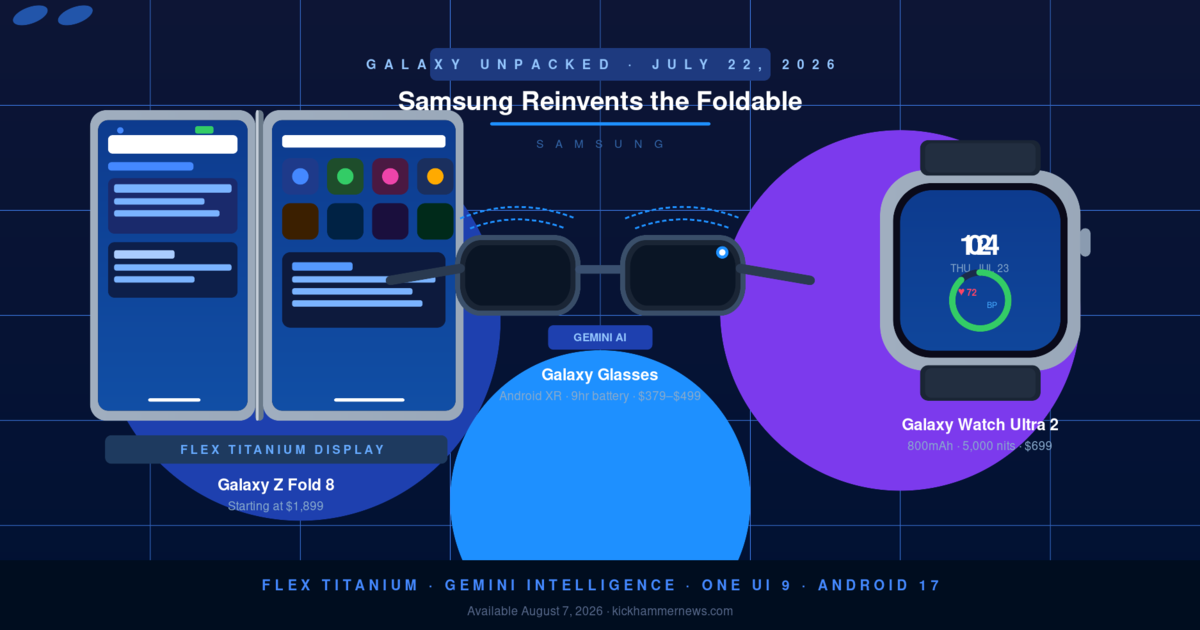
Samsung staged one of its most consequential Unpacked events in years on July 22 in London’s Old Billingsgate — a Victorian market hall that hasn’t hosted a Samsung keynote before — and the company used the occasion to redefine what a foldable phone lineup actually looks like. For the first time in seven generations, Samsung launched two simultaneously available book-style foldables with fundamentally different design philosophies, introduced a titanium-based display technology aimed at the persistent crease that has dogged every foldable ever shipped, debuted its first entry into AI smart eyewear, and pushed out Android 17 as the platform baseline for what an agentic AI smartphone should do in the second half of 2026.
The competitive timing is not accidental. Apple is widely expected to unveil its first foldable iPhone in September. Samsung’s London event lands eight weeks ahead of that window.
Flex Titanium: The Crease Problem, Finally Addressed
The crease at the center of a foldable display has never been a secret. Every Galaxy Z Fold from the first-generation device through last year’s Z Fold 7 used a polymer film beneath the OLED panel — and every generation carried the same mechanical failure mode: the polymer deforms at the fold line over time, creating a permanent visible groove that no amount of software can hide.
Samsung’s answer is Flex Titanium, a two-component redesign of the display stack that debuts across all three foldables announced this week. The first component is a titanium-alloy film — approximately one-third the thickness of a human hair — placed directly beneath the OLED panel. Samsung says the alloy film is 20 times stiffer than the polymer layer it replaces, and that stiffness is the engineering point: a stiffer backing distributes the mechanical stress of repeated folding across a wider area rather than allowing it to concentrate at a single crease line. The second component is a titanium plate with micro-patterned perforations beneath the alloy film, which allows the structure to flex thousands of times daily while reducing air gaps between display layers.
The result is a significantly reduced crease — not an invisible one. Samsung Display has indicated that a fully crease-free foldable is a 2028 target. Flex Titanium is the most serious engineering attempt at the problem to date, and hands-on testing after the August 7 launch date will determine how much of the improvement buyers can feel in daily use.
Two Book-Style Foldables: A Design Fork Seven Years in the Making
The Galaxy Z Fold 8 and Galaxy Z Fold 8 Ultra share a name and a display architecture, but they disagree about almost everything else.
Galaxy Z Fold 8 — the wider “passport” form factor
The standard Z Fold 8 is the more radical departure. Samsung has shifted the inner display to a 4:3 aspect ratio and a shorter, wider body — a design that opens to something closer to a small tablet than the tall, narrow form factor the Fold line has used since 2019. The 7.6-inch inner display pairs with a 5.5-inch cover screen at 16:10, wide enough for two-thumb typing without the stretching that made prior Fold cover screens feel like a compromise. Folded thickness hits approximately 9.7mm; unfolded, it comes in around 5.5mm.
The camera system trades range for geometry: a 50MP main sensor and 50MP ultrawide, with no telephoto. That is a deliberate trade-off, and it matters for buyers who rely on optical zoom. The 4,800mAh battery — up from 4,400mAh on the Z Fold 7 — comes with 45W wired and 20W wireless charging. Starting price: $1,899.
Galaxy Z Fold 8 Ultra — the flagship successor
The Ultra is the true heir to the Z Fold 7 lineage: the same tall, narrow book-style form factor, now labeled with the “Ultra” tier for the first time in the Fold line’s history. The camera upgrade is significant: a 200MP primary camera — matching the Galaxy S Ultra tier — paired with a 10MP telephoto and a 50MP ultrawide that improves substantially on the Z Fold 7’s 12MP ultrawide. Battery reaches 5,000mAh, the first meaningful capacity increase for the tall-style Fold in five years, with 45W wired charging. Samsung calls it the thinnest Galaxy Z Fold yet. Starting price: $2,099.
Galaxy Z Flip 8 — refinement, possibly a final act
The Z Flip 8 brings iterative updates: a 6.9-inch main display at 120Hz, 12GB of RAM, Snapdragon 8 Elite Gen 5, and a 4,300mAh battery. At 6.1mm thick unfolded, it is Samsung’s thinnest Flip. The more notable addition is a reworked hinge design and a cover screen UI that behaves more like the open display — partially addressing the long-standing criticism that the Flip’s cover screen has been less useful than competitors.
Pre-launch reporting from two independent supply-chain sources suggests the Z Flip 8 may be Samsung’s last clamshell foldable, built at lower volumes than either Fold model. Samsung has not confirmed this, and it should be treated as unverified until the company addresses it directly.
All three devices ship August 7 with Android 17 and One UI 9, and are eligible for seven years of OS and security updates.
One UI 9 and Gemini Intelligence: The Agentic Smartphone Arrives
One UI 9 — built on Android 17 — is Samsung’s most substantive software platform update in several years, and the headline addition is Gemini Intelligence: Google’s agentic AI layer, integrated at the system level across Samsung’s native apps.
Earlier Galaxy AI features operated within individual applications. Gemini Intelligence allows the system to understand context across apps and execute multi-step instructions — booking a reservation, summarizing a document and drafting a reply, reorganizing a calendar — without requiring manual handoffs between applications. It is the clearest production example yet of what a genuinely agentic smartphone can do in daily use.
The capability has a hard hardware floor: Gemini Intelligence requires a current flagship-generation chip, AI Core hardware support, Gemini Nano v3, and at least 12GB of RAM. It will arrive first on the new foldables and is unlikely to reach older devices at full capability even after the broader One UI 9 rollout begins in August.
There is a meaningful caveat that Samsung’s keynote materials will not feature prominently. Independent security researchers have identified prompt injection — where malicious content in a web page or app instructs the agentic AI to take unintended actions — as a genuine open risk in any agentic AI system. Early real-world experience with the predecessor agentic feature on Galaxy S26 showed inconsistent performance outside controlled demos. The practical guidance is to start with low-risk tasks and treat every agentic action as something that benefits from oversight until the platform matures.
Galaxy Watch 9 and Watch Ultra 2: The Battery and Chip Upgrade
Samsung’s wearable line gets the chipset transition it has needed. Both new watches run Qualcomm’s Snapdragon Wear Elite — marking the Galaxy Watch line’s first departure from Samsung’s Exynos W-series — with a neural processing unit for on-device AI health insights.
The Galaxy Watch 9 (40mm and 44mm, starting at $379) adds ultra-wideband support for directional Find My Phone, digital car keys, and proximity-based device unlocking. Health additions include a Heart Health Score, Daily Cardio Load metric, Fitness Index, Hearing Health Monitoring, and Blood Pressure Trends — the latter arriving in the United States for the first time on a Galaxy Watch.
The Galaxy Watch Ultra 2 ($699) is the more dramatic upgrade. Its 800mAh battery represents a 36% increase over the original Ultra’s 590mAh cell. The display reaches 5,000 nits of peak brightness — a 67% improvement over the first-generation Ultra’s 3,000-nit panel. The titanium case is now 12% thinner, and the watch carries an IP69K water and dust resistance rating, enabling tracking during high-pressure, high-temperature water exposure. Both watches ship August 7.
Galaxy Glasses: Samsung Enters the AI Smart Eyewear Category
The final announcement — and in some ways the most consequential for the longer arc of wearable technology — is Samsung’s entry into AI smart glasses with Galaxy Glasses, built on Android XR with Gemini AI integrated.
The first-generation Galaxy Glasses are a display-free design: no screen, no AR overlay. All output is audio — voice responses, real-time translation, navigation directions, notification readouts, photo capture. The hardware platform includes a Qualcomm Snapdragon AR1 processor, a 12MP Sony IMX681 camera with autofocus, directional speakers, dual microphones, and a 155mAh battery in a frame weighing approximately 50 grams. Battery life reaches nine hours on a charge; the included case provides seven additional charges.
The glasses were developed in collaboration with Gentle Monster and Warby Parker. Google confirmed at I/O 2026 that the Galaxy Glasses pair with both Android and iOS devices, with computation routed through the paired smartphone via Bluetooth and Wi-Fi.
The direct competitor is Meta’s Ray-Ban smart glasses. The Galaxy Glasses match Meta Ray-Ban’s price range directly — expected at $379 to $499 — rather than undercutting it. The key differentiator is Gemini versus Meta AI, and which AI assistant performs better in daily use is something only sustained independent testing after launch can determine.
Samsung has already confirmed a second-generation model, codenamed “Haean,” for 2027, which will incorporate a micro-LED display for AR overlays and target the $600 to $900 range. The 2026 device is, in other words, explicitly a stepping stone — and Samsung is saying so openly.
The Apple Subtext
The competitive subtext of this Unpacked cannot be overstated. Samsung is introducing a second book-style foldable designed around a 4:3 aspect ratio — the same ratio Apple’s anticipated foldable iPhone is reportedly targeting — eight weeks before Apple is expected to take the stage. The crease-reduction engineering of Flex Titanium, the dual book-fold launch, the agentic AI platform, and the smart glasses entry are all landing simultaneously, and all timed to establish Samsung’s position before Apple’s first foldable arrives.
There is a notable footnote: Samsung Display is the supplier of OLED panels for Apple’s anticipated foldable iPhone under a multi-year exclusive supply agreement. The screens inside the device Samsung is trying to preempt are being manufactured by Samsung. That dynamic has no precedent in the foldable category and underscores how deeply intertwined these two companies’ supply chains remain, regardless of their headline competition.
For the broader Android platform, the One UI 9 / Android 17 stable release sets the AI baseline for the second half of 2026 — the reference point against which every other Android OEM’s software will be measured for the remainder of the year.
Pre-orders open now. Devices ship August 7, 2026.


