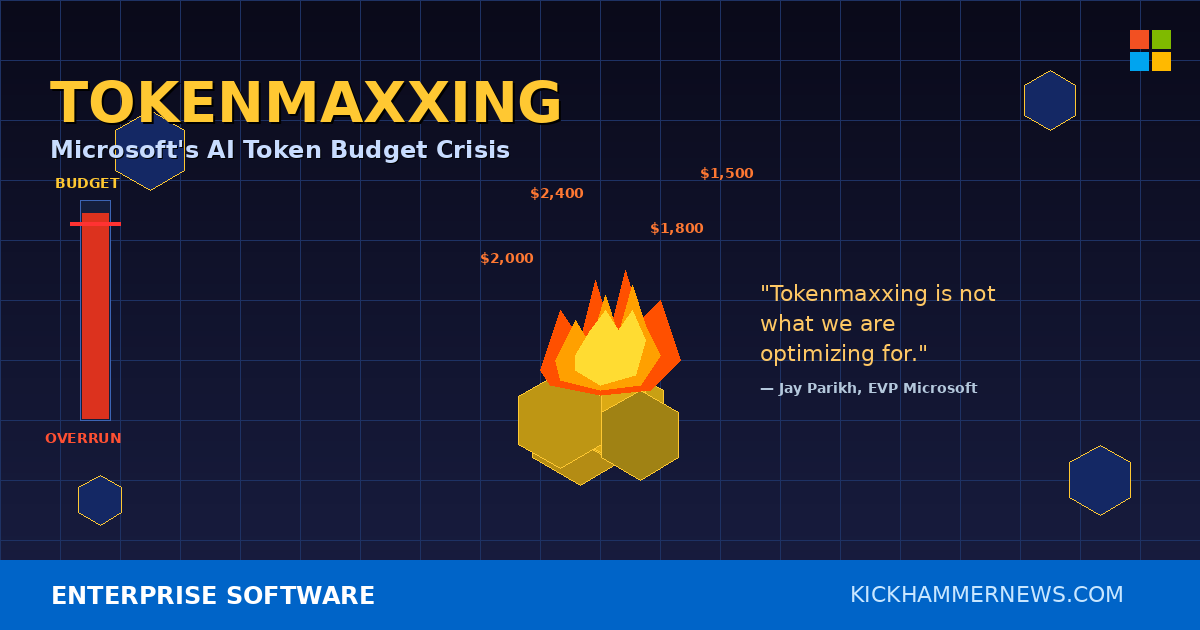
There is a darkly ironic spectacle unfolding inside Microsoft’s engineering organization: the company that has staked its future on selling AI to the world cannot afford the AI habits of its own engineers. An internal memo obtained by multiple outlets this week reveals that Microsoft EVP Jay Parikh has put the entire company on notice with a blunt new directive — “Tokenmaxxing is not what we are optimizing for.”
The message is pointed but also reflects a structural reckoning rippling through every technology company brave enough to deploy AI coding tools at scale. The enterprise AI tab has arrived, and it is larger than almost anyone planned for.
From Enthusiastic Rollout to Budget Emergency
The story of Microsoft’s token crisis begins in December 2025, when the company enthusiastically rolled out Claude Code — Anthropic’s agentic AI coding assistant — to approximately 5,000 engineers in its Experiences and Devices division. By April 2026, adoption had climbed to between 84 and 95 percent of the engineering cohort. Microsoft’s internal numbers told a success story that any AI vendor would be proud to cite.
Then the invoices arrived.
Token billing hit $2,000 per engineer per month — and the annual AI budget for the division burned through in a matter of months, not the twelve the finance team had projected. By May 2026, Microsoft had canceled the vast majority of its Claude Code licenses. The Experiences and Devices group went from being one of the highest-profile enterprise deployments of an AI coding agent to a cautionary tale cited in boardrooms across Silicon Valley.
Microsoft’s decision to cancel was not, the company insists, a verdict on Claude Code’s quality. Engineers who used it reported genuine productivity gains. The problem was simpler and more fundamental: when engineers adopt an AI coding tool at a 90 percent rate and run it aggressively all day, the cost model breaks. Enterprise AI token pricing simply does not behave like a SaaS seat license. The more useful the product, the more it costs — and the cost curve is steep.
The Tokenmaxxing Memo
Parikh’s email, sent this week to Microsoft’s engineering division, introduces a new framework the company calls “AI token budget targets.” Starting in July 2026, each Microsoft division now has an explicit token spending cap, and individual engineers can track their own consumption. The default internal model has been switched from a frontier-tier offering to the cheaper GPT-5.6, with more expensive models available only when engineers can demonstrate a specific business case for the additional capability.
The language in the memo is stark: “I want all of us focused on maximizing outcomes that move the needle for our customers and our business. Tokenmaxxing is not what we are optimizing for.” Parikh noted that many engineers were spending “hundreds of dollars a month to a few thousand dollars in tokens” — a range that, when aggregated across tens of thousands of engineers, compounds into hundreds of millions of dollars in annual AI infrastructure costs.
“We are updating our internal guidance and managing token spend with the same discipline we apply to every other critical resource,” Parikh wrote. The framing is notable: AI tokens are now a capital resource on par with compute, storage, and headcount, to be budgeted, tracked, and optimized.
An Industry-Wide Reckoning
Microsoft is not alone. Uber’s CTO publicly confirmed this year that the ride-sharing company burned through its planned 2026 AI coding budget in just four months. Multiple companies are discovering the same pattern: pilots go well, adoption rates are encouraging, costs are initially manageable — then engineers reach a tipping point where they are using AI for virtually every development task, and usage patterns that seemed moderate in testing become expensive at scale.
The challenge is structural. Unlike traditional software licenses, which are priced per seat regardless of how heavily they are used, token-based AI billing scales directly with consumption. A developer who uses an AI coding assistant occasionally costs roughly the same as one who uses it rarely. A developer who uses it constantly — running long agentic loops, refactoring large codebases, generating test suites — can cost ten or twenty times as much. Enterprises that priced AI deployments based on average usage quickly found that actual usage, when tools work well, skews dramatically toward the high end.
Microsoft’s Deeper Strategic Play
The tokenmaxxing memo exists within a broader context that makes it more than just a cost-control story. Microsoft has spent the past year quietly replacing third-party AI models with its own MAI family across its product suite, explicitly to reduce its dependency on OpenAI and Anthropic — and to lower its internal AI infrastructure costs. MAI-Cyber-1-Flash, the company’s in-house cybersecurity model, was specifically built to outperform Anthropic’s much larger Mythos model at half the cost.
Switching engineers from Claude Code to more cost-efficient internal tools — or to GPT-5.6 as a default — fits neatly into a company-wide strategy of monetizing AI while simultaneously tightening its own AI spending. Microsoft has a strong financial incentive to push its own MAI models internally: every token that runs on Azure against a Microsoft-owned model is margin that stays in Redmond rather than flowing to a competitor.
The decision to cap token budgets also signals something more subtle: Microsoft is communicating to the market that frontier AI usage by knowledge workers is not, in fact, a zero-marginal-cost proposition. This matters enormously for enterprise software pricing discussions happening in procurement departments everywhere.
What This Means for the Enterprise Software Industry
The tokenmaxxing crisis is the enterprise software story of 2026 that nobody wanted to write but everyone will need to grapple with. The AI industry spent three years arguing about model capability. The next three years will increasingly be spent arguing about unit economics.
For CIOs and IT directors planning their own AI coding deployments, Microsoft’s experience offers a clear lesson: demand contractual token caps or flat-rate enterprise pricing before committing to large-scale rollouts. Pilot programs that look affordable with dozens of engineers can become budget emergencies with thousands. The “land and expand” sales motion that works so well for SaaS vendors works even better — and more expensively — for token-based AI tools.
For the AI vendors themselves — Anthropic, OpenAI, and others — the cancelation of Microsoft’s Claude Code licenses is a warning signal dressed as a compliment. Engineers loved the product. They loved it so much they used it constantly. That usage intensity, in the current pricing model, broke the budget. The companies that figure out enterprise-compatible pricing — whether through flat-rate commitments, usage tiers, or negotiated rate cards — will win the agentic AI deployment wave. Those that don’t will keep watching promising enterprise rollouts get canceled after the first quarterly review.
Microsoft’s “tokenmaxxing” memo may be an internal note, but its implications are very public. The AI cost reckoning is here. Every enterprise with an AI deployment in production is watching how Redmond handles it.
Sources: TechRadar | 404 Media | The Next Web | Enterprise DNA | CyberNews | AI Weekly