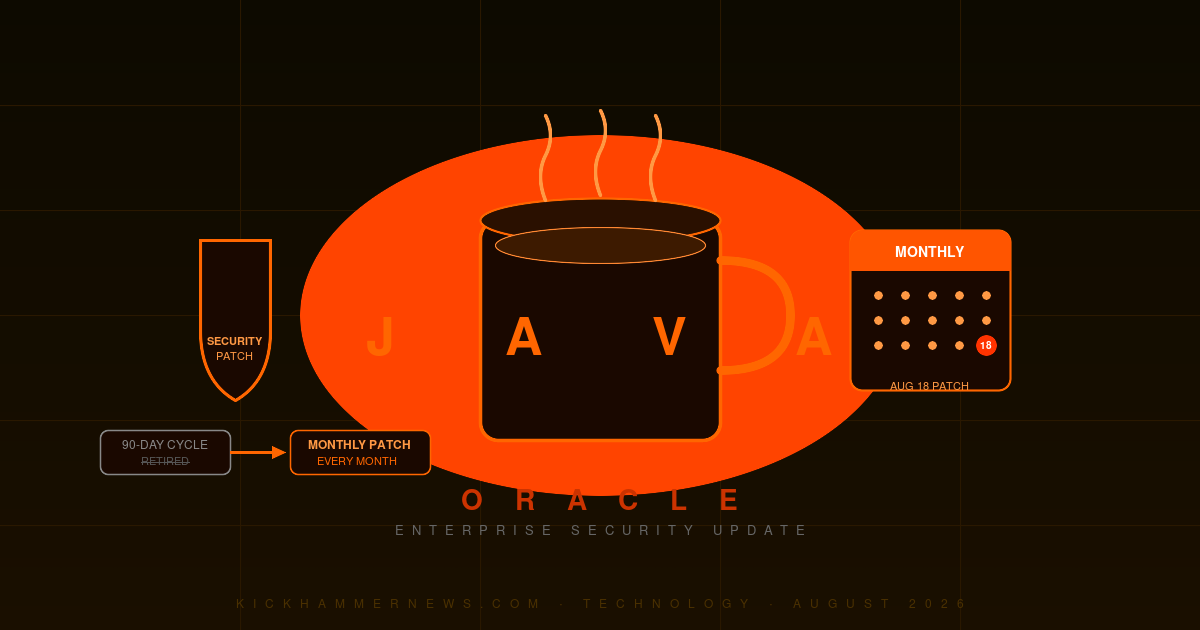
The first Java Critical Security Patch Update lands August 18 — and enterprise DevOps teams need to start adapting now.
For over a decade, Java developers have lived by a predictable rhythm: security patches arrive on the third Tuesday of January, April, July, and October. Mark the calendar, update the JDK, run the test suite, ship. The quarterly Critical Patch Update (CPU) cadence has been one of enterprise software’s most reliable rituals since Oracle standardized it in 2014. That ritual is now changing.
On July 20, 2026, Donald Smith, Oracle’s Vice President of Product Management for Java, published a blog post announcing that Oracle intends to provide Java security updates more frequently than the established quarterly schedule. The first of these new-style releases — called a Critical Security Patch Update, or CSPU — is targeted for August 18, 2026. That’s less than a month away, and it marks the beginning of a significant shift in how the world’s most widely deployed enterprise runtime handles vulnerability remediation.
What Is a CSPU, and How Is It Different from a CPU?
The CSPU is not a replacement for the quarterly CPU. It’s an additional release type that can slot in between the existing January, April, July, and October releases when a high-priority vulnerability needs to be fixed sooner than the next quarter allows. The quarterly schedule stays intact. What changes is that organizations can no longer treat the space between CPUs as a guaranteed patch-free period.
The scope of a CSPU is deliberately narrow. Oracle is explicit: CSPUs carry security and stability fixes only. No new features, no API changes, no behavior changes beyond what’s strictly required to address the vulnerability being patched. OpenJDK maintainers have reinforced this message on the jdk-updates-dev mailing list, emphasizing that CSPU scope will be kept especially tight while the new process is being established.
Version numbering follows the existing convention with one extra digit appended. The August CSPU for JDK 26 will be versioned 26.0.2.1 — one step past the July CPU release of 26.0.2. The same pattern applies to the other supported update trains: 8u, 11u, 17u, 21u, and 25u. As OpenJDK maintainer Andrew Hughes confirmed, those trains will treat CSPUs the same way they treat interim releases — branch from the prior GA tag, add security patches, keep scope minimal, merge back.
Why Oracle Is Accelerating Now
Oracle’s stated rationale is straightforward, even if the implications are substantial. The announcement links explicitly to a blog from Oracle’s Integrated Cyber Center (ICC), which has been rolling out monthly CSPUs across all Oracle products since late May 2026. The ICC’s explanation focuses on AI: the latest generation of AI tools has dramatically accelerated both sides of the vulnerability lifecycle.
Attackers can now scan for exploitable weaknesses in software at a scale and speed that would have been impractical a few years ago. But defenders can also find and fix vulnerabilities faster. The 90-day wait between quarterly CPUs, which used to be an acceptable window, now leaves meaningful exposure time between a vulnerability being discovered or published and a fix being available to production systems. CSPUs are designed to close part of that gap.
This is a trend that’s been building across the enterprise security world. Adobe moved to twice-monthly security bulletins earlier this year. Microsoft’s July 2026 Patch Tuesday set a record for CVE volume. The security patch cadence across the enterprise software industry is tightening, and Oracle’s Java announcement is the most significant instance yet to affect a runtime that underpins billions of enterprise transactions daily.
What the August 18 CSPU Covers
Oracle has not disclosed the specific vulnerabilities that will be addressed in the August 18 CSPU at this writing — that information is typically withheld until release day to give organizations time to apply patches before exploit code proliferates. What Oracle has communicated is that no CSPU is planned for September. The October quarterly CPU, Smith’s post notes, will carry a larger batch of vulnerability fixes than usual, since Oracle is holding some fixes for that quarterly release rather than pushing them all into August’s CSPU.
This has a practical implication: organizations that decide to skip or delay the August CSPU should budget additional testing time for the October CPU. It’s likely to be heavier than a typical quarterly release.
Azul, one of the major commercial OpenJDK distributors, has already announced that its release infrastructure supports the new cadence. Azul stated that it will deliver CSPU-equivalent releases for Azul Core and Azul Prime across all supported LTS versions, with the same stability validation it runs on quarterly updates. Other JDK distributors have not yet made equivalent announcements, so organizations consuming vendor JDK builds should verify their vendor’s CSPU plans before August 18.
What Enterprise Teams Need to Do Now
The narrow scope of CSPUs is intentional good news for anyone worried about regression risk. A CSPU should behave like a small, focused CPU. But “small” doesn’t mean “optional” from a security posture standpoint, and the irregular cadence requires some process adjustments that teams should start on immediately.
Update patch monitoring to a monthly check. Even though not every month will bring a Java CSPU, the current practice of checking for Java security releases only every quarter will miss them. Oracle’s security alert email subscription and the relevant OpenJDK Updates mailing lists are the most reliable signal channels.
Confirm your pipeline can run on an unscheduled trigger. Many enterprise release pipelines were designed with the quarterly Java cadence in mind, with testing cycles planned around those known dates. A CSPU arrives with less lead time. Teams should verify that test and promotion stages can complete without hitting manual approval bottlenecks that assume weeks of buffer.
Don’t defer everything to October. Some teams may be tempted to skip August’s CSPU and wait for the October CPU, reasoning that the October release will include everything anyway. That reasoning trades security exposure for scheduling convenience. The right response is to treat August 18 as a patch event, not an optional one.
Check your bundled JDK distributions. Organizations that ship applications with a bundled JDK or JRE — a common pattern in enterprise Java deployments — need to assess whether their build and packaging process can incorporate a CSPU without requiring a full release cycle of their own application. For some teams, this is a non-trivial change.
The Bigger Picture: Enterprise Java’s Security Posture Is Changing
Oracle’s move to more frequent Java security updates is part of a broader recalibration of enterprise security expectations. The implicit assumption that quarterly patches are sufficient for a runtime handling critical workloads was always somewhat optimistic. AI-accelerated vulnerability discovery has made that assumption untenable.
For the Java ecosystem, the shift carries particular weight. Java runs in banking systems, healthcare platforms, government infrastructure, and logistics networks that can’t afford meaningful exposure windows between vulnerability disclosure and patch deployment. Monthly CSPUs — even irregular ones — represent a materially improved security posture for those environments.
The 90-day window for critical Java security fixes isn’t going away immediately. Oracle has been clear that 2026 will see CSPUs show up irregularly, with a fuller monthly cadence planned for calendar year 2027. But the direction is set. August 18 is the starting line. Enterprise Java teams that haven’t started adjusting their patch pipelines should be doing so now.
The first Java CSPU is scheduled for August 18, 2026. Subscribe to Oracle’s security alert notifications at oracle.com/security-alerts/securityemail.html to receive updates when releases ship.


