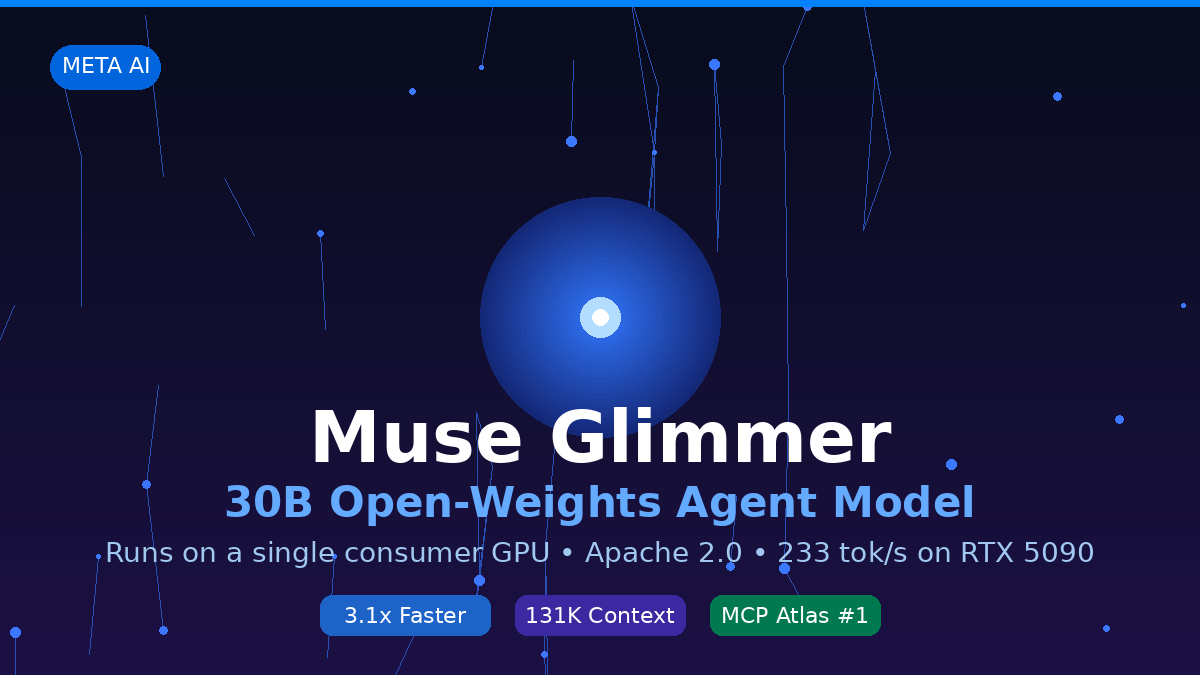
Meta has released Muse Glimmer, a 30-billion-parameter open-weights model that runs entirely on a single consumer GPU — no cloud required, no subscription, no per-token bill.
Released on August 10, 2026, Muse Glimmer is the latest salvo in the increasingly competitive battle between open and closed AI ecosystems. Where OpenAI and Anthropic lock powerful models behind API paywalls, Meta is once again betting on openness — and this time, the bet looks like it might pay off big.
What Is Muse Glimmer?
Muse Glimmer is a dense multimodal model distilled from Meta’s flagship Muse Spark model. At 30 billion parameters, it sits in a sweet spot that increasingly defines the frontier of “local AI”: large enough to outperform many proprietary models on reasoning benchmarks, small enough to run on hardware millions of people already own.
The model ships under the Apache 2.0 license, meaning anyone can download it, run it, modify it, and even build commercial products with it. Weights are available on Hugging Face in multiple formats: BF16 for full precision, GGUF k-quant builds for consumer hardware, ExecuTorch packages for mobile deployment, and a bundled DFlash drafter for acceleration.
Meta’s Chief AI Officer Alexandr Wang framed the release as part of the company’s broader push toward “personal superintelligence” — the idea that every individual should have access to a powerful AI that runs on their own device, not on a distant server they don’t control.
The Engineering Challenge: Fitting 55 GB Into 24 GB
A 30B model at full BF16 precision requires roughly 55 GB of VRAM — well beyond any consumer GPU. Meta solved this through aggressive 4-bit quantization combined with a novel speculative decoding architecture called DFlash.
Two quantized variants ship with the model. The K-Quant-Dynamic build targets 32 GB VRAM at just 0.2% average accuracy degradation across 15 standard benchmarks. The K-Quant-17GB build squeezes into a 24 GB card — the same size as an RTX 4090 or RTX 5090 — at 1.0% degradation. For most practical uses, that’s imperceptible.
Speed was the harder problem. Even a perfectly quantized model is useless in an agentic workflow if it takes five seconds to respond to a tool call. This is where DFlash comes in. The drafter is a compact 5-layer transformer that predicts 16 tokens simultaneously in a single forward pass. The main Muse Glimmer model then verifies the entire block in parallel, accepting or rejecting tokens before generating the next batch. The net effect is dramatic: on an RTX 5090, throughput jumps from 74.9 to 233.4 tokens per second — a 3.1x speedup. Apple Silicon users see similar gains, with an M5 Max climbing from 26.6 to 50.2 tokens per second and an M4 Max reaching 37.8.
Architecture: Built for Agents First
Muse Glimmer is not a general-purpose chat model with agentic features bolted on. It was designed from the ground up for agent workflows, and the architecture reflects that.
The language backbone uses grouped-query attention with 32 query heads and 2 KV heads, following a Local-Local-Local-Global attention pattern with a 2,048-token sliding window. This is computationally efficient for long-running agent sessions where context accumulates over many tool calls. The full context window extends to 131,072 tokens — enough to hold an entire software project or legal document in memory at once.
Vision is handled by a dedicated ViT-G/14 perception encoder with roughly 1.8 billion parameters. It accepts up to 4,096 visual tokens per image, letting agents interpret screenshots, charts, diagrams, and documents alongside text. Audio is not currently supported, and video is processed frame by frame rather than as a continuous stream.
The training pipeline ran in three phases. Pre-training used logit distillation from Muse Spark, allowing the smaller model to inherit reasoning patterns from its larger teacher. Mid-training introduced longer-context, agent-heavy data with richer reasoning traces. Post-training combined supervised fine-tuning, on-policy distillation, and reinforcement learning across general reasoning, coding, and agentic tasks.
Benchmark Performance: Leading Where It Matters Most
Meta pitted Muse Glimmer against Gemma4-31B and Qwen3.6-27B in thinking mode — two of the strongest open-weights models in its weight class.
On MCP Atlas, the benchmark measuring agentic orchestration ability, Muse Glimmer scores 75.5, compared to 54.2 for Gemma4-31B and 62.5 for Qwen3.6-27B. On DeepSearch QA, which tests multi-step retrieval and reasoning, it scores 74.6. GAIA2 comes in at 43.3, and SWE-Bench Pro — the gold standard for AI coding agents — reaches 51.2.
Mathematical reasoning is equally strong: 94.7 on AIME 2026, the prestigious American competitive math benchmark that has historically separated frontier models from the rest. Instruction-following scores 77.0 on IFBench, and long-context reasoning hits 80.0 on AA-LCR.
The model’s weaknesses are real and worth noting. Qwen3.6-27B holds the advantage on OSWorld-Verified (75.6 vs 65.9), which measures computer-use and GUI interaction, and on TerminalBench 2.1. If your agent workflow involves a lot of direct desktop or terminal control, Qwen may be the better choice. Muse Glimmer is clearly optimized for reasoning-heavy, tool-orchestration tasks rather than pixel-level computer use.
Who Is This For?
Meta explicitly targets several use cases where cloud AI is currently impractical.
Regulated industries — healthcare, legal, financial services, defense — often cannot send sensitive data to external servers. Muse Glimmer gives these organizations a frontier-level agent they can run entirely within their own infrastructure, air-gapped from the internet if necessary.
Individual developers and small teams gain access to a powerful agent without monthly API bills that scale with usage. A one-time hardware investment in a 24 GB GPU or a Mac with an M4/M5 Max chip is all that’s required.
Consumer applications gain new possibilities. Desktop agents that read screenshots and take actions, coding assistants that work offline, document analyzers for sensitive personal files — all become feasible with a model that runs locally at 233 tokens per second.
The Bigger Picture
Meta’s open-source AI strategy has had moments of controversy — questions about whether releasing powerful models is responsible, whether Apache 2.0 is truly open or a competitive tactic against cloud rivals. But the practical effect is hard to argue with: each major Meta release pushes capability closer to consumer hardware and further from centralized control.
Muse Glimmer represents a genuine inflection point. For the first time, a model competitive with frontier closed systems on the tasks that matter most for agentic AI can run on hardware you already own, in a room you control, with data that never leaves your building.
That matters — for privacy, for cost, and for the long-term question of who gets to decide what AI can and cannot do.
Meta’s Muse Glimmer 30B weights are available on Hugging Face under Apache 2.0. Technical details are available on the Meta Research blog.


