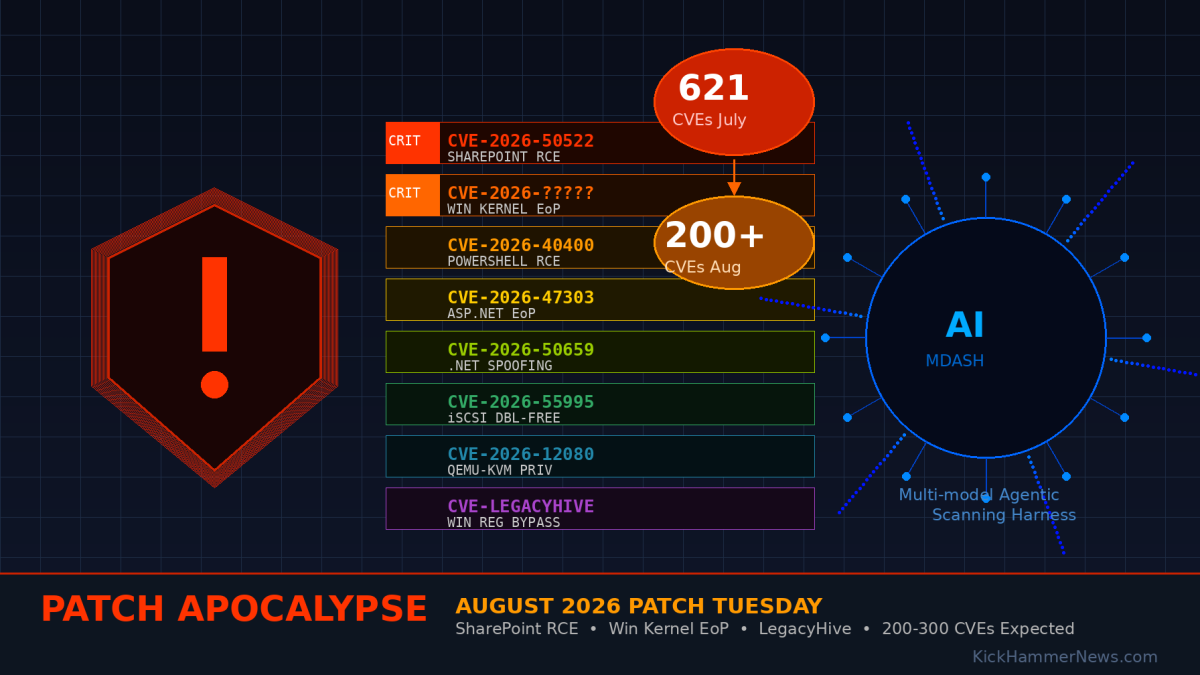
August 11, 2026 — Today marks another milestone in what security professionals are calling the “Patch Apocalypse.” Microsoft has released its August 2026 Patch Tuesday security updates, delivering a fresh wave of critical fixes just one month after July’s historic release of 621 CVEs — the largest single Patch Tuesday in the program’s twenty-three-year history. If 2026 has taught enterprise IT teams anything, it’s that the old rules of patch management no longer apply.
The Numbers Behind the New Normal
For years, IT administrators could plan their patching cycles around a predictable baseline: typically 60 to 130 vulnerabilities per month, with anything above 150 considered anomalous. That era is over.
Microsoft’s 2026 monthly CVE counts tell a clear story of escalation: January brought 112 CVEs, April jumped to 165, June crossed 200, and then July shattered all expectations with 621 patched vulnerabilities — covering nearly every product in Microsoft’s portfolio, including Windows 11, Windows Server 2025, SharePoint, Office, SQL Server, Exchange Server, and even gaming titles like Age of Empires and Minecraft Server. August is projected to deliver another 200 to 300 CVEs, representing a new, elevated baseline rather than a temporary anomaly.
The driver behind this explosion is no mystery. Microsoft’s internal vulnerability-hunting system, MDASH — the Multi-model Agentic Scanning Harness — is an AI-powered framework that deploys teams of specialized models to probe codebases for security weaknesses at a scale and speed impossible for human researchers. When AI finds vulnerabilities faster than humans ever could, the patch counts follow. Microsoft has publicly acknowledged this new reality, noting that customers should “expect this to be reflected in the size of a given Patch Tuesday.”
What’s Critical in August
While the full CVE list for August drops today, several high-priority items were identified in advance through Microsoft Security Response Center notifications and industry researchers.
SharePoint Server RCE Vulnerability Chain. Perhaps the most urgent item on this month’s agenda is a remote code execution vulnerability chain affecting Microsoft SharePoint Server 2016 and 2019. Organizations running on-premises SharePoint deployments — especially those in hybrid configurations with Microsoft 365 — should move this to the top of their patching queue. CISA flagged the risk in early July, and security teams at Ivanti have emphasized that exploitation risk spikes dramatically in the 48-72 hours after patch details are made public. The clock starts today.
This urgency is compounded by a lingering threat from last month. SharePoint CVE-2026-50522, a remote code execution vulnerability patched in July, is now being actively exploited in the wild. Attackers using this flaw can steal machine keys and maintain access even after patching — meaning organizations that delayed their July SharePoint patches may already be compromised.
Windows Kernel Privilege Escalation. A local privilege escalation vulnerability in the Windows kernel affects Windows 10, Windows 11, and Windows Server across multiple versions. While local EoP flaws require initial system access to exploit, they are frequently chained with phishing or web-based attacks: an attacker gains a foothold with user-level privileges, then leverages the kernel flaw to escalate to SYSTEM, disabling security controls and establishing persistence. Enterprise-wide patching is required, though the deployment timeline is somewhat more forgiving than the SharePoint situation.
LegacyHive: An Emerging Threat. A new vulnerability dubbed LegacyHive, discovered by researcher Nightmare Eclipse and analyzed by ACROS Security, has been making waves in the security community. The flaw allows a non-administrative user to mount another user’s registry hive with full access, potentially exposing stored secrets or enabling attackers to modify registry values that execute code at login. Microsoft has acknowledged the issue, and a fix is expected as part of this month’s release. Organizations should watch for it specifically in the Security Update Guide.
An Embargoed Unknown. Per advance notifications, at least one additional vulnerability has been kept under embargo until today’s release — a common practice for flaws where premature disclosure would enable exploitation before patches are available. The industry is watching for whether it involves the second half of a remote code execution chain that researchers have alluded to in recent weeks.
New Features Buried in the Patch
August 2026’s cumulative update does more than plug security holes. Microsoft is bundling several notable Windows 11 improvements into this month’s release, a continuation of its approach of delivering feature updates through the monthly patch cycle rather than waiting for major version releases.
The most discussed addition is the ability for Copilot+ PC users to uninstall AI models — a practical concession to reality on devices with limited storage, where multiple on-device AI models can consume tens of gigabytes. Windows Hello Enhanced Sign-in Security (ESS) gets improved biometric authentication protections. Voice Access users gain voice isolation to filter background noise, and Voice Typing receives Fluid Dictation for a more natural transcription experience. Touchpad gesture support expands, and File Explorer, Windows Search, and the Widgets panel all receive incremental improvements.
These additions are welcome, but they should not delay security deployments. The features arrive alongside the security patches in a single cumulative update — IT teams don’t get to choose one without the other.
Looming Deadlines Raise the Stakes
August’s patch cycle arrives against a backdrop of approaching end-of-support deadlines that add urgency to modernization efforts. Windows 11 Version 24H2 reaches End of Servicing on October 13, 2026 — just two months away — followed by Windows 11 Version 23H2 Enterprise and Education editions on November 10. Organizations still running on these versions will need to upgrade to Windows 11 25H2 to remain in a supported, patched state.
More immediately, Exchange Server 2016 and 2019’s Extended Security Update program ends in October 2026, with no further extensions planned. Microsoft has been explicit: ESU support will not be renewed again. Any organization still running Exchange on-premises on these versions is facing a hard deadline. The window for planning and executing migration to Exchange Online or a newer on-premises alternative is rapidly closing.
Rethinking Patch Management for the AI Era
The Patch Apocalypse demands a new approach. Traditional ring-based deployment — where all patches roll out through pilot groups to critical systems over a multi-week cycle — was designed for a world where IT teams could reasonably review every CVE before deploying. With 600-plus CVEs dropping in a single month, that model collapses.
Security experts at Ivanti, Rapid7, and independent researchers are converging on a risk-prioritized framework: identify the small subset of CVEs that are known to be exploited in the wild or that expose internet-facing systems, and deploy those patches within three days as Microsoft now recommends for high-priority vulnerabilities. The remaining patches — the vast majority in any given month — can proceed through standard testing and deployment cycles.
The math supports this approach: only three CVEs from July’s 621 were confirmed as exploited zero-days or publicly disclosed before patching. Treating every vulnerability as an emergency is both operationally impossible and strategically counterproductive.
As AI continues to surface vulnerabilities at an accelerating pace, the gap between the volume of patches and the capacity of IT teams to deploy them will only widen. The organizations that survive the Patch Apocalypse intact will be those that invest now in automation, risk-based triage, and the cultural shift away from treating patching as an all-or-nothing proposition.
Microsoft’s August 2026 Patch Tuesday is here. The question for enterprise security teams isn’t whether to patch — it’s whether they’ve built the processes to patch at machine speed.
Sources: Help Net Security, Zecurit, Ivanti, BleepingComputer, Microsoft Security Response Center


