Oracle’s August 2026 AI update is one of the company’s most substantive single-month releases, stacking a half-dozen infrastructure and developer upgrades that collectively lower the bar for building production-grade AI systems on Oracle Cloud Infrastructure. From same-day availability of NVIDIA’s newest open-source agent model to natural-language querying of enterprise databases, the announcements chart a clear direction: Oracle wants OCI to be the platform enterprises reach for when AI moves out of the pilot phase and into core operations.
Nemotron 3.5 Lightning Lands Day Zero on OCI
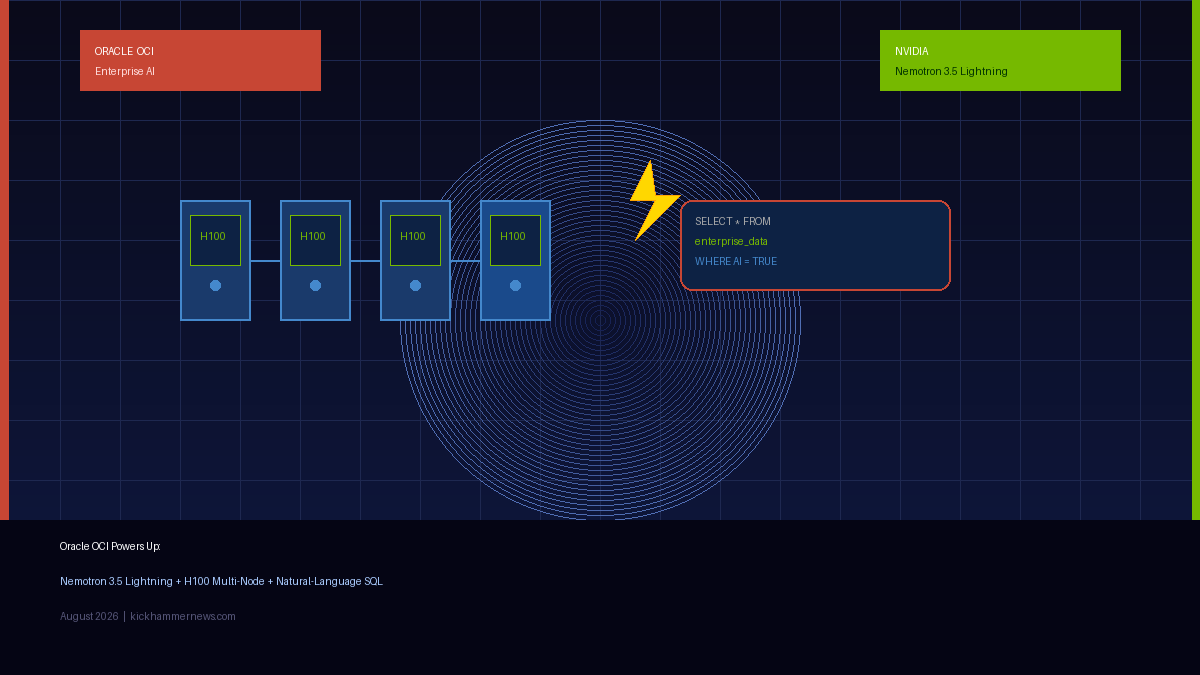
The headline feature is OCI Enterprise AI’s Day 0 support for NVIDIA Nemotron 3.5 Lightning, released August 11, 2026. That timing matters. Being among the first cloud platforms to carry a major model release — rather than weeks or months later — signals a deeper integration with NVIDIA’s roadmap, not just a reseller arrangement.
Nemotron 3.5 Lightning is a 30-billion-parameter mixture-of-experts model with only 3 billion active parameters per token, distilled from NVIDIA’s much larger Nemotron 3 Ultra. The architecture is deliberately built for the repetitive, high-volume sub-tasks that accumulate in long-running agentic workflows: tool calls, result parsing, format validation, status checks. NVIDIA claims up to 4x faster output speed and 30% faster task completion versus comparable models. For enterprises running multi-agent pipelines — where a single user request might spawn dozens of sub-agent calls — those gains compound quickly into real cost and latency savings.
The key design insight behind Nemotron 3.5 Lightning is that not every task in an agentic pipeline needs the heaviest possible model. Larger frontier models handle planning, complex reasoning, and synthesis. Nemotron 3.5 Lightning handles the execution work that follows — precisely, quickly, and cheaply. Enterprises can tune it toward a specific job, whether parsing legal contracts, monitoring security alerts, or processing ERP transactions. OCI supports model routing that automatically selects Nemotron 3.5 Lightning when its speed-accuracy profile is the best fit, without requiring developers to manually orchestrate model selection.
H100 Multi-Node Serving Unlocks Larger Models
OCI Enterprise AI has added H100 multi-node serving for imported models — meaning organizations can now deploy models that are too large to fit on a single H100 GPU node by spreading inference across multiple connected nodes. This is significant for enterprises that have fine-tuned large proprietary models or want to deploy cutting-edge open-weight models that are still too big for single-node inference.
Previously, running these workloads required either significant internal infrastructure investment or accepting the operational complexity of managing distributed serving yourself. Oracle’s implementation abstracts that complexity, handling the distributed serving layer natively within OCI. Organizations get the scale without the overhead.
This feature arrives alongside expanded on-demand model availability, which broadens the catalog of models accessible without requiring dedicated infrastructure reservations. Enterprises can now evaluate new models, spin up capacity when needed, and scale down without the commitment of reserved GPU clusters — a practical improvement for organizations still in the middle of determining which models fit which workloads.
Natural-Language SQL: Querying Enterprise Data in Plain English
One of the more immediately practical additions is natural-language access to Oracle Database data, now available through the Oracle Database Console and the OCI Enterprise AI SQL Assistant MCP Toolset. Users can write a question in everyday language — “what were the top five revenue-generating product lines in Q2?” — and the system translates it into SQL and returns results.
This is not a new concept in the industry, but Oracle’s implementation is notable for where it lives: natively inside the database console and tied directly to enterprise governance infrastructure. Business analysts who have historically depended on data engineering queues to pull reports can now get answers faster. Developers building AI-powered internal tools can use the SQL Assistant MCP Toolset to integrate natural-language database querying into agents without writing complex prompt engineering around SQL synthesis.
The underlying capability converts natural-language requests into SQL using the language models available through OCI Enterprise AI, then executes those queries against Oracle Database. For enterprises running Oracle’s ERP and financial systems — where the richest, most sensitive operational data lives — the implication is that AI agents can now query that data directly using the same identity and governance controls already in place.
IAM Authentication for AI Application Endpoints
OCI Enterprise AI’s hosted application endpoints now support OCI Identity and Access Management authentication. On the surface this sounds like plumbing, but it addresses a friction point that has slowed enterprise AI deployments: credential proliferation.
When AI applications need their own separate authentication systems, security teams face sprawl. OCI IAM integration means hosted AI applications use the same identity and policy framework already governing the rest of an organization’s OCI environment. A developer doesn’t need to set up a separate credential store; a security team doesn’t need to audit a parallel access control system; compliance reviews can treat AI applications with the same tooling used for every other cloud workload.
Background Mode for Long-Running AI Tasks
The OCI Responses API now supports Background Mode, allowing AI tasks to execute asynchronously. For workflows involving complex reasoning chains, large document processing, or multi-step agentic tasks that take minutes rather than seconds, Background Mode lets applications fire a request and handle the result via callback rather than holding an open connection.
This is a meaningful reliability improvement for production workloads. Applications no longer need to implement their own retry and timeout logic around long-running AI calls. Oracle handles the async execution, and applications can continue processing other work while waiting for results. In practice this makes OCI Enterprise AI more suitable for batch-style enterprise workflows — overnight report generation, large-scale contract review, or AI-assisted financial close processes — that don’t fit the typical interactive request-response pattern.
More Hardware Flexibility for Cohere and Meta Models
Oracle has added additional hardware unit shapes for Cohere and Meta models in OCI Enterprise AI, giving customers more visibility into the physical infrastructure underlying their AI workloads. Rather than accepting opaque “managed inference,” organizations can now choose hardware configurations that match performance requirements and cost targets with more precision. This matters in regulated industries where understanding compute infrastructure is a compliance requirement, not just an optimization preference.
Oracle AI World 2026 on the Horizon
Registration is now open for Oracle AI World 2026, Oracle’s flagship AI event. The company is positioning it as the venue for its next round of major AI announcements. Given the velocity of Oracle’s recent releases — this August update follows a July that included the Fusion Agentic Builder Pro launch and the OCI Dedicated Cloud AI announcement — Oracle AI World 2026 will likely surface the next wave of Fusion ERP AI features, new OCI infrastructure, and expanded database AI capabilities.
The Enterprise AI Infrastructure Race
Oracle’s August 2026 update reflects a strategy that has been consistent throughout the year: depth over breadth. Rather than announcing sweeping new product categories, Oracle has been systematically closing the gaps that prevent enterprises from deploying AI at scale — authentication, async execution, multi-node serving, natural-language data access, day-zero model availability.
For enterprise buyers evaluating cloud AI infrastructure, Oracle’s moves are a direct challenge to AWS and Azure. The combination of Oracle Database’s installed base, OCI’s AI infrastructure investments, and tight integration with NVIDIA’s model roadmap gives Oracle a credible path to being the platform of record for AI workloads that touch core business data. Whether that translates to share gains against entrenched competitors remains to be seen — but August 2026 makes the competitive case much harder to dismiss.