Released August 11, 2026 | Microsoft AI
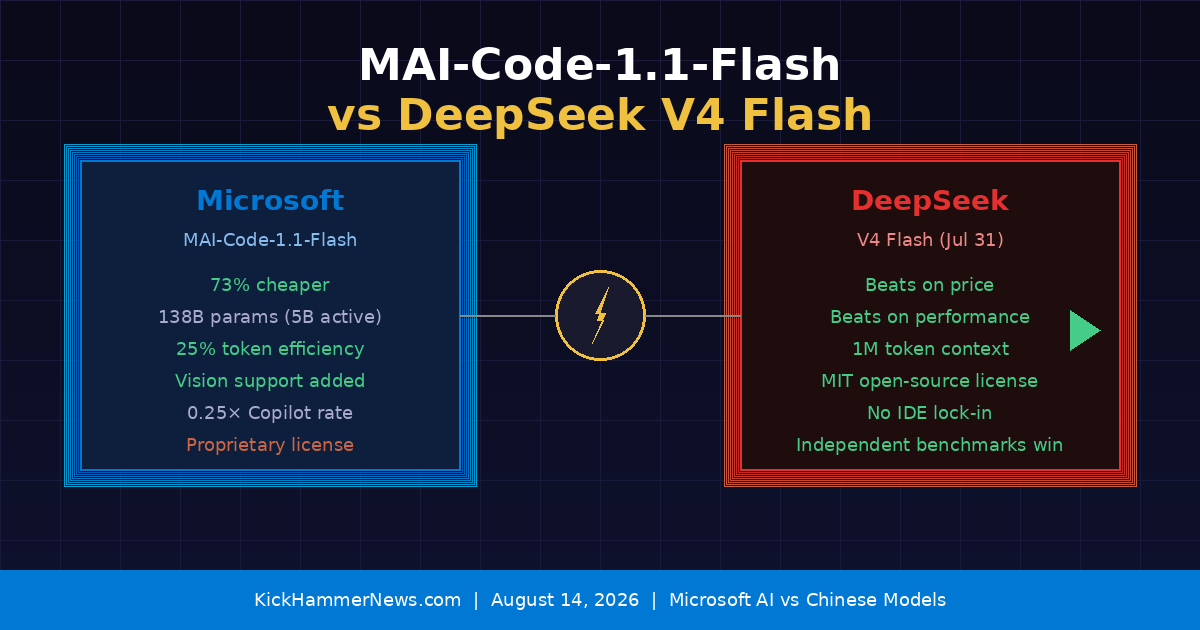
Microsoft dropped its latest coding model last week with confident messaging: MAI-Code-1.1-Flash is faster, cheaper, and smarter than what came before. The company boasts 25% greater token efficiency, a 73% price cut versus its predecessor, and a 22% improvement on Terminal-Bench 2.1 in GitHub Copilot CLI. On paper, it sounds like a win. In practice, developers who’ve run comparisons are landing on a less flattering verdict — DeepSeek’s V4 Flash beats it on both price and raw performance, and by a margin that’s hard to ignore.
The timing matters. Microsoft explicitly designed MAI-Code-1.1-Flash to “better compete with Chinese models,” per the Neowin headline. That framing makes the DeepSeek benchmarks more than a technical footnote. If the stated purpose of your new model is to close the gap with Chinese AI, and independent testing shows the gap remains wide, that’s a strategic problem as much as a product one.
What MAI-Code-1.1-Flash Actually Is
MAI-Code-1.1-Flash is a sparse mixture-of-experts (MoE) architecture with 138 billion total parameters but only around 5 billion active at any given time. That’s the efficiency play — by routing compute to a small subset of specialists rather than firing every neuron on every token, Microsoft can serve the model at a dramatically lower cost. It’s the same architectural logic behind Google’s Gemini Mixture-of-Experts approach and is increasingly standard for models designed to run cheap and fast.
The new version adds native vision support, a meaningful upgrade from MAI-Code-1-Flash’s text-only capability. Developers can now pass screenshots, UI mockups, or error logs directly to the model and receive contextual code responses. That opens up workflows that were previously awkward — generating components from design specs, debugging visual layout issues, or interpreting CI/CD dashboard screenshots without manually transcribing them.
Performance gains are real, if modest. On .NET tasks specifically, MAI-Code-1.1-Flash shows a 15% improvement over its predecessor. Code survival rate — meaning code generated by the model that makes it past review without being thrown out — climbed 4%. Return visits, a proxy for developer trust in the model’s output, rose 9% in production environments.
The GitHub Copilot Integration
The model is now live across the entire GitHub Copilot product tier. Free and Student users get it via auto model selection. Pro, Pro+, Max, Business, and Enterprise subscribers can manually select it alongside other available models. It works inside VS Code, Visual Studio, all major JetBrains IDEs, Eclipse, Xcode, GitHub Mobile, and Copilot CLI — essentially anywhere Copilot currently operates.
For subscribers on annual Copilot plans, MAI-Code-1.1-Flash is billed at a 0.25× premium request multiplier. That makes it the cheapest consciously-selected model in the Copilot portfolio, and for tasks like code completion, lightweight refactoring, or test generation, the tradeoff of slightly lower capability for dramatically lower cost may be entirely rational. Not every task needs frontier model power.
Microsoft also announced that MAI-Code-1-Flash will be retired across all Copilot experiences on September 10, 2026 — about a month out. Developers relying on that model have time to evaluate the upgrade, but the clock is running.
The DeepSeek Problem
Here is where the comfortable narrative frays. According to analysis from The Decoder and benchmarks aggregated at LLM Stats, DeepSeek V4 Flash — released July 31, just eleven days before MAI-Code-1.1-Flash — beats Microsoft’s model at comparable price points on general coding tasks. DeepSeek V4 Flash also specifies a 1,048,576-token input context window, dwarfing MAI-Code-1.1-Flash’s published specs. The context advantage alone matters for enterprise codebases where pulling in relevant files, documentation, and historical commits can push any reasonable coding session well past standard context limits.
DeepSeek V4 Flash is MIT-licensed. MAI-Code-1.1-Flash is proprietary. That licensing difference has downstream implications for developers who want to integrate AI coding capabilities into their own tooling — DeepSeek’s open license invites experimentation and deployment in environments where proprietary APIs create compliance or cost friction.
None of this makes MAI-Code-1.1-Flash a bad model. Within the GitHub Copilot experience specifically, the deep IDE integration, the trust infrastructure Microsoft has built around it, and the native embedding in enterprise developer workflows give it durable advantages that raw benchmark comparisons don’t capture. Developers who are already Copilot subscribers aren’t comparison shopping on a leaderboard — they’re evaluating what actually works in their daily flow.
The Broader AI Coding War
The MAI-Code-1.1-Flash launch is happening in the context of an increasingly crowded AI coding market. OpenAI’s o3 and o4-mini target complex reasoning. Anthropic’s Claude Sonnet models compete hard at the capability end. Google’s Gemini Flash is aggressive on price. DeepSeek’s open-source and low-cost offerings continue to eat at the margins of proprietary models. And Microsoft, despite owning GitHub Copilot’s enormous installed base, has to keep its model tier competitive to prevent subscribers from routing to third-party models through the Copilot model picker — which Microsoft itself built.
The MAI model line started as a flex play: Microsoft demonstrating it could build world-class AI without exclusive reliance on OpenAI. MAI-Thinking-1 debuted at Build 2026 as a reasoning model. MAI-Code-1-Flash followed in June as an efficiency-focused coding specialist. MAI-Code-1.1-Flash is an iterative upgrade that arrived faster than the typical development cycle — a signal that Microsoft is moving urgently to close gaps competitors are widening.
What Developers Should Do Now
If you’re a GitHub Copilot subscriber, MAI-Code-1.1-Flash is worth evaluating against your actual workflows. The vision support is new and genuinely useful. For heavy-context enterprise codebase work, you may hit ceiling faster than with frontier models, but for the day-to-day tasks that make up the bulk of coding assistance — completions, test writing, documentation — the cost profile is hard to argue with at 0.25× multiplier.
MAI-Code-1-Flash goes dark September 10. That gives developers less than a month to decide whether 1.1-Flash covers their needs or whether they want to make MAI-Thinking-1 or a third-party model their new default inside Copilot.
Microsoft is building faster than before. The question the DeepSeek comparison raises is whether fast enough is the right standard when the competition isn’t slowing down either.


