August 16, 2026 — The Linux kernel 7.2 stable release landed today, right on schedule. What should have been a routine milestone for the world’s most important open-source project turned into something more significant: a living demonstration that artificial intelligence has permanently altered how the Linux kernel is developed — and Linus Torvalds himself confirmed it.
The Largest Late-Cycle Release in Years
Torvalds has published weekly state-of-the-kernel messages for decades, but the ones leading up to 7.2 had an unusual tone. On August 2, announcing the sixth release candidate, he opened with a blunt assessment: “This rc is huge.” He went further: “Even by the ‘new normal’ standards this is a big rc, and I think it’s the biggest rc6 we’ve had in years at least by commit count.”
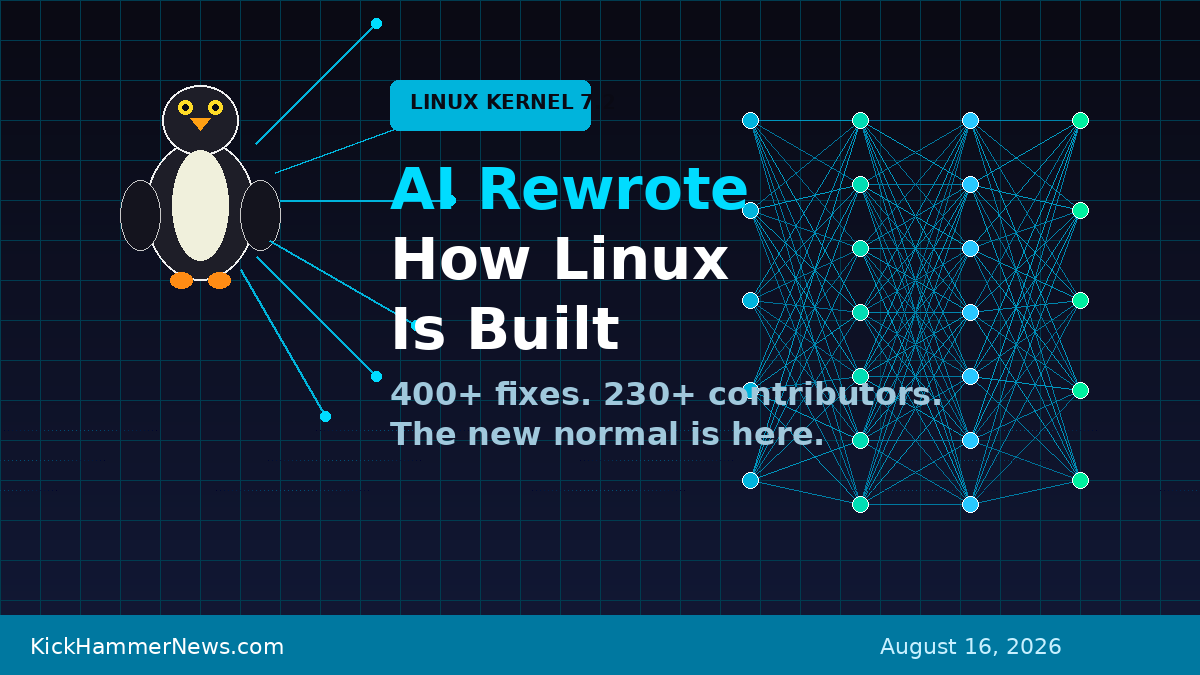
Then came RC7 a week later, carrying more than 400 fixes signed by over 230 contributors — a volume that would have been unthinkable for a late-cycle candidate in previous kernel generations. Torvalds was candid about why. “I can’t say that I’m exactly thrilled about the size of this all,” he wrote in the rc7 announcement. “But it is what it is: the new normal with a lot of fixes, many of them due to review by various AI tools.”
That single sentence encapsulates a structural shift years in the making. AI tools are now scanning Linux kernel code continuously, surfacing bugs that human reviewers missed or quietly deprioritized for years. The result is that each release cycle is flushing out a backlog of accumulated technical debt at a pace that was previously impossible.
Review, Not Authorship
It is worth being precise about what AI is doing here. Torvalds is not describing AI that writes kernel code. The contributors are still humans — they read the AI-flagged findings, validate them, write the patches, and submit them through the standard review process. What AI has changed is the discovery phase: machine tools can read millions of lines of kernel source in the time it takes a human reviewer to examine a single subsystem, and they do not get tired, do not deprioritize obscure driver code, and do not forget about a subtle race condition they noticed six months ago.
The consequence is a flood of legitimate, human-authored fixes that the kernel’s tooling previously had no mechanism to surface at scale. Torvalds noted that rc7’s fixes are “pretty much spread all over — drivers (gpu, sound, networking, you name it), filesystems, core networking, arch code.” Nothing catastrophic; just a long tail of small corrections that would historically have waited cycles — or never been caught.
Torvalds has had a complicated public relationship with AI. He has railed against AI-generated documentation that papers over poor underlying code. He complained earlier this year that the Linux kernel security mailing list had become “almost entirely unmanageable” due to a flood of duplicate AI-generated bug reports. He has also declared, memorably, “Linux is not one of those anti-AI projects” — drawing a line between AI he sees as useful and AI he sees as noise. The 7.2 development cycle suggests the kernel community has begun to find where that line actually is.
What Is Actually New in 7.2
Despite the headline domination of AI review, Linux 7.2 delivers a meaningful set of technical improvements.
The most significant scheduler change introduces cache-aware task placement. The kernel can now co-locate tasks that share data within the same Last Level Cache domain, reducing cache misses for workloads that spawn communicating threads or processes. On modern CPUs with large LLC caches and heterogeneous core topologies — the architecture that dominates both data centers and high-end laptops — this can translate into real throughput gains for multi-process workloads without any application changes.
On the GPU side, the AMDGPU driver gains initial HDMI 2.1 FRL (Fixed Rate Link) support, enabling the higher bandwidth modes that 4K 120Hz and 8K display connections require. The Intel Xe driver adds initial CRI (Common Runtime Infrastructure) platform support. Neither of these is a flashy consumer feature, but both clear the path for distribution-level support of modern display hardware in the 7.2-based releases coming this autumn.
Security hardening received sustained attention. The Speculative Return Stack Overflow (SRSO) mitigation on x86 was strengthened significantly. SELinux underwent a policy validation overhaul. Open vSwitch, IPSet, and the VMware graphics driver vmwgfx all received extensive bounds-checking improvements — the sort of unglamorous work that prevents entire categories of memory corruption vulnerabilities.
The kernel also continued its long-running cleanup of aging APIs. Linux 7.2 completes the elimination of the long-deprecated strncpy() from the kernel’s own codebase, removes architecture-specific optimized MD5 implementations in favor of a unified crypto path, and begins the deprecation of AF_ALG — the userspace crypto socket interface. The minimum supported LLVM/Clang version was raised, which matters for distributions and embedded vendors that build with Clang rather than GCC.
Who Gets It First
Linux 7.2 is not a long-term support release. It is a standard kernel release on the mainline cadence, which means distributions pick it up on their own schedules. Fedora 45 and Ubuntu 26.10, both expected this autumn, will ship with 7.2 as their base kernel. Embedded BSP maintainers have had access to the release candidates for weeks; the stable tag today gives them a fixed target to ship against.
Oracle had already positioned itself ahead of the curve. VirtualBox 7.2.14, released in July, added initial Linux 7.2 kernel support on Linux hosts and improved compatibility with RHEL 9.8 and 9.9 kernels for Linux guests. For organizations running mixed virtualization environments, VirtualBox is now ready to run on 7.2 hosts from day one.
Canonical’s Ubuntu ecosystem is another key downstream. With Ubuntu 26.10 scheduled to carry 7.2, the cache-aware scheduler improvements and the AMDGPU display changes will land in front of millions of desktop and server users without any manual kernel update required.
The Broader Implication
The 7.2 cycle raises a question that the open-source world has not fully reckoned with: when AI tools dramatically accelerate bug discovery, who sets the pace of remediation? The Linux kernel community has managed the answer pragmatically — accept the fixes, ship a bigger release, and call it the new normal. But the same dynamic applies to any large codebase under continuous AI scrutiny.
For enterprise users of Linux, the immediate effect is positive. More bugs caught earlier means more stable releases. For kernel maintainers, the challenge is absorbing a higher volume of incoming fixes without compromising the review quality that keeps the kernel trustworthy. Torvalds acknowledged the tension plainly: he is not thrilled, but he is shipping.
The 7.2 kernel is available now at kernel.org. Distribution packages will follow on each project’s own schedule. For anyone running Linux in production, there is no emergency — this is a clean release on a standard cadence. But it arrives as a marker: the Linux kernel’s development process has changed, and the code coming out the other side is better for it.
Sources: The Register (Simon Sharwood, August 10, 2026); TechVeda (Raghu Bharadwaj, August 4, 2026); Linux kernel mailing list rc7 announcement (Linus Torvalds, August 9, 2026); 9to5Linux; OSTechNix; UbuntuHandbook.