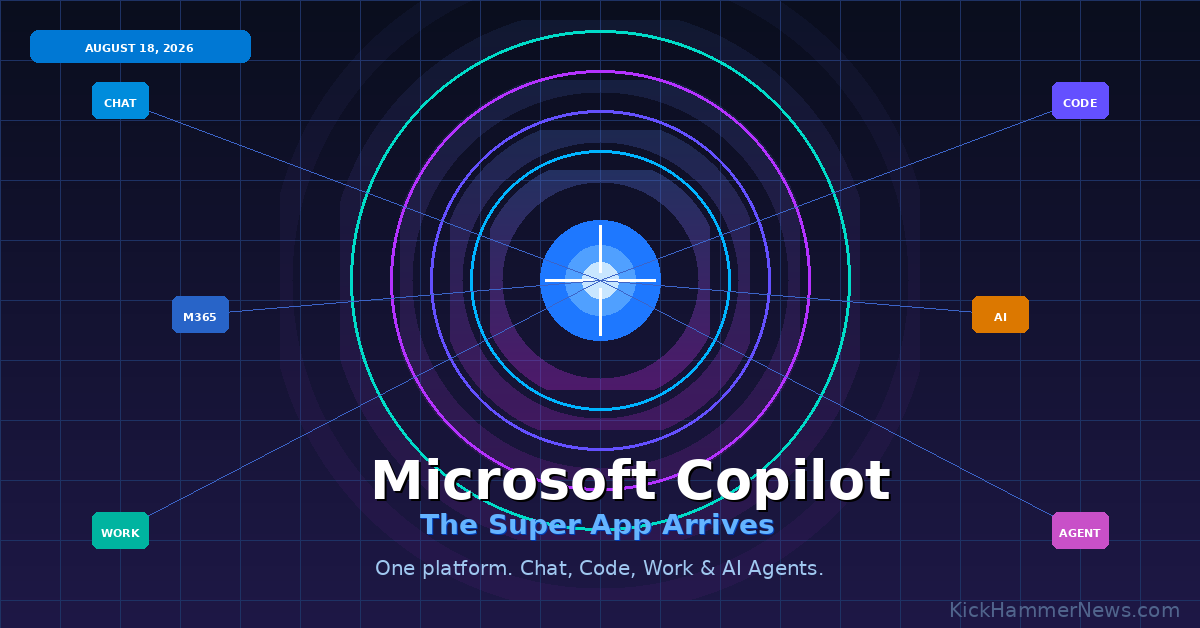
August 18, 2026 — If you open the Microsoft Copilot app on your phone or browser today, things may look a little different. That’s not a glitch. It’s the beginning of one of Microsoft’s most consequential software consolidations in years: the merger of its consumer Copilot app and Microsoft 365 Copilot into a single, unified AI platform — and the first stage of an even bigger “super app” the company has promised to ship before October.
Two Apps Become One
For most of the past two years, Microsoft maintained two parallel Copilot experiences. There was the consumer-facing Copilot app — a generative AI chatbot built on GPT-4 and later models, aimed at everyday users who wanted help with writing, image generation, or quick research. And there was Microsoft 365 Copilot, the enterprise-grade assistant woven into Outlook, Word, Excel, Teams, and the rest of the Microsoft 365 suite, priced at a steep $30 per user per month.
The distinction made some sense at launch, when Microsoft needed to keep corporate data tightly siloed from personal usage. But over time, the two-app strategy created as much confusion as it solved. Users who toggled between personal projects and work tasks had to manage two identities, two interfaces, and two feature sets. Developers building Copilot extensions had to account for both surfaces. And Microsoft, competing against OpenAI’s ChatGPT and Google’s Gemini in a market that rewards simplicity, increasingly couldn’t afford the fragmentation.
Starting today, that fragmentation ends — at least structurally. Microsoft has begun rolling out a unified Copilot experience across mobile and web, with Windows and macOS apps following in mid-September.
What’s Actually Changing
For most Microsoft 365 Copilot users — the enterprise crowd — the visible changes are minimal. The app gets a slightly updated icon and drops the “Microsoft 365” prefix from its name. Everything else, including the security model, tenant controls, and compliance protections, stays exactly the same.
For consumer users, the change is more substantial. The updated app will expose access to Microsoft 365 tools — Word, Excel, Outlook — directly within Copilot, even for users on personal Microsoft accounts. Calendars, email, and cloud storage can be connected. The interface will now show distinct visual cues indicating whether you’re operating in a personal (Microsoft account) or work (Microsoft Entra ID) context, including different background colors and a “Work” label in the navigation pane.
Critically, Microsoft is emphatic that work and personal data remain fully separated. “Personal (Microsoft account) and work (Microsoft Entra) accounts are distinct by design,” the company said. “Data entered into the work experience does not flow into the personal experience, and vice versa.”
What’s Getting Cut
Not everything is making the journey forward. Microsoft is retiring three features as part of the unification:
Group Chat goes dark today. All group chat threads, messages, and user-created images will not carry forward after August 18. Microsoft has advised users to manually download anything they want to keep before the cutoff.
Podcasts, the AI-generated audio summary feature, is also being retired entirely. Users can still download individual podcast files they’ve previously generated, but the creation tool will no longer be available.
Deep Research — one of the most powerful features in the consumer Copilot lineup, capable of multi-step web research and synthesized long-form reports — is being retired for free consumer users starting today. This one stings. Microsoft 365 premium subscribers retain access to a similar capability through a feature called Researcher, but the free tier is losing a genuinely useful tool. It’s a move that reads less like housecleaning and more like a monetization nudge: if you want deep research, get a subscription.
The Bigger Picture: Copilot as Super App
The unification rolling out today is the foundation, not the finish line. Microsoft CEO Satya Nadella confirmed on the company’s July 29 earnings call that a Copilot “super app” would ship before the end of September. The ambition is substantial: a single application that integrates chat, GitHub Copilot coding assistance, the Copilot Cowork tool (for file and task automation), and a new agentic layer internally called Autopilot.
Autopilot is the piece that could genuinely change how users think about the app. Unlike Copilot’s current chat model — where you ask a question and get an answer — Autopilot agents are designed to complete longer, multi-step workflows with limited human intervention. The framing is less “AI assistant” and more “AI colleague”: something that can be handed a project and trusted to execute it across multiple apps and data sources over an extended period.
Microsoft is clearly betting that collapsing GitHub Copilot, Cowork, and agentic automation into a single surface will make the product harder to ignore for enterprise buyers who have so far hesitated. Only 3.3% of Microsoft 365 customers were paying for the add-on Copilot tier when Microsoft last disclosed granular figures, though the company says paid seats have grown dramatically — from 15 million earlier this year to 30 million as of July 2026. That’s meaningful growth, but it still leaves an enormous population of Microsoft 365 users who haven’t converted.
Bundling everything into one app is partly a product simplification play and partly a sales tactic: when Copilot is the only app you need for AI work, it’s easier to justify the subscription than when it’s one of several overlapping tools.
The URL Nobody Asked About
In a detail that will matter more to IT administrators than end users, Microsoft is also migrating the Copilot web app from m365.cloud.microsoft to copilot.cloud.microsoft. The redirect begins rolling out in late August, with deferred rollout for enterprise tenants in late September. Firewall rules, conditional access policies, and bookmarks pointing to the old domain will need updating — a quiet headache that will surface in IT helpdesk tickets over the coming weeks.
What Users Should Do Right Now
If you use Group Chats in Copilot, download your content today — it won’t be available after this point. If you relied on the free Deep Research feature, start evaluating alternatives: Microsoft’s own Researcher (paid), or third-party tools like Perplexity or OpenAI’s ChatGPT Pro deep research mode.
For enterprise IT teams, the immediate priority is auditing any bookmark, automation, or conditional access policy that references m365.cloud.microsoft before the URL redirect goes live.
For everyone else, the changes are largely invisible today — a cleaned-up interface, a unified account switcher, and the quiet disappearance of features that, based on Microsoft’s decision to cut them, apparently weren’t being used enough to justify the maintenance cost.
The Competitive Subtext
Microsoft’s rush to consolidate Copilot isn’t happening in a vacuum. OpenAI’s ChatGPT — now approaching 600 million weekly active users — has steadily expanded its own capabilities, adding deep research, a coding interpreter, voice mode, and an agent framework. Google’s Gemini has embedded itself across Google Workspace. Both competitors offer simpler stories than Microsoft’s historically fragmented Copilot portfolio.
The super app push is Microsoft’s answer: stop competing on individual features and win on integration. If you’re already in the Microsoft ecosystem — using Outlook for email, Teams for collaboration, GitHub for code — a Copilot super app that connects all of those surfaces is a compelling proposition. The question is whether September’s full rollout delivers on that promise, or whether the app feels like a collection of features stapled together under a single logo.
Today’s unification is step one. The harder work starts in September.
Article published August 18, 2026. Sources: Windows Central, Computerworld, Microsoft Support documentation.