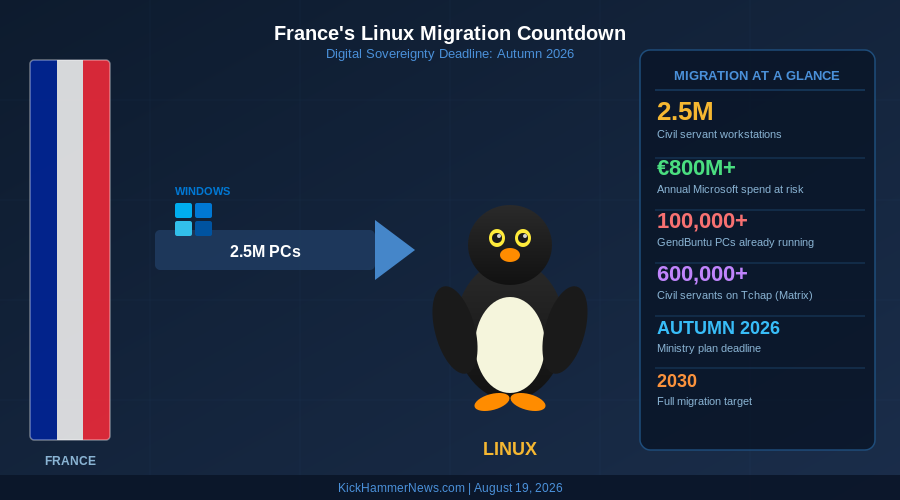
When France’s Interministerial Directorate for Digital Affairs (DINUM) issued its landmark digital sovereignty directive on April 8, 2026, it set the entire European technology industry on edge. Every French government ministry and public operator was ordered to submit detailed migration plans — covering operating systems, cloud infrastructure, AI platforms, and collaboration tools — by autumn 2026. That deadline is now weeks away, and the stakes could not be higher: 2.5 million civil servant workstations, currently running Microsoft Windows, are targeted for migration to Linux.
Four months in, France’s audacious bet on open-source sovereignty is moving from political declaration to operational reality — and the world is watching.
The Directive That Shook European Tech
The April DINUM directive was not France’s opening move in the digital sovereignty chess match; it was the capstone. The French government had spent years quietly assembling the pieces. In January 2026, a binding mandate ordered all 2.5 million civil servants off Microsoft Teams, Zoom, Webex, and GoTo Meeting by 2027, replacing them with Visio — a domestically built platform running on open-source Jitsi infrastructure. Before that, DINUM rolled out Tchap, an end-to-end encrypted messaging app built on the open-source Matrix protocol, now used by more than 600,000 civil servants. The messaging app, productivity tools, and file-sharing stack together constitute “La Suite Numérique” — France’s growing sovereign software ecosystem.
What April 2026 added was the directive’s most consequential element: Linux. Every ministry must now file a formal roadmap to replace Windows across all government desktops and laptops, with no opt-outs permitted. The scope is staggering — and deliberate.
“We must become less reliant on American tools and regain control of our digital destiny,” said David Amiel, France’s Minister of Public Action and Accounts. “We can no longer accept a situation in which our data, our infrastructure, and our strategic decisions depend on solutions whose rules, pricing, evolution, and risks we do not control.”
Why Autumn 2026 Is a Pivotal Moment
The autumn 2026 deadline is not the finish line — it is the starting gun for the migration itself. When ministries submit their plans in the coming weeks, DINUM will have, for the first time, a complete picture of the scale, complexity, and timeline of what it has ordered. Those plans will reveal how deeply Microsoft’s technology stack has embedded itself into French government operations over the past three decades — from desktop operating systems to database backends, from Azure-hosted AI services to Microsoft 365 workflows.
What happens next will define whether this initiative becomes Europe’s most significant government technology transformation in history, or its most instructive failure.
DINUM has structured the directive around four core sovereignty axes: operating systems, collaboration tools, cloud infrastructure, and artificial intelligence. Each ministry must address dependencies across all four domains, as well as supplementary areas including antivirus software, databases, virtualization platforms, and network equipment. The breadth of scope is unprecedented — previous European government open-source mandates typically targeted a single product category. France has drawn the map all at once.
A Proof of Concept Already in Operation
One reason French officials are cautiously optimistic is that they are not starting from zero. GendBuntu — a hardened Ubuntu derivative maintained by the Gendarmerie Nationale, France’s national police force — has been running on more than 100,000 police workstations for over fifteen years. The Gendarmerie has reported reduced licensing costs, faster security patch cycles, and tighter control over sensitive operational data. More importantly, it has produced something invaluable: a battle-tested Linux deployment model at scale, complete with documented procurement processes, training playbooks, and a pool of Linux-certified administrators.
DINUM is widely expected to draw heavily on the GendBuntu model for the broader civil service rollout. Several French officials have floated GendBuntu — or a closely aligned distribution — as the candidate platform. If adopted, it would give the migration a proven technical foundation that no comparable European government effort has ever enjoyed.
The DINUM headquarters itself serves as another proof of concept. Since April, the agency’s 250-person staff has been migrating its own workstations from Windows to Linux, turning the directorate into a living laboratory for the challenges and solutions that lie ahead.
The Scale of What Microsoft Stands to Lose
For Microsoft, France’s migration represents a direct threat to a revenue stream it has long treated as structurally secure. Industry analysts estimate that government-wide Microsoft 365 and Windows licensing for 2.5 million users costs the French government between €500 million and €800 million annually, including enterprise agreements, cloud services, and associated support contracts.
That figure does not include database licensing (Microsoft SQL Server), Azure cloud services, Microsoft Teams, or the dozens of other Microsoft products embedded across government infrastructure. The total annual expenditure on Microsoft technology across the French public sector likely exceeds €1 billion.
The financial exposure extends well beyond France. If the migration succeeds and other EU member states follow — and they are watching very closely — Microsoft’s European government business could face cumulative revenue impacts measured in billions annually. Germany’s Schleswig-Holstein state has already committed to migrating 30,000 government PCs to Linux. The Netherlands, Spain, and several Scandinavian countries have active open-source government initiatives that a successful French migration would accelerate.
Microsoft has not publicly responded to the French initiative. The company’s traditional response to large-scale migration threats — competitive pricing, local data center investments, sovereignty-aligned cloud offerings — may prove less effective when the motivation driving the migration is political and strategic rather than financial.
The Munich Lesson: Why France Could Succeed This Time
No discussion of government Linux migration is complete without reckoning with Munich. The German city spent over a decade migrating 15,000 municipal workstations to LiMux, a custom Ubuntu derivative, before reversing course in 2017 amid user complaints and political pressure — pressure that intensified after Microsoft relocated its German headquarters to Munich in 2016.
France’s approach differs in several critical respects. First, the mandate comes from the national government, not a single city council, making it far harder to reverse through local political maneuvering. Second, the migration spans all ministries simultaneously, eliminating the internal compatibility friction that plagued Munich when some departments ran Linux while their partners remained on Windows. Third, and most importantly, the geopolitical context of 2026 bears no resemblance to 2003.
France’s migration is not primarily about saving money. It is about national security and strategic independence. The US CLOUD Act — which permits American authorities to compel US-based companies to hand over data stored anywhere in the world, including data stored on European servers — has been a persistent concern for French officials. The Liberation Day tariffs of April 2025, which disrupted transatlantic technology supply chains, sharpened those concerns considerably. When digital sovereignty becomes a matter of national security policy rather than municipal cost optimization, the political will to sustain a difficult migration through its inevitable rough patches is fundamentally stronger.
As Italo Vignoli, a founding member of The Document Foundation, put it: “Munich’s mistake was treating the migration as a technology project. France is treating it as a sovereignty project.”
The Training Mountain
The hardest challenge France faces is not technical. It is human. Training 2.5 million civil servants — ranging from young urban professionals already comfortable with multiple platforms to long-tenured administrators who have run Windows since Windows XP — to work effectively on Linux is an undertaking without precedent in democratic governance.
Modern Linux desktop environments, particularly GNOME and KDE Plasma, have matured dramatically. Today’s Linux desktops are significantly more user-friendly than the interfaces Munich’s employees struggled with in the mid-2000s. LibreOffice has achieved near-complete compatibility with Microsoft Office file formats. And critically, La Suite Numérique — the productivity stack hundreds of thousands of civil servants are already using — runs identically on Linux and Windows. For many users, the operating system transition will be largely invisible.
The French government is also pursuing a web-first strategy that reduces dependence on the desktop OS entirely. Where workflows have already moved to browser-based applications — and in the French public sector, many have — users will notice little operational difference between a Windows browser and a Linux browser.
ANSSI, France’s National Cybersecurity Agency, is overseeing the security certification of the chosen Linux distribution, ensuring the migration does not introduce new vulnerabilities while closing the ones Microsoft’s ecosystem has accumulated. The agency’s active involvement transforms what might otherwise be an IT procurement exercise into a national security program.
Who Benefits Beyond France
The European open-source ecosystem stands to gain enormously if France’s migration succeeds. Canonical, the UK company behind Ubuntu, is widely regarded as a leading support candidate for the civil service rollout. SUSE, the German enterprise Linux company, is another strong contender. French companies — BlueMind for email and collaboration, Nexedi for ERP and cloud, Scaleway for infrastructure — are positioned to absorb software spending that currently flows to American vendors.
The migration also validates decades of advocacy from the open-source community. The argument that open-source software offers genuine strategic advantages over proprietary alternatives has moved from the margins of technology policy to the center of national security discourse in one of the world’s largest economies.
If France reaches autumn 2026 with credible ministry migration plans in hand, the story shifts from political announcement to operational program. That transition — from rhetoric to roadmap — may prove to be the most consequential development in European enterprise software since the European Commission’s landmark antitrust rulings against Microsoft in the 2000s.
What to Watch This Autumn
The submission of ministry migration plans in the coming weeks will reveal several things that are currently unknown: how many desktops each ministry runs, what legacy Windows-only applications will require replacement or emulation, how each ministry proposes to sequence its migration, and which Linux distribution or distributions will be nominated for government-wide adoption.
Observers should also watch for Microsoft’s response. The company’s European government division will not surrender this market without a fight. Expect announcements about European-specific cloud offerings, data residency guarantees, and potentially aggressive pricing concessions designed to erode the sovereignty argument.
And watch the rest of Europe. If France’s plans are credible and technically sound, the political pressure on other EU member states to follow will intensify rapidly. Digital sovereignty has become the defining technology policy issue of this decade. France’s Linux migration is its most concrete expression yet.
The countdown to Europe’s most ambitious government open-source deployment is now measured in weeks. The autumn 2026 deadline will tell us whether France’s declaration of digital independence has a real plan behind it — or whether the gap between political ambition and operational reality is wider than it appeared in April.
Sources: DINUM directive (April 8, 2026), TechRadar, Tech-Insider.org, TechCrunch, The Register, The Next Web, StatCounter, Linux Foundation