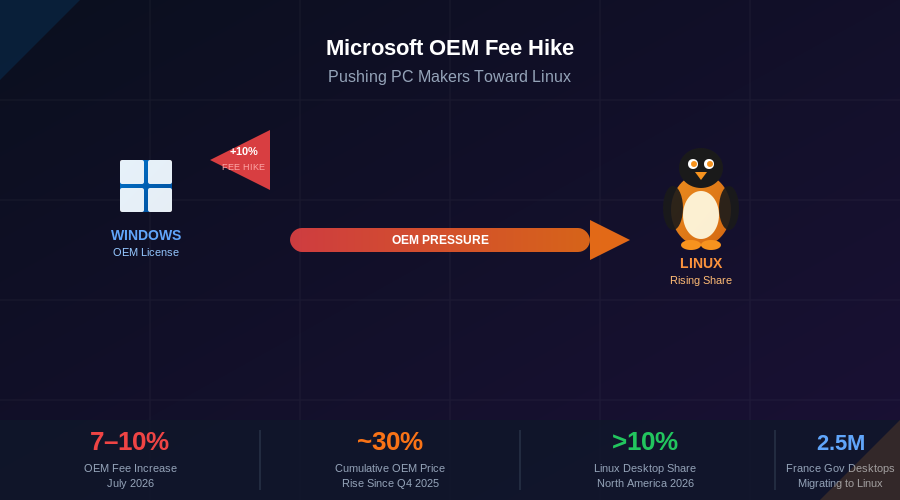
The PC industry is bracing for another round of price increases, and this time the culprit isn’t just memory chips or tariffs — it’s Microsoft itself. Leaked documents and reports from Taiwanese supply chain sources confirm that Microsoft quietly raised its OEM Windows license fees by 7% to 10% starting in July 2026, a move that has sent shockwaves through a hardware market already strained by soaring RAM costs and lingering component shortages.
For OEMs, the timing is brutal. Asus and Acer have already signaled cumulative retail price increases of up to 30% since late 2025. Adding a Windows license surcharge on top of hardware cost inflation isn’t just an inconvenience — it’s a structural threat to the affordable PC market. And for the first time in a long time, Linux is being discussed in OEM boardrooms not as a contingency plan, but as a genuine commercial strategy.
Why This Hike Is Different
Microsoft has raised OEM licensing fees before, but typically by low single-digit percentages that disappear quietly into margin calculations. A 7–10% increase — applied specifically to manufacturers preinstalling Windows on complete systems, and scaled by processor tier so premium machines take proportionally larger hits — is a departure. It’s the kind of number that shows up in quarterly earnings calls and forces procurement decisions.
According to reports in Taiwan’s United Daily News and corroborated by analysis from TechPowerUp and VideoCardz, the fee hike applies to the full spectrum of Windows 11 SKUs bundled with OEM devices. Retail license buyers are unaffected, which means the burden falls almost entirely on the companies assembling the laptops, desktops, and handheld gaming PCs that end up on store shelves.
Asus has already signaled a roughly 5% retail price increase in coming months as a direct response. The company’s total cumulative price increase since Q4 2025 is approaching 30% — a figure that fundamentally changes the calculus for budget-conscious buyers.
The Handheld Gaming Angle
Nowhere is the pressure more acutely felt than in the handheld PC gaming market, a category that barely existed five years ago but now represents one of the fastest-growing segments in consumer electronics. Devices like Asus’s ROG Ally and Lenovo’s Legion Go series already operate on thin margins because buyers comparison-shop aggressively against competitors. Adding $15–25 to the Windows licensing cost per unit in a market where $50 separates product tiers is a serious problem.
This is partly why the Steam gaming platform’s Linux support is suddenly relevant again. Valve’s SteamOS — the Linux-based operating system powering the Steam Deck — has matured considerably. Proton compatibility now covers the vast majority of the Steam library, and recent data shows Linux accounting for over 5% of active Steam clients. Some estimates suggest Linux’s share of gaming-focused computing, when handheld devices are included, is even higher.
Several smaller handheld OEMs are already exploring SteamOS licensing or custom Arch-based distributions as Windows alternatives. A 10% reduction in per-unit licensing cost, for a segment that ships in the hundreds of thousands of units per quarter, represents a meaningful margin improvement — or an opportunity to undercut Windows-based competitors on price.
Enterprise Inertia vs. OEM Economics
The conventional wisdom has long been that enterprise software lock-in — Microsoft 365, Teams, Active Directory, Azure integrations — makes Windows practically mandatory for business PCs. That argument remains largely intact for corporate procurement. But the OEM fee hike is less an enterprise story than a consumer and SMB one.
In the consumer market, where cloud-based applications increasingly run entirely in the browser, the operating system underneath matters less than it did in 2015. A user who spends their day in Chrome, with Google Docs, YouTube, and web-based productivity tools, doesn’t fundamentally require Windows. The calculus changes when a Windows laptop costs $75–100 more than a functionally equivalent Linux device.
Several European governments have been moving in this direction for years. France announced earlier in 2026 a binding plan to migrate 2.5 million government desktops to Linux by autumn, joining Germany, the Netherlands, Denmark, and Austria in government-sector migrations. These efforts were primarily motivated by digital sovereignty concerns, but the economic argument has suddenly become louder.
What OEMs Are Actually Doing
No major Tier 1 OEM has publicly announced a Linux-first strategy in response to the fee hike. That would be a significant commercial gamble — Windows brand recognition remains a powerful consumer signal, and enterprise buyers in particular are conservative. But behind the scenes, there is more Linux experimentation than at any point since the netbook era.
Canonical, the company behind Ubuntu, confirmed in July 2026 that enterprise Ubuntu Pro licensing conversations with multiple large OEM partners had accelerated in the past quarter. Lenovo, which already offers Ubuntu pre-installed on select ThinkPad lines, has expanded the option to more SKUs. Dell’s XPS developer edition and other Linux-certified configurations have quietly seen increased availability.
The OEM movement is happening at the edges first: budget devices, developer machines, handheld gaming hardware, and government contract bids. These are the segments where price sensitivity is highest and Windows lock-in is weakest. Whether the trend migrates to mainstream consumer laptops depends largely on how far Microsoft pushes the licensing lever, and whether OEMs find that Linux machines sell.
Microsoft’s Calculated Bet
From Microsoft’s perspective, the OEM fee increase is defensible. The company’s revenues increasingly derive from Azure cloud services, Microsoft 365 subscriptions, and AI tooling — not Windows OEM licenses. Raising the Windows license fee is almost a low-stakes move for a company whose enterprise customers are already paying monthly per-seat fees for Copilot and 365.
The risk Microsoft is accepting is the consumer-facing one: if price-sensitive buyers start choosing Linux devices and finding them adequate, the habit of reaching for a Windows machine starts to erode. Microsoft’s Copilot AI features — deeply integrated into Windows 11 and positioned as a differentiator — are designed to justify the price premium. But Copilot’s consumer appeal remains uneven, and open-source AI assistants running locally on Linux are rapidly closing the gap.
Microsoft’s Azure revenue hit $100 billion in Q4 FY2026, a milestone that underscores where the company’s center of gravity has shifted. In that context, Windows OEM licensing is almost a rounding error. But it is a rounding error that is now, for the first time in years, generating real momentum for Linux adoption at the hardware level.
The Bottom Line
The 7–10% OEM Windows license fee increase won’t immediately reshape the PC market. But it has arrived at a moment when nearly every other pressure — memory costs, tariffs, component shortages, and growing government-sector Linux mandates — is pointing in the same direction. For OEMs operating at thin margins, every dollar saved on licensing is a dollar that can be passed to consumers or captured as profit.
If Linux devices begin outselling their Windows counterparts in even a few key segments, the story changes quickly. The industry has been here before, and Windows survived. But the structural incentives are more aligned than they have ever been. The question is whether OEMs will blink first — or whether Microsoft will.