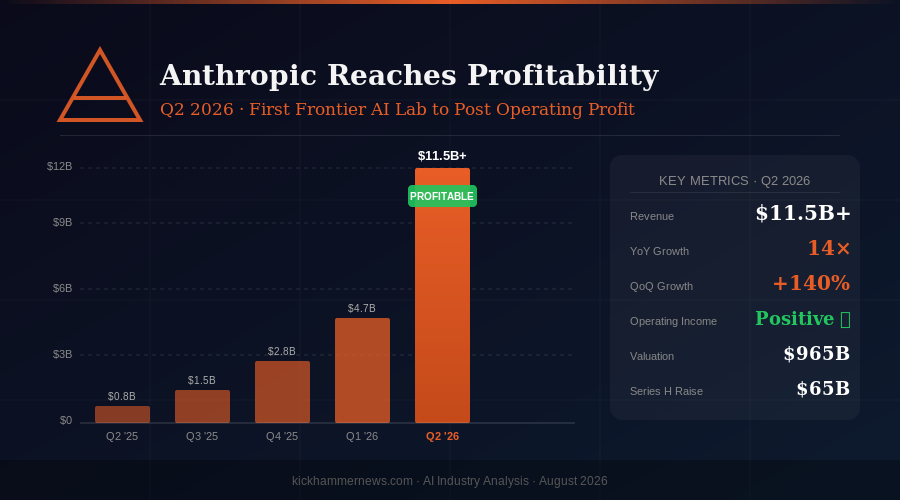
August 20, 2026 — In a moment that may define the trajectory of the artificial intelligence industry, Anthropic has posted preliminary second-quarter 2026 revenue exceeding $11.5 billion alongside its first-ever positive adjusted operating income. The numbers are staggering not just in their size, but in the speed at which they arrived — the company’s own financial projections from just a year ago did not anticipate profitability until 2028.
From $787 Million to $11.5 Billion in Twelve Months
A year ago, Anthropic was on a strong growth trajectory but still firmly in investment mode. In Q2 2025, the company generated $787 million in revenue — a figure that impressed analysts at the time. Then the curve bent sharply upward.
By Q1 2026, Anthropic had reached $4.73 billion in quarterly revenue. That alone would have been a landmark achievement for any AI startup. Then Q2 2026 arrived and shattered expectations entirely: revenue topped $11.5 billion, more than doubling in a single quarter. Quarter over quarter, that represents roughly 140% growth. Year over year, it is a 14x increase.
Even more significant than the raw revenue figure is what came with it: positive adjusted operating income. Frontier AI labs have long been characterized by their enormous computational costs and burn rates. Training and serving large language models at scale consumes extraordinary compute, and companies like Anthropic, OpenAI, and Google DeepMind have competed in a race where spending — not profitability — defined the pace of progress. Anthropic’s Q2 results challenge that assumption.
The Economics Behind the Milestone
The path to profitability wasn’t accidental. Anthropic’s chief advantage has been a steady improvement in compute efficiency per dollar of revenue. Earlier reporting indicated that compute costs as a share of revenue fell from 71 cents per dollar in Q4 2025 to 56 cents by Q1 2026 — a dramatic reduction in a single quarter. That trend, if it continued into Q2, would help explain how a doubling of revenue translated into a flip to positive operating income.
Claude, Anthropic’s flagship model family, has become the AI backbone for a growing roster of enterprise clients. The Claude API powers everything from legal research tools and medical coding software to enterprise chat assistants deployed by Fortune 500 companies. The combination of API revenue, Claude.ai consumer subscriptions, and direct enterprise contracts has created multiple revenue streams that collectively reached escape velocity this quarter.
The company also benefited from the broader enterprise AI adoption wave. Across industries, 2026 has seen corporations move from AI pilots to full-scale deployments. That shift from experimentation to production has been a tailwind for every frontier model provider — but Anthropic’s reputation for safety and reliability has given it a particular edge in regulated sectors like finance, healthcare, and law.
Capital, Valuation, and What Profitability Changes
Anthropic’s financial picture also includes its recent Series H funding round, which raised $65 billion and valued the company at $965 billion post-money — placing it just shy of the trillion-dollar threshold that only a handful of companies in history have crossed. The round underscored investor conviction in Anthropic’s trajectory even before Q2 results became public.
With positive operating income now in hand, that conviction looks well-placed. But profitability changes more than the company’s balance sheet. It changes the narrative around frontier AI economics entirely.
For years, critics of the AI boom pointed to the unsustainable math: compute costs scale with model capability, and more capable models require ever-more expensive training runs and inference infrastructure. The argument held that no AI company could achieve the kind of margin profile that justified their valuations. Anthropic’s Q2 results don’t simply counter that argument — they break it.
A company can simultaneously invest in frontier model development AND generate operating profit. The efficiency gains from better hardware (particularly NVIDIA’s latest GPU generations), improved inference optimization, and accumulated engineering expertise have compressed the time to profitability from what once seemed like a distant goal to an accomplished reality.
Competitive Implications
Anthropic’s milestone puts pressure on its competitors in revealing ways.
OpenAI, despite its larger revenue scale, has been investing heavily in infrastructure and compute, and its road to profitability has remained a topic of investor speculation. The company’s CFO recently told employees that OpenAI “will be a public company in 2027” — and Anthropic’s profitable quarter strengthens the case for why that IPO window matters. Public markets will now benchmark every AI company against Anthropic’s demonstrated ability to earn more than it spends.
Google DeepMind operates within Alphabet, making direct comparisons difficult, but its Gemini models compete directly with Claude for enterprise contracts. Microsoft’s tight integration with OpenAI via Azure means it has a stake in how the competitive landscape evolves.
For emerging players and smaller AI labs, the dynamic is more complicated. Anthropic’s profitability demonstrates that scale advantages in AI are real. Companies that cannot achieve similar revenue-per-compute efficiency will face growing pressure, either to find differentiated niches or to consolidate.
The Safety Question
What makes Anthropic’s profitability particularly notable is that it came while the company maintained its emphasis on AI safety research. Critics have occasionally suggested that safety-focused AI development was a luxury that only well-funded organizations could afford, and that commercial pressures would inevitably force corners to be cut.
Anthropic’s Q2 results suggest a different story: that a safety-first approach and commercial viability can be complementary rather than opposed. The company’s interpretability research, Constitutional AI methodology, and investment in alignment have not prevented it from building models that enterprises want to pay for — they may have contributed to it, by building the kind of institutional trust that drives long-term contract relationships.
What Comes Next
The preliminary nature of these figures means final results could be revised — though the direction is clear. Annualizing Anthropic’s Q2 run rate implies a company on track for well over $40 billion in annual revenue, with improving margins as compute costs continue to decline relative to revenue.
For the AI industry, the question is no longer whether frontier AI can be profitable. Anthropic has answered that. The questions that follow are harder: how quickly competitors will reach the same threshold, what the profitability race means for compute investment and model capability, and whether the efficiency gains that made this quarter possible will continue to compound.
For now, one milestone stands: the first frontier AI lab has crossed into profitability, and the industry will not look the same on the other side.
Sources: CNBC, Fortune, Forbes, WebProNews, Dataconomy


