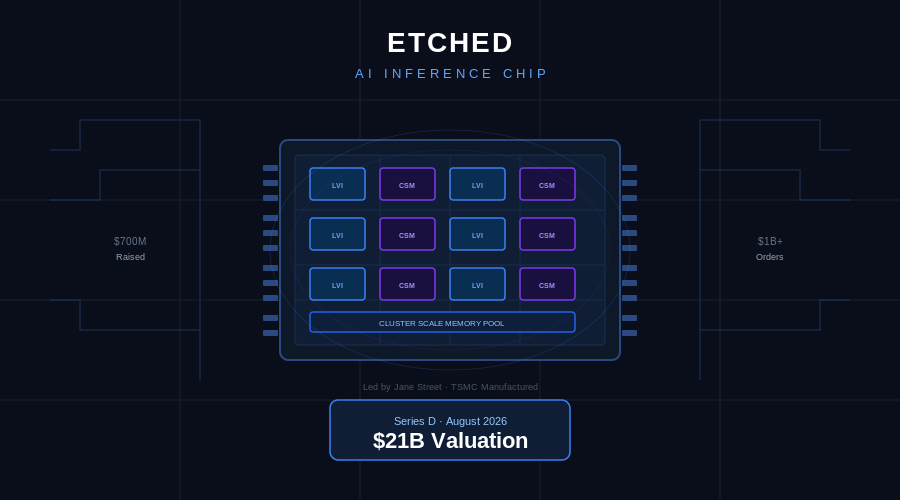
A Silicon Valley chip startup most people had never heard of a year ago just closed a $700 million round at a $21 billion valuation — and the investor that led the deal had an actual rack of Etched hardware running in its datacenter before writing the check.
The story of Etched is one of the most remarkable valuation trajectories in recent tech memory. In December 2025, the company was worth $5 billion. In July 2026, it closed a $300 million Series C that pegged it at $10.3 billion. Less than a month later, it has nearly doubled again to $21 billion. For context, that puts a two-year-old chip startup with no publicly traded shares at roughly the same valuation as many established semiconductor companies.
The round was led by Jane Street, the secretive quantitative trading firm that rarely makes public technology investments. That fact alone sent a signal through the industry: this is not speculative enthusiasm. Jane Street tested the hardware, bought a system, installed a rack in its own datacenter, and then decided the results were compelling enough to lead a nine-figure fundraise.
What Etched Actually Builds
To understand why investors are moving so fast, you have to understand what Etched is actually building — and what problem it is solving.
Nvidia dominates AI infrastructure. Its H100 and subsequent Blackwell-family GPUs power the overwhelming majority of AI training and inference workloads worldwide. That dominance is real, deeply entrenched, and supported by a software ecosystem — CUDA — that took two decades to build. Challenging Nvidia is not a new idea. Dozens of startups have tried. Most have struggled to gain traction beyond niche deployments.
Etched’s approach is different in a specific and technically important way. The company is not trying to build a general-purpose GPU replacement. It has instead focused narrowly on inference — the phase of AI computing that happens after a model is trained, when it actually processes user requests and generates responses. This is increasingly where the money is. As AI models move from research labs into production products, inference costs often dwarf training costs. Whoever can run inference faster and cheaper wins the economics of AI deployment.
Etched’s co-founder and COO Robert Wachen explains that inference breaks down into two mathematically distinct phases. The first is “prefill,” where the system parses and contextualizes the incoming prompt — a compute-heavy operation. The second is “decode,” where the system generates the output tokens the user actually sees — a memory-bandwidth-heavy operation. These two phases have very different hardware requirements, and general-purpose GPUs are forced to compromise between them.
Etched built separate, purpose-designed components for each phase. Its prefill chip uses a low-voltage architecture that allows significantly more transistors to be packed in without the heat problems that throttle other high-density chips. More transistors, cooler operation, faster prefill. For decode, Etched created what it calls Cluster Scale Memory — a new interconnect and memory subsystem that lets many chips share a single memory pool at very low latency. The result, the company claims, is an inference system that processes tokens faster and at lower cost per query than anything currently on the market.
From Lab to Production
Claims like those are easy to make. What matters is whether hardware actually ships and whether customers find the results convincing when they plug it in.
In June 2026, Etched announced it had successfully manufactured its chips with TSMC — a significant milestone, since fabbing at TSMC at frontier process nodes is notoriously difficult for new entrants. At the same time, the company disclosed it had booked $1 billion in orders. That number raised eyebrows across the industry, but the orders were real, and the July Series C at $10.3 billion — led by Sequoia — reflected investor confidence that the company was on a credible path to delivery.
The Jane Street investment represents something more concrete: proof that the hardware not only manufactured successfully but performs in production. Jane Street is not a sentimental investor. The firm made quantitative trading famous by applying rigorous mathematical analysis to every position it takes. When it says it tested the chip and is “pleased with the early results,” the industry takes note.
In a public statement released alongside the funding announcement, Jane Street wrote: “We tested the chip and are pleased with the early results. Etched’s unique approach to inference delivers the precision we will need to support our most demanding workloads. We’re excited to now have our own rack running in our datacenter.” The understated language carries weight precisely because of the source.
Clearing Up the Misconceptions
One persistent misunderstanding has dogged Etched since its founding: the notion that its chips are somehow baked for a single AI model and cannot run anything else. The company’s name — a reference to etching circuits — and its early pitch materials implied that certain model architectures were literally hardwired into the silicon.
That is no longer the case, and Wachen has been emphatic in pushing back. Etched’s current inference clusters can run any frontier model. The specialization is in the inference pipeline itself — the architectural choices that make prefill and decode faster — not in any model-specific hardwiring. This distinction matters commercially. Enterprise customers are not going to bet their inference infrastructure on a chip that can only run one vendor’s model, especially in a landscape where the leading models change every few months.
The Broader Race
Etched’s rise comes at a moment when the AI infrastructure market is rewarding hardware differentiation more than almost any other time in computing history. The demand for inference compute is growing faster than GPU supply can keep up with, and the economics of serving AI at scale are forcing every major cloud provider and enterprise AI buyer to think seriously about alternatives to Nvidia.
AMD has made progress with its ROCm ecosystem and has signed major deals with Microsoft Azure. Google has its TPUs. AWS has Trainium and Inferentia. Apple has redesigned its entire silicon strategy around on-device AI inference. But none of these is available to third-party buyers as a standalone inference cluster product — they are either proprietary to one hyperscaler or tied to a specific cloud platform.
Etched is one of the few companies building inference hardware that enterprises and quantitative finance firms can simply buy, install, and run themselves. Jane Street’s investment suggests that in sectors where latency and throughput matter enormously — trading, real-time decision systems, high-frequency inference applications — the case for dedicated inference silicon is becoming commercially compelling.
The investor syndicate backing Etched reads like a who’s who of technology venture capital: Kleiner Perkins, Sequoia Capital, Andreessen Horowitz, Peter Thiel, Tiger Global, Bain Capital Ventures, Neo, Stripes, Blackstone, and others. The breadth of that list suggests this is not a niche bet. These firms are making a structural argument that inference hardware will be one of the defining infrastructure plays of the next decade.
What Comes Next
Etched has not disclosed its revenue figures or provided a detailed production roadmap, but the trajectory of its fundraising suggests the company is moving to scale manufacturing and expand its customer base beyond early adopters like Jane Street.
The biggest question hanging over the company is the same one that hangs over every Nvidia challenger: software. Nvidia’s moat is not primarily its hardware — it is CUDA and the decade of developer tooling, model optimization work, and deployment expertise built on top of it. Any inference chip that requires significant re-engineering work to deploy will face real friction, regardless of how good its raw performance numbers are.
Etched has not said much publicly about its software stack or its compatibility with standard ML frameworks. That gap will need to be addressed as the company moves from marquee early customers toward broader enterprise adoption.
For now, though, the $21 billion valuation and the Jane Street imprimatur have made Etched impossible for the AI hardware industry to ignore. When a company doubles its valuation in a month based on production hardware performance rather than slides and projections, it is worth paying attention.


