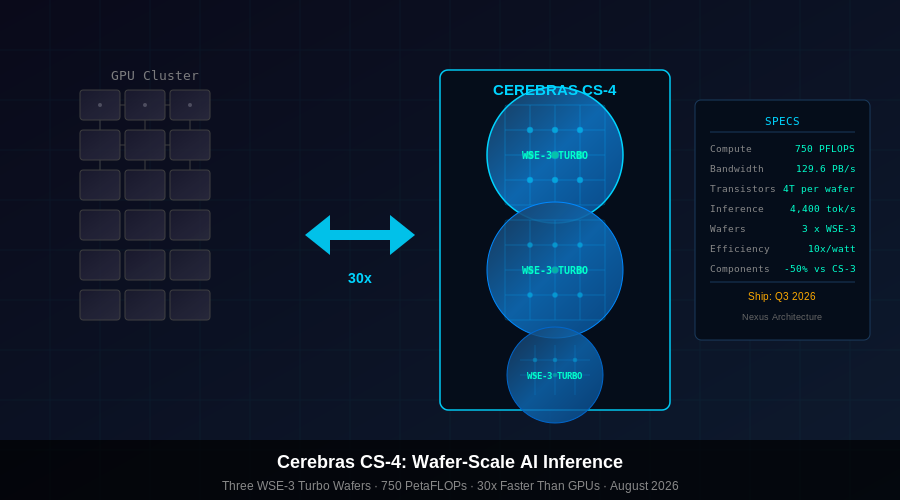
August 21, 2026 — The AI chip wars just got a new entry. On August 19, Cerebras Systems took the wraps off the CS-4 at its Supernova event in San Francisco, unveiling a rack-scale AI accelerator it claims can run inference 30 times faster than competing GPU systems. If the numbers hold up in customer environments, it is the most dramatic performance leap in AI hardware since Nvidia’s H100 redefined the training market.
What Exactly Is the CS-4?
The CS-4 is not a GPU. It is not even a cluster of GPUs. It is a rack-scale system built around three of Cerebras’ WSE-3 Turbo wafers — enormous, single-die processors that take up an entire silicon wafer rather than the thumbnail-sized chips inside traditional accelerators. Each WSE-3 Turbo packs 4 trillion transistors and delivers 250 petaFLOPs of AI compute with 43.2 petabytes per second of memory bandwidth. Three of them in a single rack brings the total to 750 petaFLOPs and an extraordinary 129.6 petabytes per second of on-chip memory bandwidth.
That bandwidth number is the key. One of the fundamental bottlenecks in running large language models is moving weights from memory to compute fast enough to keep the processor busy. GPU clusters solve this by connecting dozens or hundreds of discrete chips over high-speed interconnects, but those interconnects still have latency and finite bandwidth. Cerebras sidesteps the problem entirely by putting memory and compute on the same wafer, eliminating the chip-to-chip hop altogether.
The Performance Claims
In a head-to-head benchmark on GPT-OSS-120B — a 120-billion-parameter open-source model comparable in scale to frontier production systems — Cerebras claims the CS-4 delivers more than 4,400 tokens per second per user, up to 30 times faster than GPU solutions running the same model. On larger, 10-trillion-parameter models, the system sustains more than 1,000 tokens per second, a figure that GPU racks struggle to reach even in highly optimized configurations.
For context on what those numbers mean in practice: a typical chatbot interaction streams output at roughly 30-60 tokens per second to feel responsive to a human reader. At 4,400 tokens per second, the CS-4 can serve well over a hundred simultaneous users from a single rack while delivering near-instantaneous perceived response — or, alternatively, run massive batch inference jobs in a fraction of the time. For enterprises processing large document sets, running real-time coding assistants, or deploying multi-agent pipelines that chain dozens of model calls together, the throughput differential is material.
Cerebras also says the CS-4 delivers 10 times more throughput per watt than its predecessor, the CS-3. Energy efficiency has become an acute concern as AI data center power consumption spirals, and a 10x efficiency gain alongside a 30x performance gain — if validated — would make the economics of the CS-4 compelling even at premium pricing.
New Architecture: The Backpack Approach
Beyond raw performance, Cerebras redesigned the CS-4’s physical architecture around a modular “backpack” system that reduces total component count by 50 percent compared to the CS-3. Fewer components mean fewer points of failure, simpler installation, and lower maintenance overhead — considerations that matter enormously at data center scale where racks are deployed in the hundreds.
The Nexus interconnect architecture underpinning the CS-4 ties the three WSE-3 Turbo wafers together with enough bandwidth to present them as a unified logical processor to the software stack. Customers do not need to manually partition models across wafers or manage complex distributed inference configurations that GPU deployments typically require. From the software perspective, the CS-4 looks like a single, very fast machine.
Why This Matters Beyond the Benchmarks
The broader context matters as much as the specs. Nvidia’s GPU dominance in AI has rested on two pillars: raw compute and ecosystem. CUDA, TensorRT, and a decade of software tooling have made GPUs the default substrate for AI workloads, even when alternative architectures might be theoretically faster. Cerebras has historically offered compelling hardware performance but struggled to pull customers away from the familiar Nvidia stack.
The CS-4 launch comes at a moment when the ecosystem argument is weakening. As AI workloads shift from training — where Nvidia’s advantage has been most pronounced — toward inference at scale, the calculus changes. Inference is the operational phase where models are actually serving users and generating revenue. Cost per token and latency per request are what matter, not training throughput. Cerebras’ architecture is specifically optimized for inference, and with models continuing to scale into the hundreds of billions and trillions of parameters, the bandwidth advantage of wafer-scale integration becomes progressively more important.
The competitive landscape is also shifting. AWS added SpaceXAI’s Grok 4.6 to Bedrock the same week with a 500K context window, Samsung raised foundry prices 15 percent on surging AI demand, and the broader semiconductor industry is straining under capacity constraints. In this environment, a purpose-built inference accelerator that claims to dramatically cut per-token cost and latency is not just a product announcement — it is a direct challenge to the GPU-centric status quo that has defined AI infrastructure since 2020.
The Skepticism Layer
It would be naive to take the 30x claim at face value without independent validation. Benchmark conditions are often optimized to favor the new hardware: specific model sizes, batch configurations, and workload types that play to architectural strengths. GPU clusters running the same model with different quantization, batching, or speculative decoding strategies may close the gap substantially.
That said, Cerebras has a track record of delivering on inference speed claims. Its earlier systems genuinely did outperform GPU alternatives in certain latency-sensitive scenarios, and the company has deployed hardware at scale with national laboratories, pharmaceutical companies, and cloud providers. The CS-4 is not vaporware — first shipments are slated to begin this quarter, and the company has enough institutional credibility that customers will be kicking the tires on real deployments within months.
The Road Ahead
Cerebras is entering a market that is simultaneously exploding in demand and consolidating around a small number of infrastructure providers. The hyperscalers — Microsoft, Google, Amazon, and Meta — are all building custom silicon to reduce dependence on Nvidia, and specialized inference chips are proliferating. UK startup Fractile, which also made news this week with a $6.5 billion valuation after an Anthropic chip deal, is pursuing a similar thesis with SRAM-based inference chips.
What the CS-4 represents is a bet that the wafer-scale approach — controversial and expensive to manufacture, but architecturally elegant — can win the inference era the way GPUs won the training era. Whether 30x is the right number or an optimistic marketing claim, the CS-4 puts Cerebras firmly in the conversation at a moment when the industry is actively looking for alternatives to GPU clusters that require thousands of chips, terawatts of power, and months of procurement to spin up.
First shipments this quarter. The benchmarks will tell the rest of the story.
Sources: Cerebras Systems press release, GlobeNewswire (Aug 19, 2026); Dataconomy (Aug 20, 2026); AI Weekly (Aug 21, 2026)


