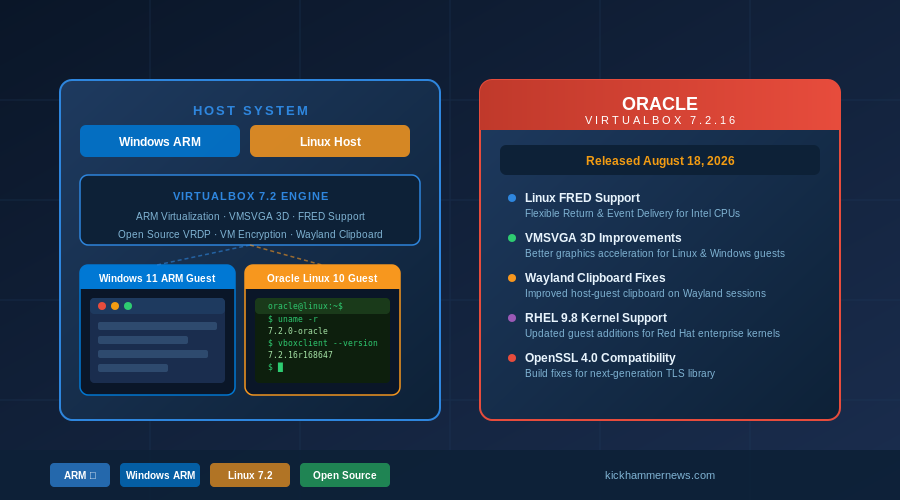
Oracle shipped VirtualBox 7.2.16 on August 18, 2026, the latest maintenance release in the 7.2 branch that has quietly become one of the most significant leaps forward in desktop virtualization in recent memory. While the point release itself is a focused set of stability improvements and bug fixes, it lands against the backdrop of a full year of the 7.2 series — a generation of VirtualBox that introduced ARM host virtualization on Windows, experimental 3D acceleration on Apple Silicon Macs, and a sweeping open-sourcing of features previously locked behind enterprise licensing.
What’s New in 7.2.16
The August 18 release carries a targeted but meaningful set of improvements. On the Linux host side, VirtualBox now adds support for FRED — the Flexible Return and Event Delivery mechanism introduced in newer Intel processors. FRED modernizes how processors handle exceptions and interrupts, moving away from the legacy IDT-based approach. Gaining FRED support in VirtualBox matters for users running the hypervisor on bleeding-edge hardware where FRED-capable CPUs are increasingly common, and it prepares the stack for a future where FRED becomes the baseline assumption rather than an exception.
The 7.2.16 release also delivers VMSVGA 3D performance improvements — a welcome change for users running graphically demanding Linux or Windows guests, where VMSVGA (VMware’s SVGA II emulation) handles hardware-accelerated rendering. Better 3D performance in the virtual graphics stack directly translates to smoother desktop environments, more capable CAD or visualization workloads inside VMs, and improved responsiveness for any guest relying on accelerated compositing.
For Linux users running guests on Wayland hosts, 7.2.16 brings improvements to shared clipboard handling. Clipboard interoperability between a Wayland host and a VirtualBox guest has historically been one of the friction points that kept Linux desktop users frustrated with the virtualization experience. The incremental fixes in this release continue a sustained effort across the 7.2 branch to make Wayland a first-class citizen rather than an afterthought.
Additional fixes address RHEL 9.8 guest kernel support, a video recording hang that occurred after large numbers of display updates, OpenSSL 4.0 build compatibility, and a GUI issue that caused OVF import warnings to be invisible to users. None of these are headline features, but taken together they represent Oracle’s continued commitment to a release cadence that keeps pace with the rapidly evolving Linux and Windows ecosystems.
The Bigger Picture: One Year of VirtualBox 7.2
To appreciate 7.2.16, it helps to look at where the 7.2 branch started. When Oracle shipped VirtualBox 7.2.0 on August 14, 2025, it marked the first time the free, cross-platform hypervisor offered full ARM virtualization on Windows ARM hosts. Users running Windows 11 on ARM — whether on Qualcomm Snapdragon-based PCs or Microsoft’s own ARM Surface hardware — could for the first time run x86 and ARM virtual machines natively through VirtualBox, without requiring costly enterprise alternatives.
For Apple Silicon Mac users, 7.2.0 introduced experimental 3D acceleration support via DXMT, replacing the previous non-functional approach that attempted to route through DXVK and MoltenVK. That previous stack never worked reliably; the DXMT approach gave macOS Arm hosts real, functional 3D acceleration in guests for the first time.
The 7.2 branch also made a meaningful statement about Oracle’s licensing philosophy by open-sourcing several features that had previously required the VirtualBox Extension Pack: the VRDP remote desktop server, USB smart card emulation, VM disk encryption, NVMe storage controller emulation, and the virtual USB webcam. These features had been useful but gated behind Oracle’s enterprise terms, creating friction for developers, system administrators, and power users who needed them for legitimate non-commercial purposes. Moving them into the open-source base package removes that friction and signals a more open posture from Oracle around VirtualBox’s core functionality.
Linux Kernel Parity
One of the quieter but practically significant stories of the 7.2 branch has been its steady progress tracking the Linux kernel release train. VirtualBox 7.2.8, released in April 2026, added initial support for kernels 6.19 and 7.0. VirtualBox 7.2.14, in July 2026, added initial support for Linux kernel 7.2. Now 7.2.16 adds FRED support, which is relevant for users running the very latest kernel builds.
This kernel parity matters because Linux users who keep their host systems up to date — particularly those running rolling-release distributions like Arch, openSUSE Tumbleweed, or Fedora Rawhide — have historically hit VirtualBox kernel module build failures after major kernel updates. The 7.2 branch has been notably faster at tracking these changes than earlier branches, reducing the window during which users find themselves unable to start VMs after an update.
The 7.2.14 release also fixed a long-standing UEFI issue involving Secure Boot DBX entries on Windows 11 guests — a fix that matters particularly for enterprise environments where Secure Boot is enforced as a compliance requirement.
Why VirtualBox Still Matters
In an era when cloud-based development environments and container orchestration have eaten into the traditional virtualization use case, VirtualBox occupies an enduring niche. It is free, cross-platform, open-source at its core, and capable of running on hardware that cloud providers don’t see. Developers who need to test OS-level behavior, run isolated Windows environments on a Linux workstation, or maintain legacy system configurations without paying for VMware Workstation or Parallels continue to rely on it.
The ARM story is particularly timely. As ARM-based Windows PCs gain market share — fueled by Qualcomm’s Snapdragon X series, Microsoft’s continued investment in ARM Surface hardware, and the broader industry push toward efficiency — the ability to run virtualized workloads on those machines becomes increasingly important. VirtualBox 7.2’s ARM host support arrives as the PC market is still in the early stages of ARM transition, giving the platform a foothold before enterprise competitors have fully addressed the same gap in their free-tier offerings.
Oracle’s pace of maintenance releases — roughly every six to eight weeks in the 7.2 branch — also contrasts favorably with the sometimes slow patch cadence of competitors. VirtualBox 7.2 has shipped nine maintenance releases in twelve months, a rate that reflects genuine engineering investment rather than a product in maintenance mode.
Looking Ahead
With Linux kernel 7.2 support now in the branch and FRED handling in place for Intel hardware, the next area of likely attention is continued hardening of the ARM virtualization stack and broader 3D acceleration support across host and guest combinations. The Wayland clipboard improvements suggest that Oracle is listening to the Linux desktop community, a constituency that has sometimes felt like an afterthought in enterprise software roadmaps.
VirtualBox 7.2.16 is available now at virtualbox.org. For Linux users, the kernel modules for major distributions are being packaged at the usual pace, with Oracle Linux, Ubuntu, and Fedora users typically seeing updated packages within days of the upstream release.