The upcoming Linux kernel 7.3 release is shaping up to be one of the most performance-focused updates in years, with Btrfs — the modern copy-on-write filesystem favored by Fedora, openSUSE, and a growing number of enterprise Linux deployments — receiving a sweeping set of improvements that push real-world throughput to near-theoretical maximums.
David Sterba of SUSE submitted the Btrfs file-system feature updates for the Linux 7.3 merge window on August 19, 2026, and the pull request reads like a performance engineer’s wishlist finally fulfilled. The headline numbers are extraordinary: some workloads will see 3x, and in targeted scenarios, up to 5x improvements in throughput and latency. For system administrators, developers, and anyone running Btrfs at scale, these changes represent a meaningful step forward — not an incremental tuning exercise.
Direct I/O Gets Unshackled
One of the most impactful changes in the Linux 7.3 Btrfs update is how the filesystem now handles direct I/O (DIO) — a mode where data bypasses the kernel page cache and flows straight between user-space applications and storage hardware. This matters enormously for database workloads, virtual machine disk images, and any application that manages its own caching layer.
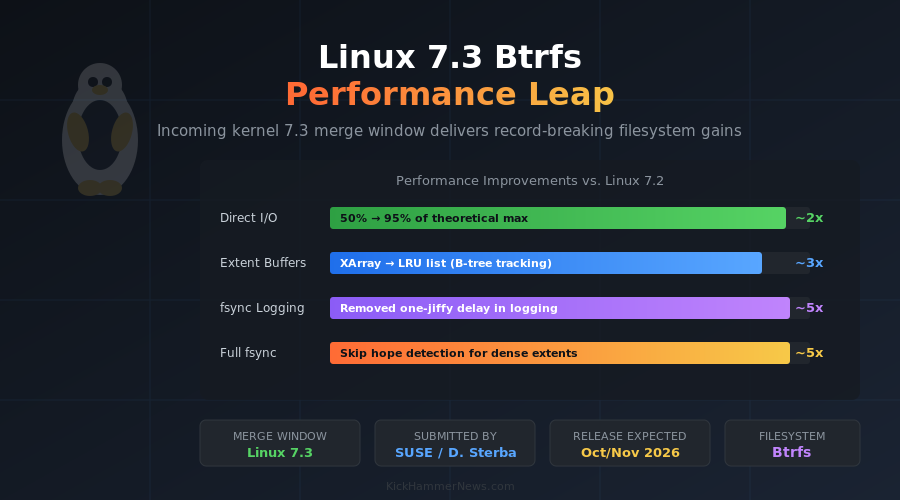
Prior to Linux 7.3, Btrfs had to fall back to buffered I/O in certain correctness scenarios rather than trusting the direct path. The result was that Btrfs DIO performance was running at roughly 50% of the theoretical hardware maximum — leaving half of your storage subsystem’s capability on the table. The fix, now merged for Linux 7.3, switches to using the IOmap bounce buffer for direct I/O operations. The merge request notes that DIO performance is now reaching approximately 95% of the theoretical maximum. That’s a near-doubling of throughput for affected workloads, and it closes a long-standing gap between Btrfs and other filesystems like XFS and EXT4 in DIO-heavy use cases.
Extent Buffer Tracking Rewritten for 3x Gains
Inside Btrfs, extent buffers are used to manage the B-tree structures that underpin the entire filesystem. Tracking which extent buffers are “inhibited” (temporarily locked out from certain operations) previously relied on XArray, a general-purpose kernel data structure. For Btrfs’s specific access patterns, this was a mismatch.
The Linux 7.3 update replaces XArray with a local LRU (Least Recently Used) list specifically designed for the way Btrfs accesses and manages these buffers. The result is approximately 3x better performance in the extent buffer tracking path — a core operation that touches nearly every Btrfs read and write. This isn’t a niche optimization; it’s a reduction in overhead for the foundational data structures of the filesystem.
fsync and Logging Get Up to 5x Throughput Boost
Two separate changes target the fsync path — the critical operation applications use to ensure data is safely written to disk. fsync performance has long been a sensitivity point for Btrfs, particularly in database workloads where transactional consistency demands frequent fsync calls.
The first change eliminates what turns out to be an unnecessary one-jiffy delay in non-SSD mode when multiple logging tasks are active simultaneously. This delay was conservative engineering from an earlier era that no longer reflects the reality of modern storage. Removing it drops latency and increases throughput by approximately 5x on representative multi-threaded logging workloads.
The second fsync improvement targets the “skip hope detection” logic during full fsync for files that have no holes but contain many extents — a common pattern for large files that have been written sequentially. Optimizing this path yields another approximately 5x win on the specific workload. For users running Btrfs on NVMe storage with applications that heavily use fsync, both changes combine to make a meaningful practical difference.
Free-Space Cache v2 Becomes the Default
Linux 7.3 also marks a housekeeping milestone: Btrfs now officially disables its legacy free-space cache v1 code by default. The v2 free-space cache implementation has been available for years and has been the recommended configuration for some time, but v1 remained as a fallback. With v2 now proven and mature, the old code path is being switched off at the default level.
For most users this is a transparent change — if you’ve been running Btrfs with default settings, you’ve likely been on v2 already. But removing the v1 default path simplifies the codebase, eliminates edge cases tied to the older implementation, and paves the way for future feature development that only needs to target the modern architecture.
Part of a Broader Linux 7.3 Performance Push
The Btrfs improvements don’t exist in isolation. Linux 7.3’s merge window has been notable for its performance emphasis across multiple subsystems. EXT4, the workhorse filesystem for countless Linux deployments, is also receiving performance improvements in this cycle. Memory management has seen two significant optimizations land, with developers describing them as “very exciting.” The x86 memory management subsystem is getting patches specifically targeting latency-sensitive workloads.
The networking subsystem also saw changes merged, though maintainers noted that the review queue has grown significantly as AI-generated patch submissions increase in volume — a challenge that the kernel community is actively working to address.
Additionally, FSCRYPT (the Linux kernel’s filesystem-level encryption framework) is receiving cleanup work in Linux 7.3 that opens the door for more features, including native Btrfs encryption — a capability that has been anticipated for years and whose groundwork is now actively being laid.
What This Means for Linux Deployments
For Fedora users — where Btrfs has been the default filesystem since Fedora 33 — these improvements arrive automatically with the next kernel update. For openSUSE Tumbleweed and Leap users, likewise. Enterprise deployments on RHEL, SUSE Linux Enterprise, or Ubuntu derivatives will see these gains flow through in future kernel backport cycles.
Database administrators running PostgreSQL or MySQL on Btrfs-formatted NVMe storage will find the combined DIO, fsync, and logging improvements particularly relevant. Developers using Btrfs snapshots for development environment management benefit from the extent buffer and locking improvements across all operations.
The Linux 7.3 kernel is expected to enter its release candidate phase in early September 2026, with a final release anticipated in late October or November, following the standard kernel release cadence.
For a filesystem that has matured steadily over more than a decade, landing this density of meaningful performance improvements in a single merge window signals both the depth of engineering investment going into Btrfs and the degree to which it has become central to the Linux storage landscape. The numbers speak for themselves: near-doubling of DIO throughput, 3x better extent buffer performance, and 5x improvements on critical fsync paths. When the next kernel ships, Btrfs will be measurably faster — and for the workloads that depend on it, that matters.