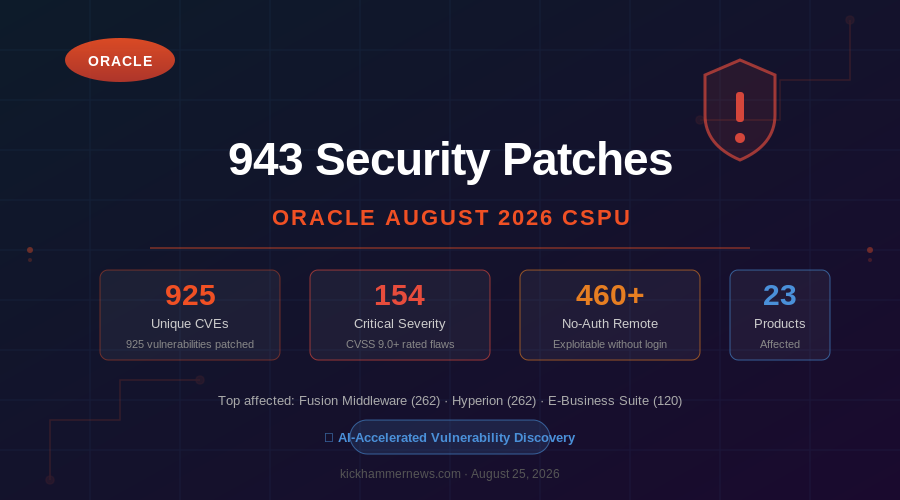
Oracle’s August 2026 Critical Security Patch Update (CSPU) arrived on August 18 with a number that stopped enterprise security teams in their tracks: 943 new security patches addressing 925 unique CVEs across 23 product families. To put that in perspective, Oracle’s June 2026 CSPU — itself only the second in the company’s new monthly release cycle — resolved 243 CVEs in 245 patches across 11 product families. In two months, the scope of Oracle’s between-cycle security releases has nearly quadrupled.
What is driving that explosion, and what does it mean for the tens of thousands of organizations running Oracle’s sprawling portfolio of enterprise software? The answers point toward a fundamental shift in how software vulnerabilities are discovered, disclosed, and patched — one that is being turbocharged by artificial intelligence.
The Numbers in Context
Oracle switched to a hybrid patching model in May 2026, introducing monthly CSPUs to sit between the larger quarterly Critical Patch Updates (CPUs). The idea was to move high-severity fixes to customers faster without waiting for the next scheduled quarterly window. The April 2026 CPU, the last purely quarterly release before the new cadence, contained 481 patches across 241 CVEs. The July 2026 CPU — the largest quarterly release of the year — ran to 1,449 patches across 1,235 CVEs.
August’s CSPU, at 943 patches, now sits comfortably above that April CPU baseline and represents roughly 65 percent of July’s massive quarterly volume. What was designed as a targeted between-cycle release has quietly become a major security event in its own right. The expansion from 11 product families in June to 23 in August — covering virtually the full breadth of Oracle’s enterprise lineup — further erodes the distinction between CSPU and CPU in terms of real-world impact.
Of the 943 patches, 154 carry a critical severity rating, representing 16.3 percent of the total. High-severity patches account for the bulk of the update at 556, followed by 198 medium and 35 low-severity fixes. Nearly 90 of the underlying CVEs carry a CVSS score of 9.8 or higher, the maximum being 10.0 — meaning a successful exploit can yield complete system compromise with no user interaction and no prior authentication required.
The remotely exploitable without authentication (RCE-no-auth) count is perhaps the most alarming figure: more than 460 of the patched vulnerabilities can be exploited over a network by an unauthenticated attacker. In a world where threat actors routinely scan the entire internet for exposed Oracle endpoints within hours of a disclosure, that category of vulnerability represents immediate, existential risk for organizations that delay patching.
Where the Patches Land
Oracle Fusion Middleware and Oracle Hyperion share the top spot this month, each receiving 262 patches. Fusion Middleware alone accounts for 27.8 percent of all patches issued, with 182 of those fixes targeting vulnerabilities that can be exploited remotely without authentication and 80 carrying a critical severity rating. Hyperion follows with 107 unauthenticated remote exploitability fixes and 27 critical patches.
For organizations running Oracle E-Business Suite — the cornerstone ERP product for thousands of manufacturers, distributors, and government agencies worldwide — the August update brings 120 patches with 27 addressing unauthenticated remote attack vectors. Given the sensitivity of financial, procurement, and HR data typically processed by EBS deployments, those 27 fixes alone warrant immediate prioritization.
Oracle Commerce (66 patches, 47 unauthenticated remote), Siebel CRM (50 patches, 21 unauthenticated remote), and Supply Chain (46 patches, 18 unauthenticated remote) round out the top tier. Further down the list, Oracle MySQL (9 patches), Java SE (5 patches), and Database Server (6 patches) each received fixes addressing remotely exploitable weaknesses — products that often sit at the core of non-Oracle application stacks as well, making patch urgency extend well beyond Oracle-centric shops.
The AI Acceleration Effect
Oracle has been candid that it is using large language models to accelerate vulnerability research and patch development. The company confirmed earlier in 2026 that advanced LLM tooling was being integrated into its security engineering workflows to identify flaws at scale and speed that human-only teams could not match. The August CSPU’s scope appears to validate that approach — or at least illustrates the sheer volume of technical debt it is now surfacing.
The phenomenon is not unique to Oracle. The AI-assisted vulnerability discovery wave is reshaping patch cadences across the entire software industry in 2026. Microsoft’s August 2026 Patch Tuesday addressed 421 vulnerabilities including three zero-days. The pattern is consistent: AI tooling finds more, faster, and the security update calendar is expanding to accommodate the flood.
For Oracle specifically, the implications are both reassuring and sobering. Reassuring because the company is evidently investing seriously in finding and fixing its own vulnerabilities proactively, rather than waiting for external researchers or, worse, threat actors to surface them. Sobering because the volume arriving at enterprise patch desks each month is increasing faster than most security operations teams can comfortably absorb.
Oracle itself acknowledges the risk of delay. Its advisory notes explicitly: “Oracle continues to periodically receive reports of attempts to maliciously exploit vulnerabilities for which Oracle has already released security patches.” The ShinHunters breach of Oracle PeopleSoft in mid-2026 — which compromised university systems globally — exploited a flaw for which a patch had been available for weeks. The August CSPU provides 460 new opportunities for that scenario to repeat itself at organizations that do not move quickly.
What Enterprise Teams Should Do Now
Security leaders managing Oracle environments should treat the August 2026 CSPU as requiring the same urgency as a quarterly CPU. Prioritization should start with the unauthenticated remote attack surface: the 182 Fusion Middleware fixes and 107 Hyperion fixes in that category represent the highest probability of active exploitation in the near term. E-Business Suite’s 27 unauthenticated remote fixes should follow, particularly in environments where EBS interfaces are exposed to internal networks without additional access controls.
Oracle’s advisory and verbose risk matrices are available at oracle.com/security-alerts/cspuaug2026.html and provide CVE-level detail to support triage. Tenable, Qualys, and other vulnerability management platforms have released plugin coverage aligned to the August advisory, enabling automated scanning for affected asset inventories.
The broader message from Oracle’s August CSPU is structural rather than tactical: the era of predictable, quarterly patch windows is over for Oracle customers. The new cadence demands that enterprise security and IT operations teams build patch pipeline infrastructure capable of processing major security releases on a rolling monthly basis. Organizations that still treat Oracle patching as a once-per-quarter event are now operating with a persistent and growing exposure gap — and the threat actors scanning for Oracle vulnerabilities are not working on a quarterly calendar either.
Sources: SecurityWeek, Tenable, Oracle Advisory


