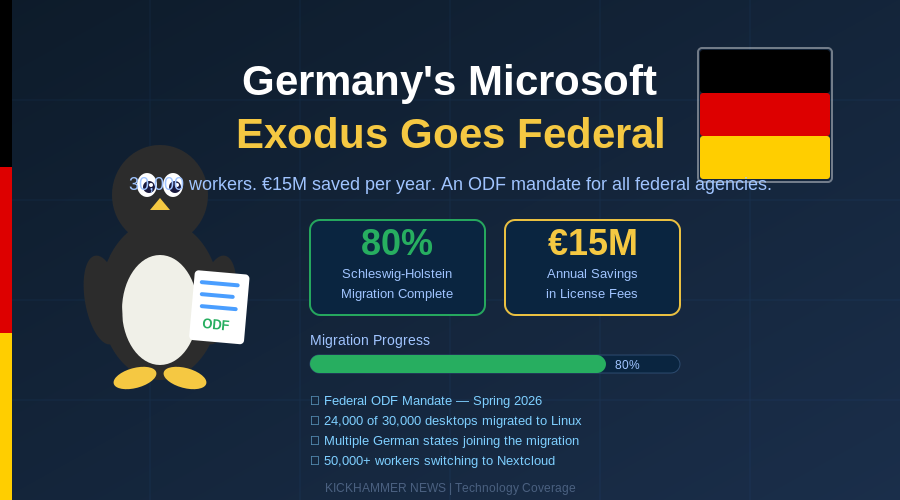
When the German state of Schleswig-Holstein first announced it would migrate 30,000 government workers off Microsoft Windows and Office in 2021, most analysts dismissed it as provincial ambition — a modest northern German state tilting at windmills. Five years later, Schleswig-Holstein is 80 percent complete, saving over €15 million per year in software licensing fees, and its experiment has metastasized into something far larger: a nationwide, institutionally mandated shift away from Microsoft that now carries the force of federal law.
Germany is not just migrating — it is rewriting the rules.
The Federal ODF Mandate: A Quiet Revolution
In spring 2026, Germany’s Federal Ministry for Digital Transformation and Government Modernization issued a framework that will prove far more consequential than any single state’s migration project: beginning in fiscal year 2027, only Open Document Format (ODF) files will be accepted as official government documents across all federal ministries and agencies. Microsoft’s proprietary .docx, .xlsx, and .pptx formats — the dominant file standards for nearly three decades — are no longer the default for German federal administration.
The mandate does not ban Microsoft products outright. Bureaucrats can still run Word on their desktops. But what it does is structurally undermine the business case for keeping them. When interoperability with government peers requires ODF, and when LibreOffice produces ODF natively while Microsoft Office requires format conversion, procurement decisions tend to resolve themselves. In practical terms, the ODF mandate is a slow-acting digital sovereignty enforcement mechanism — one that works through procurement logic rather than political decree.
The move was praised by open-source advocates across Europe and quietly condemned by Microsoft’s government affairs teams in Brussels and Berlin. The software giant has already lobbied for interoperability exceptions and delay mechanisms, but as of September 2026, the mandate stands. Germany’s federal bureaucracy is moving, however deliberately, away from Redmond.
Schleswig-Holstein: The Blueprint at Scale
The most concrete proof that German government Linux deployment works at scale is Schleswig-Holstein. The state has been running the migration for three years, replacing Microsoft Windows with its own Linux distribution, Microsoft Office with LibreOffice, Exchange with Nextcloud Mail, and Microsoft Teams with open-source alternatives based on Matrix and Jitsi.
The numbers, as of September 2026, tell a clear story. Approximately 24,000 of the state’s 30,000 government workstations have been migrated. The state spent roughly €9 million on the migration — a one-time investment covering infrastructure, retraining, and custom development. Against that, it is saving over €15 million annually in Microsoft licensing fees. The payback period was under eight months.
More revealing than the financial data is the human data. Early surveys indicated significant employee resistance: civil servants comfortable with decades of Microsoft muscle memory balked at LibreOffice’s interface differences. But follow-up surveys conducted in late 2025 show satisfaction levels that have normalized. The productivity dip that critics predicted has not materialized in aggregate workforce output metrics. Some specialized applications — particularly in municipal planning and social services — still require Windows compatibility layers, but these are edge cases being systematically addressed.
Schleswig-Holstein has not merely proved that a government can migrate to Linux. It has produced a transferable playbook: documented procurement processes, a curated software stack, tested training modules, and a pool of Linux-certified administrators. Other German states are actively pulling from that playbook.
The Domino Effect: More German States Join the Queue
Schleswig-Holstein’s success has not gone unnoticed in other state capitals. In July 2026, another German state announced its own migration plan, citing Schleswig-Holstein’s cost data as the primary justification for the decision. The state declined to publicize the full scope of its transition timeline, but procurement documents obtained by German technology press indicate a phased three-year migration beginning in Q1 2027.
Mecklenburg-Vorpommern has taken a different path, focusing first on collaboration infrastructure rather than the operating system. The state has deployed Nextcloud as a replacement for Microsoft SharePoint across more than 5,000 staff, with plans to extend the deployment to over 50,000 public employees by end of 2026. Nextcloud, founded in Germany and deeply aligned with European data sovereignty principles, has become a preferred alternative to Microsoft 365 across German government procurement.
The pattern is significant. Each state is arriving at open source through a slightly different route — some leading with the OS layer, others with collaboration tools, others with the file format mandate — but the destination is converging. Germany’s open-source momentum is no longer driven by a single motivated state administrator. It is becoming structurally embedded across multiple institutional layers simultaneously.
What Microsoft Is Doing About It
Microsoft has not accepted European government defection quietly. The company has ramped up its sovereign cloud offerings — Azure Sovereign regions, data residency guarantees, EU Data Boundary commitments — to address the data sovereignty concerns that initially fueled the migration movement. Microsoft has also accelerated lobbying activity in Brussels, arguing that open-source mandates distort competition and disadvantage European governments by locking them into less capable alternatives.
The company’s technical arguments have found some sympathy. Enterprise IT administrators genuinely note that Microsoft 365’s AI integration — Copilot deeply embedded in Word, Excel, Teams, and Outlook — offers productivity capabilities that LibreOffice and Nextcloud have not yet matched. Germany’s federal ODF mandate says nothing about AI features, and as AI becomes central to knowledge work productivity, the capability gap between Microsoft’s AI-infused suite and the open-source stack may become the decisive argument in individual agency procurement decisions.
But Microsoft’s fundamental problem in Germany is political, not technical. Digital sovereignty has become a first-order policy priority for German officials in a way that no amount of EU Data Boundary marketing can fully address. The NSA surveillance revelations of the early 2010s left permanent institutional scars in German government IT policy. The acceleration of U.S. tech geopolitical leverage under successive administrations has deepened those concerns. When German politicians debate procurement choices, “dependence on American software infrastructure” is no longer a theoretical risk — it is a lived institutional memory.
The European Context: Germany Is Not Alone
Germany’s shift is part of a broader European government software movement that has acquired real institutional momentum in 2026. France’s DINUM has ordered all 2.5 million civil service workstations onto Linux migration roadmaps, with autumn 2026 as the submission deadline for ministry plans. Italy’s Commissioners for Digital Italy have funded an open-source productivity suite deployment targeting 800,000 public sector desktops. Denmark has published a national open-source strategy. Austria has mandated ODF for federal procurement.
Across the continent, digital sovereignty is the common thread — but the drivers vary by country. France is motivated by strategic autonomy. Germany is driven by privacy law, procurement efficiency, and an ingrained cultural preference for software independence that traces back to post-reunification IT policy debates. Italy is responding to budget pressures. Denmark is reacting to vendor lock-in concerns after a problematic Microsoft licensing renegotiation in 2024.
The aggregate market signal reaching Redmond is unmistakable. European governments — which collectively represent one of the world’s largest software procurement markets — are systematically de-risking their dependence on American commercial software vendors. Not all at once, not uniformly, and not without setbacks. But the direction is clear and the velocity is increasing.
What This Means for Enterprise Software
The implications extend beyond government offices. When public sector procurement shifts at scale, private sector technology choices tend to follow — particularly in regulated industries that must maintain tight interoperability with government systems. German insurance companies, banks operating under BaFin oversight, and healthcare providers subject to federal health data regulations all maintain significant data exchange relationships with government agencies. If those agencies standardize on ODF and open-source collaboration tools, the private sector faces quiet but powerful pressure to align.
For enterprise software vendors, the more immediate question is whether Germany’s ODF mandate becomes an EU-level standard. The European Interoperability Framework has long advocated for open standards in government ICT, and the European Commission has been watching German and French policy experiments closely. A successful German federal ODF transition would provide compelling evidence for advocates of an EU-wide open-format mandate — one that would affect software procurement for all 27 member states.
For now, Germany’s open-source bet is not yet won. The federal ODF mandate is policy, not practice — its full implementation will take years. Schleswig-Holstein’s 80 percent migration is a milestone, not a finish line. And the AI capability gap in the open-source productivity stack is a genuine challenge that will not resolve itself through political will alone.
But the direction is no longer in doubt. Germany said it would dump Microsoft. It’s actually happening — and the ripple effects are only beginning.
*KickHammer Tech covers enterprise software, operating systems, and the technologies reshaping how organizations build and run digital infrastructure.*