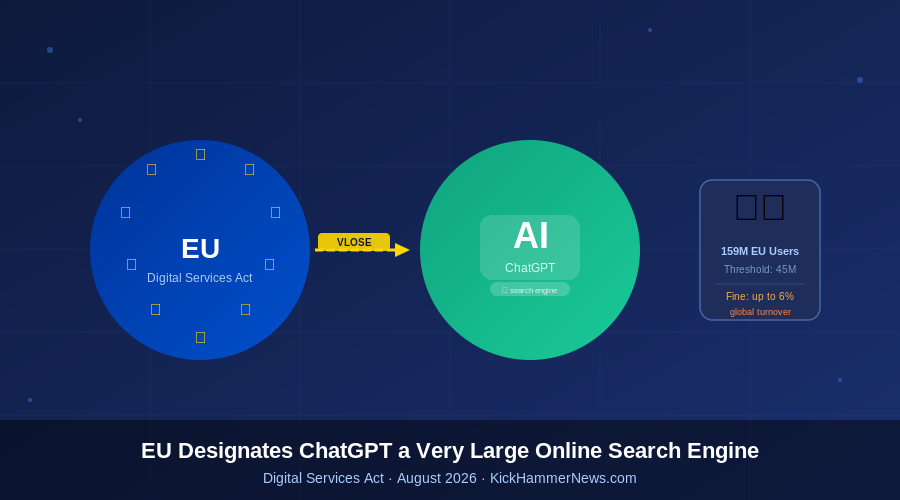
The European Commission’s designation of ChatGPT as a “Very Large Online Search Engine” under the Digital Services Act marks a watershed moment for AI regulation, forcing OpenAI into compliance territory that could reshape how the world’s most popular AI chatbot operates.
On August 31, 2026, the European Commission made history by designating OpenAI’s ChatGPT as a Very Large Online Search Engine (VLOSE) under the Digital Services Act (DSA) — the first time a standalone AI service has been brought under the EU’s most stringent platform regulations. The decision wasn’t entirely surprising to observers who’ve watched ChatGPT quietly evolve from a conversational novelty into a de facto search replacement for hundreds of millions of users. But the formal classification carries enormous practical and symbolic weight: it places OpenAI in the same regulatory category as Google, forces sweeping transparency and risk mitigation requirements on the company, and signals that the era of AI services operating under a regulatory gray zone is decisively over.
Why ChatGPT Qualifies as a Search Engine
The EU’s logic is straightforward and difficult to argue with. ChatGPT reached approximately 159.1 million average monthly active users in the European Union during the six months ending March 31, 2026 — nearly three and a half times the 45 million user threshold that triggers VLOSE status. More importantly, the Commission describes ChatGPT as a “hybrid service” that doesn’t merely generate responses from its training data but also actively searches the web when formulating answers to user prompts. That real-time web search capability is the crux of the classification: if a platform is searching the internet and surfacing results to users at scale, the DSA says it’s a search engine, regardless of whether it presents those results as a blue-link list or a conversational paragraph.
This is a meaningful reframing of what counts as search. For two decades, the search engine category was synonymous with Google and a shrinking list of competitors. ChatGPT has upended that model — not by building a traditional index, but by routing queries through AI synthesis that often reaches web sources. The EU has recognized this functional equivalence and acted accordingly.
What OpenAI Must Now Do
VLOSE designation under the DSA comes with a substantial compliance burden. OpenAI now has four months — until January 2027 — to meet a new tier of obligations that go well beyond what applies to ordinary online platforms.
At the core of these requirements is a mandate to assess and mitigate systemic risks. These include the spread of illegal content, harms to minors, threats to users’ physical and mental well-being, violations of fundamental rights, disruption of electoral processes, and threats to public security. The word “systemic” is significant: OpenAI won’t just have to handle individual reported violations; it will have to proactively map out the vectors through which its platform could cause large-scale harm and put controls in place to address them.
Beyond risk assessment, OpenAI must submit to audits conducted by qualified independent organizations, share data with the Commission and vetted researchers on request, and implement greater algorithmic transparency — including how ChatGPT’s search behavior selects and ranks the sources it draws upon. The company will also be required to participate in the Commission’s formal monitoring process, providing regular compliance reports.
Failure to comply carries fines of up to 6% of global annual turnover. For OpenAI, which was recently valued at over $300 billion and is generating revenues that analysts project to exceed $10 billion annually in 2026, that exposure is not trivial. Repeated or severe violations could theoretically result in temporary service bans in the EU, though regulators have historically preferred fines and remediation orders for first-time compliance failures.
The Broader Regulatory Context
ChatGPT’s designation doesn’t exist in isolation. The Commission announced simultaneously that Reddit and Roblox would also be brought under heightened DSA scrutiny. But the ChatGPT ruling is the one with far-reaching implications for the AI industry, because it establishes a precedent: AI platforms with large user bases and web-search capabilities are search engines for regulatory purposes, even if their founders call them “large language models” or “assistants.”
This matters enormously for the rest of the field. Google’s Gemini, Microsoft’s Copilot, Anthropic’s Claude — all offer web search functionality and have tens or hundreds of millions of users. None have yet been designated as VLOSEs, but the Commission’s framework makes clear that scale plus search equals regulatory accountability. The question is not whether other AI companies will face similar designations, but when.
It’s also worth noting that ChatGPT already faces separate but overlapping obligations under the EU AI Act, which entered full effect earlier in 2026 and imposes its own transparency and risk management requirements on general-purpose AI models. OpenAI is now navigating a complex matrix of EU AI rules that no company has had to traverse before — a compliance challenge that will require significant legal, technical, and organizational resources.
OpenAI’s Response and Strategic Implications
OpenAI has not publicly protested the designation, and industry analysts suggest the company anticipated it was coming. The company’s recent moves — including the appointment of a dedicated EU policy team and the opening of a European policy office — suggest it’s been preparing for precisely this kind of regulatory engagement.
Strategically, the designation could actually benefit OpenAI in certain ways. By operating under a known regulatory framework, OpenAI gains a clearer set of rules to comply with — and competitors who haven’t yet invested in compliance infrastructure may find themselves at a disadvantage when they are inevitably designated as well. Regulatory compliance, when navigated skillfully, can become a competitive moat.
Still, there are genuine concerns about the practical effects on ChatGPT’s development. Risk mitigation requirements for electoral processes, for instance, could lead OpenAI to restrict what ChatGPT will say about political topics in ways that frustrate users. Mandated algorithmic transparency around web sourcing could reveal aspects of ChatGPT’s search behavior that the company considers proprietary. And the audit process, however well-intentioned, will consume engineering and legal resources that might otherwise go toward product development.
A New Era for AI Accountability
The EU’s designation of ChatGPT as a search engine is less a technicality than a statement of values: AI platforms that have become essential infrastructure for information access will be held to the same accountability standards as the search giants that preceded them. It reflects a growing global consensus that AI is too consequential to leave unregulated, and that existing frameworks — including ones designed before generative AI existed — can and should be adapted to cover the new reality.
The next four months will determine whether OpenAI can meet the January 2027 deadline with a robust compliance package or whether it will require extensions and negotiation. Either way, the designation represents a permanent shift in how the EU — and likely regulators worldwide — will think about AI chatbots. They are no longer experimental curiosities. They are, in the words of the Commission, very large online search engines, and they will be treated accordingly.
This article is based on reporting from Euronews, Business Standard, AI Weekly, Gizmodo, and SearchEngineWatch.


