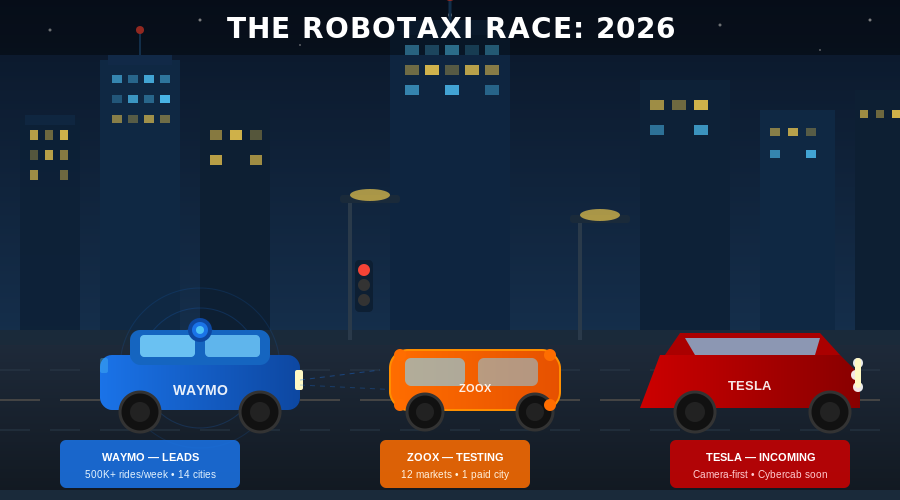
A race that once seemed perpetually on the verge of arriving has finally arrived. Waymo, the autonomous driving subsidiary of Alphabet, announced this week that it is launching commercial driverless service in three new U.S. cities — San Diego, Tampa, and Denver — while Amazon-backed Zoox prepares to expand its testing footprint and Tesla readies new details about its Cybercab program. The moves signal that the robotaxi industry has crossed a threshold: it is no longer a technology demonstration. It is becoming a business.
The gap between the competitors, however, could hardly be more pronounced.
Waymo Pulls Further Ahead
Waymo now operates more than 4,000 vehicles across 14 U.S. cities and delivers over 500,000 robotaxi rides every single week. The company has set an ambitious target of surpassing 1 million weekly rides before the end of 2026 — a goal that looked implausible a few years ago but now sits squarely within reach given the pace of its expansion.
The three new markets are not minor additions. Denver represents Waymo’s first commercial presence in Colorado, a significant milestone for a state that has invested heavily in smart infrastructure and transportation technology. San Diego brings Waymo into California’s second-largest city, extending its presence in its home state. Tampa opens a foothold in Florida, a critical growth market with year-round rideable weather and an aging population that stands to benefit enormously from driverless mobility options.
In each city, Waymo expects to begin with dozens of vehicles before scaling to “hundreds over time,” according to a company spokesperson. Riders will hail rides directly through the Waymo app.
The fleet Waymo is deploying reflects the company’s maturing hardware strategy. Its newer Ojai vehicles, built on Zeekr’s minivan-style platform, feature automatic sliding doors, three large interior displays, and Waymo’s sixth-generation autonomous driving system. Google’s Gemini AI is integrated into the in-car entertainment experience — an early signal of how Alphabet’s AI investments and its autonomous vehicle division are beginning to reinforce each other.
Waymo also benefits from a distribution partnership with Uber in select markets, giving it a second major channel beyond its own app to reach riders. That dual-channel approach could prove decisive as Waymo moves from niche to mainstream.
Zoox: Testing, Not Yet Competing
Amazon-owned Zoox is expanding its testing operations into Houston and San Diego, giving the company a presence in 12 U.S. markets. But a crucial distinction separates Zoox from Waymo: Zoox’s expansion involves vehicles with human supervisors on board. It is not yet operating paid commercial driverless rides in those cities.
For now, Las Vegas remains the only market where Zoox offers a paid ride-hailing service. In San Francisco, Zoox provides free rides to a select pool of users but has not announced a timeline for commercial launch there.
Zoox’s vehicle design is genuinely distinctive — its purpose-built pod-like vehicles are designed from the ground up for robotaxi service, with no steering wheel and symmetrical seating facing inward. If the technology matures, the design could offer real advantages in comfort and space efficiency. But manufacturing purpose-built autonomous vehicles at scale is extraordinarily expensive and logistically complex. Zoox is proving out its technology city by city before making the leap to commercial service.
The strategic gap between Zoox and Waymo is significant, but it isn’t necessarily permanent. Amazon’s deep capital reserves and logistics expertise give Zoox resources that smaller rivals cannot match.
Tesla’s Different Bet
Tesla represents a fundamentally different philosophy — and potentially a fundamentally different threat.
The electric vehicle giant is expected to release new details about its Cybercab and broader robotaxi ambitions imminently. Tesla’s approach is built on cameras and increasingly capable neural networks rather than the multi-sensor stacks that Waymo deploys. Waymo’s system uses cameras, lidar, and radar working in redundant concert — a belt-and-suspenders approach that Waymo argues is essential for safely operating in complex urban environments at scale.
Waymo pushed back on Tesla’s approach publicly last month, citing more than 200 million fully autonomous miles accumulated under its current architecture and arguing that Level 4 autonomy demands independent sensing systems capable of backing each other up when any single sensor fails. Tesla, for its part, argues that better neural networks trained on vastly larger datasets can achieve the same safety outcomes at a fraction of the hardware cost — making robotaxis economically viable at a scale that lidar-heavy systems cannot match.
That debate is no longer purely academic. It may soon become a regulatory matter. A proposed framework in New Jersey would require autonomous vehicles operating as taxis to use multiple distinct sensor types. If such rules proliferate across states, they could institutionalize Waymo’s architecture as the de facto standard — and make pure camera-based approaches legally unviable in major markets.
Regulators across multiple states are watching the evidence accumulate, and the companies know it. Every incident — every autonomous vehicle that blocks traffic, every time a first responder has to manually move a stuck robotaxi — becomes data in an ongoing argument about which approach is safer.
The Stakes Are Real
The commercial opportunity driving these moves is substantial. Goldman Sachs Research projects the U.S. robotaxi market will grow from roughly $3 billion next year to $19 billion by 2030 and nearly $50 billion by 2035. Globally, the market could be significantly larger. Whoever builds a scalable, trusted robotaxi network in the next five years will own a category that could rival traditional ride-hailing — or replace it entirely.
That potential has not gone unnoticed by labor groups, who are raising concerns about the long-term impact on professional drivers. The Teamsters and other transportation unions have pushed for regulatory guardrails that would slow autonomous deployment in key markets. Cities are grappling with how to zone for charging depots, manage robot fleets that sometimes behave unexpectedly in traffic, and ensure that driverless services don’t hollow out public transit funding by luring away higher-paying riders.
Safety advocates, meanwhile, are pressing all three companies for more consistent and standardized disclosure of crash data, near-miss reports, and miles driven without intervention. The current patchwork of state-by-state reporting requirements makes direct comparisons difficult.
A Race With No Finish Line
What’s clear as we enter the fall of 2026 is that this race has moved past the proof-of-concept phase. Waymo is operating at significant scale, generating revenue, and expanding methodically. Zoox is accumulating data and building toward a commercial launch. Tesla is preparing to make a move that could reshape the competitive landscape entirely — or fall short again.
The robotaxi industry has spent years promising to change how people move through cities. In San Diego, Tampa, and Denver, those promises are now showing up as actual rides booked through an actual app. For consumers in those cities, the future just arrived a little early.
For competitors, the clock is ticking louder than ever.


