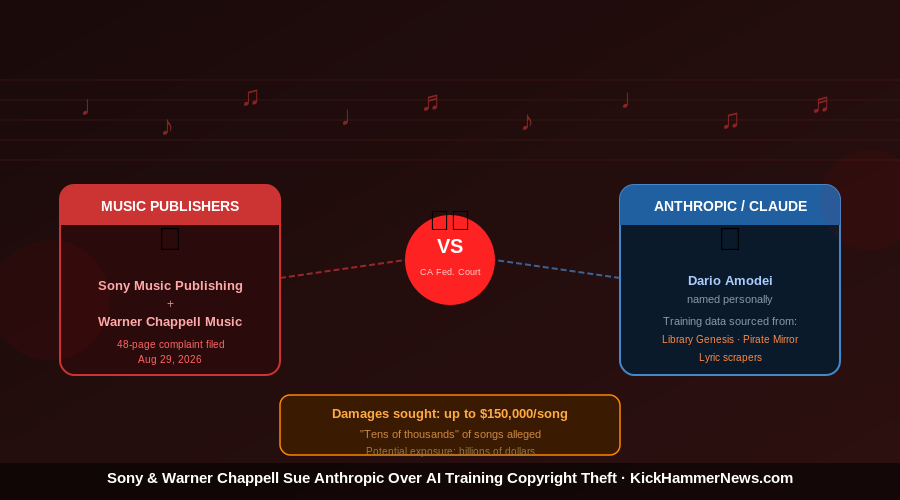
Sony Music Publishing and Warner Chappell have filed one of the music industry’s most aggressive intellectual property lawsuits in years, targeting Anthropic and its founders personally over allegations that Claude’s AI training rested on a foundation of stolen songs.
The lawsuit, filed in California federal court on August 29, 2026, describes Anthropic’s conduct as “one of the largest and most blatant ongoing thefts of intellectual property in history.” The 48-page complaint names not just Anthropic as a company but also its co-founders Dario Amodei and Benjamin Mann as individual defendants — a move designed to send a message that music publishers will pursue the people, not just the entities, who allegedly profited from pirating their catalogs.
What the Publishers Are Alleging
At the heart of the lawsuit is a straightforward but explosive claim: that Anthropic trained its Claude AI models on tens of thousands of copyrighted musical compositions without authorization, acquiring those works through pirated sources rather than licensed channels.
The complaint alleges that Anthropic obtained copyrighted song lyrics and sheet music through Library Genesis and the Pirate Library Mirror — notorious repositories that house millions of documents copied without publisher permission. Anthropic is also alleged to have scraped licensed lyric websites including Musixmatch and LyricFind, accessing material that those platforms had paid to license legally and that Anthropic had no right to scrape for AI training purposes.
The songs cited in the complaint are not obscure catalog: they include Mariah Carey’s “All I Want for Christmas Is You,” Taylor Swift’s “Paper Rings,” Marvin Gaye’s “Ain’t No Mountain High Enough,” and the stadium-rock anthem “Eye of the Tiger” by Survivor. The breadth of the catalog at issue — from holiday perennials to literary folk to arena rock — underscores how comprehensively the publishers allege Anthropic swept their intellectual property into its training pipeline.
Sony Music Publishing and Warner Chappell are seeking statutory damages of up to $150,000 per infringed composition. The math is daunting: if the publishers can prove infringement across even a fraction of the “tens of thousands” of songs they allege were used, the damages exposure could run into the billions of dollars.
Anthropic’s Response
Anthropic issued a terse denial. “We disagree with the publishers’ claims and we intend to defend ourselves robustly in court,” the company said in a statement. The company did not address the specific allegations about Library Genesis or the licensed lyric sites.
The robustness of Anthropic’s legal defense will likely hinge on a few key arguments: whether using copyrighted works in AI training constitutes reproduction or display within the meaning of copyright law, whether any fair use defense applies to large-scale AI training, and critically, whether Anthropic actually knew or should have known that specific pirated sources were used if its training pipeline was managed by contractors or automated scraping systems.
Why This Lawsuit Is Different From What Came Before
The music publishing industry has been watching AI copyright litigation develop for several years, but this lawsuit is notable in ways that go beyond its scale.
First, the personal naming of Dario Amodei and Benjamin Mann as defendants is unusual and aggressive. Most copyright suits target corporate entities; personally naming founders exposes them to individual liability and is designed to make AI executives understand that their decision-making around training data carries personal risk.
Second, the allegation of piracy is qualitatively different from arguing that training on lawfully-acquired copyrighted text constitutes infringement. The piracy allegation — that Anthropic actively used known-pirated sources — strips away many of the more sympathetic arguments that AI companies typically make about good-faith training practices. If Anthropic or its contractors knowingly ingested Library Genesis data, the fair use defense becomes significantly harder to sustain.
Third, the lawsuit arrives in a radically different legal environment than the AI copyright suits filed in 2023 and 2024. In September 2025, Anthropic resolved a class-action suit filed by authors over pirated training data, agreeing to pay $1.5 billion following a judicial finding that while incorporating copyrighted works into AI training did not itself violate copyright law, obtaining those works through piracy did. That ruling created a live precedent that the music publishers are now explicitly invoking. The piracy pathway to liability, once theoretical, has been established in court.
The Broader Industry Stakes
For the AI industry, the timing of this lawsuit is significant. Anthropic recently became profitable, was valued at close to $900 billion in a funding round earlier this year, and has positioned itself as one of the most safety-conscious and ethically rigorous of the frontier AI labs. A finding that it built Claude on pirated music catalogs would be a profound reputational blow, not just a financial one.
For the music publishing industry, the stakes are equally high. Publishers have watched as AI companies generated billions in revenue partly on the backs of creative works they never compensated. The previous author settlement gave them proof that the piracy theory of liability can succeed. If Sony and Warner can win — or extract a substantial settlement — they will have established that the music catalog, like the book catalog, cannot be scraped for free.
The lawsuit also comes at a moment when music licensing revenue is more important than ever to publishers. The rise of streaming has eroded per-play economics; sync licensing for AI training could represent a meaningful new revenue stream if publishers successfully establish that such licensing is required. Every lawsuit that results in an AI company paying is an argument for why other AI companies should proactively license rather than litigate.
What Happens Next
Federal copyright litigation of this scope typically plays out over years. The initial skirmishing will involve motions to dismiss, discovery battles over Anthropic’s training data documentation, and likely requests by Anthropic to depose the publishers about the actual use of licensed lyric data by third parties.
The most pivotal near-term question is whether Anthropic will seek early settlement. The $1.5 billion author settlement suggests the company is not averse to resolving these disputes when the legal math looks unfavorable. With $150,000 per song in potential statutory damages and tens of thousands of songs alleged, the maximum exposure in this case dwarfs the author settlement. Settlement negotiations may begin long before any trial.
Meanwhile, the broader AI training copyright landscape is shifting week by week. The EU AI Act requires frontier AI developers to publish summaries of training data used. U.S. copyright regulators have opened formal proceedings on AI and training data. And Congressional momentum for AI copyright legislation, while slow, is building.
Sony and Warner’s lawsuit is not an isolated act of aggression. It is part of a systematic effort by the creative industry to establish, through litigation if necessary, that AI’s extraordinary commercial success cannot be decoupled from the human creativity that made it possible — and that the humans behind that creativity deserve to be compensated for it.
This article is based on reporting from TechCrunch, Variety, Music Business Worldwide, Axios, Engadget, and Fortune.


