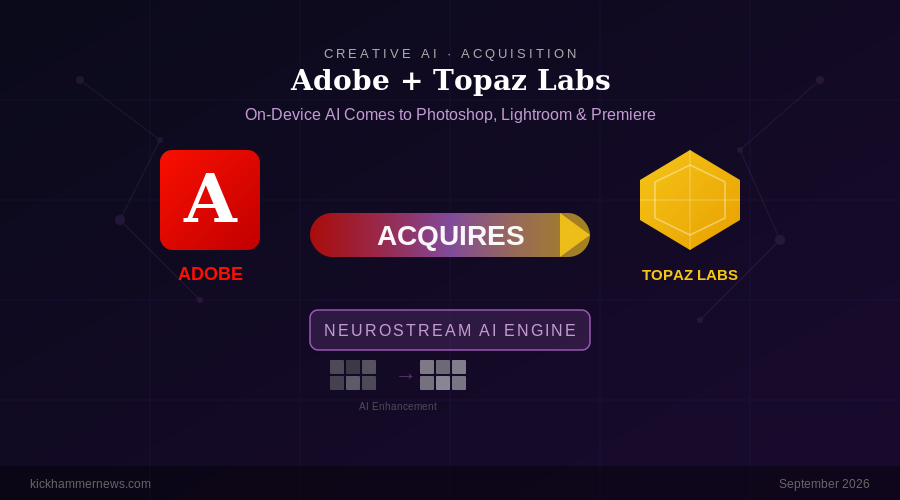
When Adobe announced in late June that it had signed a definitive agreement to acquire Topaz Labs, many photographers and videographers braced for the worst. Topaz had long been the beloved third-party plugin studio that filled the gaps Adobe’s own tools left open — Gigapixel for impossible upscaling, Video AI for silky frame interpolation and noise reduction, and Photo AI for one-click intelligent enhancement. The fear was predictable: once Adobe absorbed the company, the standalone tools would wither and the magic would be locked behind a Creative Cloud subscription.
But a series of developments over the past two months has reframed that narrative entirely. The Federal Trade Commission granted early termination of its antitrust waiting period in late July 2026, signaling no regulatory concerns with the deal. Adobe’s stock climbed to near two-month highs on the news. And with the transaction now expected to close any day in the second half of 2026, the details emerging about what Topaz Labs actually brings to Adobe’s platform are considerably more interesting than a simple plugin acquisition.
The Technology Behind the Deal: Neurostream
The centerpiece of the Topaz Labs acquisition is not Gigapixel or Video AI as consumer products. It is Neurostream, a proprietary inference engine that Topaz developed over several years to solve one of the most stubborn problems in consumer AI: how to run very large, computationally expensive AI models locally on ordinary hardware.
Cloud-based generative AI has dominated the headlines, but enterprise and creative users have persistent reasons to avoid sending their work to a server. Raw footage from a film shoot, confidential brand assets, medical imaging, archival restoration work — these are not files that can be casually uploaded to a third-party inference endpoint. Neurostream was engineered specifically to enable the same quality of enhancement that requires a data center GPU to be performed on a mid-range consumer laptop or desktop, often in real time.
Adobe’s own Firefly platform is heavily cloud-dependent. The company has made significant investments in cloud inference infrastructure, and its generative fill, generative expand, and video generation features require network connectivity and, for heavy users, Generative Credits. Neurostream represents a potential architectural shift: the ability to offer Firefly-class AI results locally, without credits, without a connection, and without the latency of a round-trip to Adobe’s servers.
“Topaz Labs and its Emmy Award-winning AI technology will be integrated across Adobe’s creative AI portfolio,” the company said at announcement, specifically naming Photoshop, Lightroom, and Premiere as integration targets. Industry observers have noted that the most natural first integration would be Premiere’s AI-powered upscaling and enhancement features, which currently lag behind Topaz Video AI in output quality for challenging footage.
An Emmy-Winning Track Record
One detail that tends to get lost in the financial coverage is that Topaz Labs’ video enhancement technology received an Emmy Award, specifically a Technology and Engineering Emmy from the Academy of Television Arts and Sciences. That recognition was for the company’s AI-powered video restoration and enhancement tools, which have been used by broadcast networks and post-production houses to restore decades-old archival footage and upscale legacy content to modern 4K and 8K standards.
This is not a startup with a promising demo. Topaz’s tools are in active production pipelines at some of the largest media organizations in the world. The upscaling work that allowed networks to remaster classic series for high-definition streaming relied in significant part on Topaz Video AI’s temporal noise reduction and frame interpolation capabilities. Bringing that pedigree in-house gives Adobe credibility in the post-production market that it has historically struggled to cultivate against competitors like Blackmagic Design’s DaVinci Resolve, which has invested heavily in its own AI toolset.
The Standalone Promise
One of Adobe’s most significant commitments in the acquisition announcement was that Topaz Labs products would continue to be sold and supported as standalone offerings through the Topaz website. CEO Eric Yang, who founded the company in 2003 and built it into one of the most respected names in image and video AI, is staying on to lead the Topaz team post-acquisition.
That commitment matters because the Topaz user base is not monolithic. A significant portion of Topaz customers are not Adobe Creative Cloud subscribers. Many are photographers who use Capture One or Affinity Photo, or videographers whose primary NLE is Final Cut Pro or DaVinci Resolve. If Adobe had announced that Topaz’s tools would be Creative Cloud exclusives, it would have risked alienating the customer base that made the acquisition worth making in the first place.
Adobe’s history with acquisitions has been mixed on this point. Frame.io, acquired in 2021, has been progressively integrated into Premiere and Creative Cloud workflows, though it remains available as a collaboration platform outside of Adobe’s ecosystem. The Substance 3D tools acquired from Allegorithmic are still sold separately. The pattern suggests Adobe understands the value of maintaining communities around specialized tools, even as it integrates the underlying technology into its flagship products.
What This Means for Creative Professionals
For the working photographer or videographer, the near-term implications are straightforward: better AI enhancement natively inside the apps they already use. Adobe Lightroom’s AI-powered denoise feature, introduced in 2023, was widely praised but required significant computation time and was cloud-optional. A Neurostream-powered successor, capable of processing the same task locally and faster, would represent a meaningful quality-of-life improvement.
For Premiere Pro users, the opportunity is even larger. Video upscaling inside Premiere currently requires export-and-re-import workflows using third-party tools. A native Neurostream integration could enable real-time or near-real-time preview of upscaled and enhanced footage directly on the timeline, eliminating a significant bottleneck in post-production pipelines.
The longer-term picture is more speculative but increasingly plausible. Adobe has been investing in what it calls “AI-native” workflows — creative processes designed from the ground up around generative and enhancement AI, rather than retrofitting AI into workflows built for manual editing. Neurostream’s local inference capability is a foundational piece of that vision: it allows Adobe to offer AI-native tools to users in environments where cloud connectivity is limited, cost-sensitive, or simply not acceptable from a privacy or security standpoint.
The Broader Creative AI Landscape
Adobe’s acquisition of Topaz Labs is one of several moves in 2026 that reflect a broader consolidation in the creative AI space. The company’s Firefly platform has expanded aggressively, adding agentic workflow capabilities and deeper integration with Adobe Experience Manager for enterprise marketing teams. The ChatGPT plugin integration, announced in August, gave third-party AI assistants access to more than 70 Adobe tools.
Topaz is different from those moves. It is not about generating content from prompts or connecting Adobe tools to external AI platforms. It is about the fundamental quality of the pixels and frames that creative professionals produce — the sharpness, the noise, the resolution, the temporal stability of video. These are the metrics that separate professional output from amateur work, and Topaz has led that space for years.
The FTC’s decision not to challenge the acquisition is notable given the regulatory climate around large technology company acquisitions in recent years. It suggests that antitrust regulators view the creative AI tools market as competitive enough that a Topaz acquisition does not raise concentration concerns — a conclusion that reflects the reality that DaVinci Resolve, Luminar, Topaz alternatives, and a growing number of open-source tools continue to compete vigorously for creative professionals’ attention and money.
Closing Thoughts
Adobe’s Topaz Labs acquisition is not the story of a monopolist absorbing a competitor to neutralize it. The more accurate read is that Adobe has recognized a technological capability — efficient, high-quality, local AI inference — that it does not have and cannot easily build from scratch, and has moved to acquire the team that built it best.
Whether that technology genuinely transforms the Creative Cloud experience or disappears into the bureaucratic machinery of a large software company is the question that Topaz users will be watching closely over the coming product cycles. Eric Yang’s decision to stay on is an encouraging sign. The FTC’s swift clearance has shortened the runway to find out.
For creative professionals who depend on tools that can take a noisy, low-resolution, temporally unstable piece of footage and make it broadcast-ready, the next twelve months of Adobe product releases just became significantly more interesting to watch.