September 3, 2026 — For the past several years, the dominant narrative around enterprise AI was simple: large companies would pay OpenAI, Anthropic, or Google for API access to the best models, bolt them into their products, and compete on application layer differentiation. The underlying intelligence was a utility, like cloud compute. You rented it.
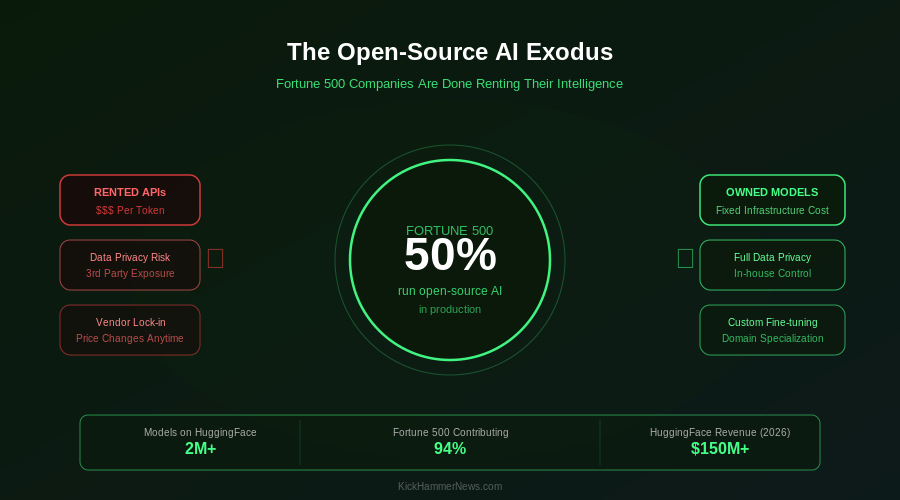
That narrative is fracturing. Hugging Face CEO Clem Delangue dropped a striking figure recently: roughly half of the Fortune 500 now runs open-source AI in production — not as a side experiment, but as a primary deployment. And they are not going back.
The Economics That Changed Everything
The shift from rented to owned AI is not driven by ideology. It is driven by arithmetic.
A company running large-scale inference on a frontier API provider might process hundreds of millions of tokens per day. At current pricing, even the more affordable frontier tiers can run to millions of dollars monthly for heavy users. The math looks different when you host your own fine-tuned open model: the inference cost is hardware, and hardware costs keep falling. More importantly, a model you own does not come with per-token pricing that can change at any moment, and it does not expose your most sensitive proprietary data to a third-party’s servers.
The economic argument has become especially compelling in regulated industries. Financial services firms, healthcare organizations, and government contractors face strict data-handling requirements that make sending sensitive information to a third-party API legally and operationally complex. Open models, deployed in-house or in a private cloud environment, sidestep that problem entirely.
Hugging Face as Infrastructure
Hugging Face’s ascent from niche model repository to enterprise AI operating layer is the clearest indicator of how far this shift has gone. The platform now hosts over 2 million models, datasets, and AI applications, and its annualized revenue crossed $150 million in the first half of 2026. Ninety-four percent of Fortune 500 companies now contribute to open-source AI projects on the platform, a figure that would have seemed implausible three years ago.
The platform’s role has evolved accordingly. Hugging Face is no longer just a place to find models — it is where enterprises manage their model supply chains. Teams use it to discover base models, track versions, share fine-tuned variants internally, and deploy to production via Inference Endpoints. For many organizations, it functions as the package registry for AI, the way npm or PyPI function for software dependencies.
That strategic importance has attracted the attention of the largest players in the market. Nvidia’s reported $12.9 billion bid to acquire Hugging Face — disclosed in August 2026 — reflects a calculation that whoever controls model distribution controls the next layer of the AI stack. For Nvidia, a company whose business depends on enterprises running AI workloads on GPUs, owning the platform where those workloads originate is a natural extension of the hardware dominance it has spent years building.
What “Open” Actually Means in 2026
The open-source AI landscape in 2026 is considerably more sophisticated than the early days of models being dropped on GitHub with a README. Modern open models come in families: base models for fine-tuning, instruction-tuned variants for direct deployment, quantized versions for edge and on-device use, and chat-optimized versions with alignment already baked in.
The quality gap between open and closed models — once the clearest argument for paying for API access — has narrowed dramatically. Alibaba’s Qwen family, with over 3 billion cumulative downloads, routinely benchmarks within striking distance of frontier closed models on tasks like reasoning, coding, and instruction following. DeepSeek’s models have repeatedly demonstrated that the margin between “best in the world” and “good enough for most production use cases” is now achievable with open weights.
This matters for enterprise procurement. When a frontier model costs ten times more per token than an open alternative that scores 95% as well on the benchmarks that matter for a specific use case, the case for the premium narrows to a specific set of genuinely hard problems — complex reasoning, cutting-edge research, tasks where the 5% gap is the 5% that matters most.
The Customization Advantage
Beyond cost, enterprises increasingly cite customization as a decisive reason to go open. A general-purpose frontier model trained to be helpful to anyone is not optimized for any specific industry’s language, workflows, or edge cases. Fine-tuning an open model on proprietary data — customer support transcripts, clinical notes, legal filings, engineering documentation — produces a specialized system that outperforms generic APIs on the specific tasks that matter to that organization.
McKinsey’s State of AI 2026 report, released earlier this week, found that 32% of organizations report having skipped purchasing at least one software product or feature because they built it internally using agentic coding tools — a figure that points to a broader pattern of enterprises reclaiming AI development as a core competency rather than outsourcing it entirely to vendors.
The Risks of Ownership
The shift is not without complications. Running open-source AI at enterprise scale requires infrastructure, MLOps expertise, and ongoing maintenance that many organizations are still building. Fine-tuning a model without introducing biases or degrading general capability is non-trivial. Safety and alignment work that frontier labs have invested heavily in must be replicated — or deliberately chosen not to be, which carries its own risks.
There is also the question of ongoing model improvement. A proprietary model improves automatically as the provider updates it. An owned model requires deliberate re-training or re-fine-tuning to absorb new capabilities, which demands resources and organizational discipline.
For enterprises that lack deep ML talent, the choice between renting a maintained frontier model and owning a static open one is not as clear-cut as the cost arithmetic suggests.
The New Competitive Logic
What emerges from all of this is a bifurcating market. A small number of organizations — research labs, frontier AI companies, enterprises running genuinely novel AI applications — will continue to pay for and benefit from the cutting edge of closed model capability. The much larger middle market of enterprises using AI to automate existing workflows, enhance existing products, and improve existing decision-making processes will increasingly run on open-source foundations they own and control.
The era of AI-as-utility is not over. But the era of AI-as-only-utility — where all intelligence must be rented from a small number of providers — appears to be. Half of the Fortune 500 has already voted with their infrastructure budgets. The second half is watching.
Hugging Face hosts over 2 million models and datasets at huggingface.co. The Nvidia acquisition, reported in August 2026, is pending regulatory review.


