September 3, 2026 — Voice interfaces have long promised to be the most natural way to interact with computers. For decades, the reality fell well short: awkward pauses while the system processed your words, robotic delivery, and the uncanny valley sensation of talking to something that was clearly listening but not truly present. OpenAI’s GPT-Live, launched in July 2026, represents the most convincing case yet that this gap is finally closing — and the technical architecture behind it explains why.
The Turn-Detection Problem
To understand why GPT-Live matters, you have to understand what was broken with previous voice AI systems. Conventional voice pipelines operated in a strict sequential loop: capture audio, detect end of turn, transcribe speech to text, run the text through a language model, convert the response back to speech, and play it back. Each handoff between components introduced latency. The turn detector — the piece of software responsible for recognizing when you had finished speaking — was a particularly thorny bottleneck.
Getting turn detection wrong in either direction was costly. Too aggressive, and the system would interrupt you mid-sentence. Too conservative, and it would hang in silence waiting for a cue that you had already given. Either failure shattered the illusion of natural conversation.
GPT-Live eliminates the turn detector entirely.
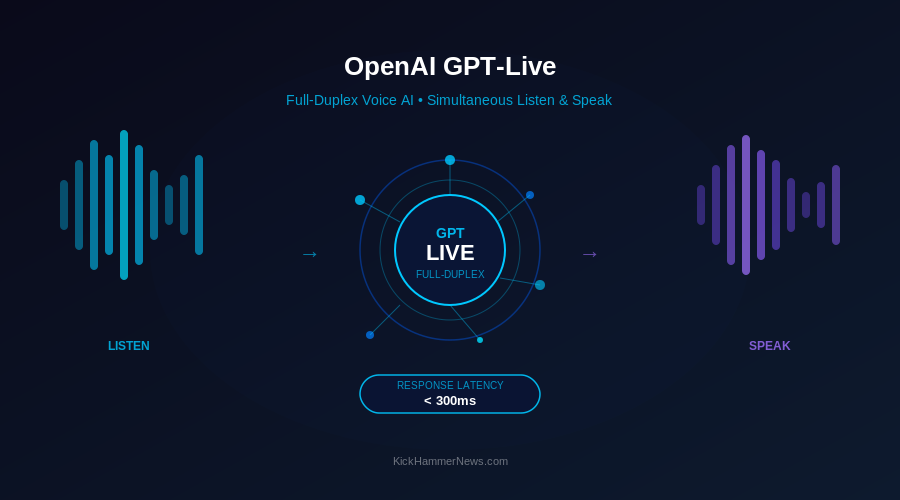
Rather than a cascaded pipeline where speech recognition feeds a text model that feeds a speech synthesizer, GPT-Live processes audio end-to-end in a unified model. The system is full-duplex: it listens and generates simultaneously, in real time. It can pick up on the prosodic cues — the slight trailing-off of a sentence, the rising pitch of a question — that humans use instinctively to signal turn transitions, without needing to classify them explicitly. The result is a voice model that responds in under 300 milliseconds on average, a threshold psychologists generally recognize as the edge of what humans perceive as “instant.”
What GPT-Live-1 and GPT-Live-1 Mini Actually Are
OpenAI launched two models simultaneously. GPT-Live-1 is the full-capability tier, serving ChatGPT Go, Plus, and Pro subscribers and running GPT-5.5 — the flagship text reasoning model — in the background for complex requests. When a user’s question requires web search, advanced reasoning, or tool calls, GPT-Live smoothly hands off to GPT-5.5 without breaking conversational flow. From the user’s perspective, there is no seam.
GPT-Live-1 mini serves free-tier ChatGPT users with a lighter footprint, trading some capability for lower inference cost while preserving the full-duplex architecture. Both models rolled out globally across iOS, Android, and ChatGPT.com starting July 8, 2026.
More Than Latency: Emotional Nuance and Conversational Cues
Speed was one design goal, but the team behind GPT-Live was clear that responsiveness without emotional intelligence would miss the point. Human conversation is not just about the exchange of information — it is continuous social negotiation. We signal agreement with brief affirmations before the speaker has finished. We interrupt when something surprises us. We pause to think in ways that are qualitatively different from the silence of a system waiting for input.
GPT-Live was trained on vast amounts of naturalistic dialogue with the explicit goal of capturing these cues. In practice, users interacting with the model report that it feels less like dictating to a transcription service and more like talking to a person with strong social intuitions. It can say “mm-hmm” in the middle of a long user turn without treating it as a response. It knows when a trailing “so…” invites a suggestion versus when it signals the speaker is still gathering thoughts.
These are not cosmetic improvements. For users who rely on voice interfaces — because they have motor impairments, because they are driving, because they are juggling tasks — the difference between a tool that requires careful orchestration and one that simply works is the difference between useful and transformative.
The API Surface and Developer Implications
OpenAI’s simultaneous release of the Realtime API alongside GPT-Live means developers are not limited to consuming this capability through ChatGPT. The gpt-realtime series of models exposes the full-duplex voice architecture via API, enabling builders to embed GPT-Live-grade voice interaction into their own applications — customer service platforms, automotive infotainment, educational software, healthcare intake systems.
The API includes support for function calling in the audio stream, meaning voice agents can trigger real-world actions — look up a calendar event, place an order, query a database — while maintaining conversational continuity. For enterprise developers who have been waiting for voice AI to reach production-grade quality, this represents a meaningful threshold crossing.
Competition and Context
OpenAI is not alone in this race. Google’s Gemini Live, announced at Google I/O in May 2026, demonstrated similar full-duplex capabilities on Android, and Apple’s Siri overhaul in iOS 27 showed meaningful progress in contextual retention across voice sessions. But GPT-Live-1’s backing by GPT-5.5’s reasoning depth gives it a potential advantage in the class of queries that require genuine understanding rather than pattern matching — the kind of complex, multi-step questions where previous voice interfaces broke down into confusion or awkward redirection to a text interface.
The market for voice AI is also growing in ways that make this timing consequential. Analyst estimates place enterprise spending on voice-enabled AI interfaces at over $28 billion annually by 2028, driven by call center automation, accessibility tooling, and the proliferation of AI-native devices that lack traditional screens.
What Comes Next
OpenAI’s roadmap for GPT-Live points toward deeper integration with its agent ecosystem. A voice-native interface that can not only answer questions but invoke agents — scheduling, executing workflows, monitoring processes — turns the modality from an input mechanism into a genuine control surface. The company has also signaled interest in personalization: models that learn a specific user’s speech patterns, vocabulary preferences, and communication style over time, building a persistent voice relationship rather than starting from scratch each session.
The full-duplex breakthrough is real, and it matters. Whether GPT-Live represents the enduring standard or merely the current high-water mark in a fast-moving category, it demonstrates clearly that the era of voice AI that requires users to adapt to its limitations is ending. The question now is how quickly — and for whom — the adaptation runs the other direction.
GPT-Live-1 and GPT-Live-1 mini are available now across ChatGPT’s mobile and web platforms. The Realtime API is available to developers via the OpenAI platform.


