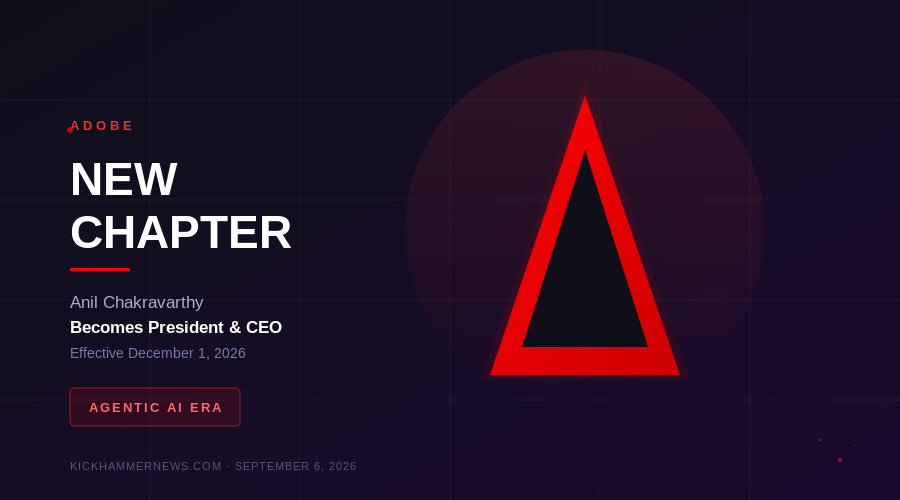
When Adobe’s Board of Directors announced on September 3 that Anil Chakravarthy would become the company’s next president and chief executive officer effective December 1, the software world took notice — not just because of who was stepping down, but because of what the choice signals about where one of tech’s most enduring creative empires is heading.
Shantanu Narayen, who has led Adobe for nearly two decades and steered it through one of the most consequential transformations in enterprise software history — from a box-software company to a cloud subscription giant — will transition to executive chair. His successor is not a Photoshop visionary or a creative evangelist. He is an enterprise data veteran with a PhD from MIT, a former CEO of Informatica, and an architect of Adobe’s fastest-growing business: customer experience.
The choice says everything about where Adobe’s revenue growth is now coming from — and where Chakravarthy intends to take it next.
Who Is Anil Chakravarthy?
Chakravarthy joined Adobe in January 2020 as executive vice president and general manager of the Digital Experience business. Before Adobe, he spent four years as CEO of Informatica, the cloud data management company, and held senior roles at Symantec, VeriSign, and McKinsey. He holds a Bachelor of Technology in Computer Science from IIT Varanasi and a Master’s and PhD from MIT — a background that has clearly shaped his instinct for data infrastructure and enterprise platform architecture.
At Adobe, Chakravarthy’s domain has been the part of the business most people outside enterprise tech never directly touch: the machinery that helps companies orchestrate customer journeys, manage content at scale, and personalize digital experiences across billions of touchpoints. That machinery — Adobe Experience Platform, GenStudio, Brand Visibility, CX Enterprise Coworker — is now Adobe’s most strategically important frontier.
In December 2021, he was elevated to president of Digital Experience and worldwide field operations, giving him stewardship over both product development and global customer sales. That dual remit — building and selling — is unusual and deliberate. It means Chakravarthy understands not just what customers want, but what they will actually pay for.
The Business Behind the Brushes
Adobe’s most famous products — Photoshop, Premiere Pro, Illustrator, Acrobat — remain cultural touchstones and cash generators. But in recent years, the company’s most explosive growth has come from its enterprise side. In Q2 FY2026, Adobe reported record revenue of $6.62 billion, up 13% year over year. AI-first annual recurring revenue had more than tripled to above $500 million.
That growth is not coming from individual creatives renewing Creative Cloud subscriptions. It is coming from enterprises signing large, multi-year agreements for Adobe’s CX Orchestration platform, from brands embedding GenStudio into their content supply chains, and from marketing departments deploying AI agents to manage personalized campaigns at scale.
Chakravarthy’s fingerprints are on much of this. Under his leadership, Adobe completed its acquisitions of Workfront (for project management and creative workflow) and Semrush (for SEO and brand visibility), and built CX Enterprise Coworker — an AI agent that helps marketing teams generate, review, and distribute content with significantly less human overhead. The Topaz Labs acquisition, announced earlier this month, adds world-class AI upscaling and noise reduction to Adobe’s creative toolset, further blurring the line between professional creative tools and AI-assisted production.
The Agentic Bet
In his first public statement as CEO-designate, Chakravarthy made clear that agentic AI is the organizing idea of his tenure. “I’m energized by the opportunity to fuel growth and drive Adobe’s leadership in the next era of agentic software for creativity, productivity and customer experience,” he said.
This is more than corporate boilerplate. Adobe has been building toward a world where AI agents handle the repetitive, derivative work of content production — resizing images, generating copy variants, routing assets through approval workflows — so that human creatives can focus on higher-order decisions. The question is whether Adobe can build those agents before its competitors, whether large platforms like Microsoft, Salesforce, or OpenAI’s enterprise products, or nimble challengers like Canva and Figma.
The pressure is real. Generative AI has destabilized the creative software market in ways that were unthinkable three years ago. Tools that once required professional skill can now produce acceptable results with a text prompt. Adobe’s Firefly platform was designed in part to answer this threat — and to ensure that Adobe, not a third party, captures the economic value of AI-generated creative output. AI-first ARR tripling in a single year suggests Firefly is gaining traction. But the competitive window will not stay open indefinitely.
Chakravarthy’s enterprise background gives him a specific advantage here: he knows how to sell platform access at scale, structure outcome-based contracts, and convince CIOs that Adobe’s AI stack is mission-critical infrastructure — not just a productivity tool. That framing matters enormously as enterprise software budgets get reorganized around AI.
What This Means for Creative Professionals
The creative community will be watching closely. Narayen was a product-first CEO who grew up alongside the tools that defined the industry. Chakravarthy is an enterprise-first CEO who has spent his career thinking about data pipelines, customer journeys, and platform economics.
That does not mean Adobe’s creative products will be neglected. The company has made substantial investments in Photoshop’s AI capabilities, Premiere Pro’s intelligent editing tools, and Lightroom’s automated processing features. But it does mean that the strategic lens through which those products are evaluated will increasingly be: how do they fit into the enterprise content supply chain?
For freelancers and independent creators, the concern is whether Adobe’s pricing and product roadmap will continue to serve their needs, or whether the enterprise pivot will leave them paying for features built for marketing departments rather than photographers. Chakravarthy will need to manage this tension carefully — the creative community’s goodwill is reputationally important even when its subscription revenue is relatively small.
Eyes on September 10
Chakravarthy’s first major public test as CEO-designate will come quickly: Adobe hosts its Q3 FY2026 earnings call on September 10. Investors will be listening for signals about AI monetization momentum, guidance on the Topaz Labs integration, and any early hints about how Chakravarthy plans to position Adobe heading into fiscal 2027.
Narayen built a company that survived the death of boxed software, the rise of subscription models, and the first wave of generative AI disruption. His chosen successor now inherits the challenge of navigating the second wave — one defined not by AI tools, but by AI agents that can think, decide, and act. That is the chapter Anil Chakravarthy was hired to write.