When Meta quietly dropped Muse Spark 1.3 on the evening of September 2, most observers had already written off the week’s model releases to Anthropic and Google. That was a mistake. Buried beneath the noise of Claude Fable 5.1 and Gemini 3.8 Flash was what may be the most practically significant coding model Meta has ever shipped — and possibly one of the most efficient agentic models in the entire field.
It’s not the biggest model. It’s not the flashiest launch. But Muse Spark 1.3 signals something important: Meta is no longer playing catch-up. It’s playing a different game.
What Changed Between 1.2 and 1.3
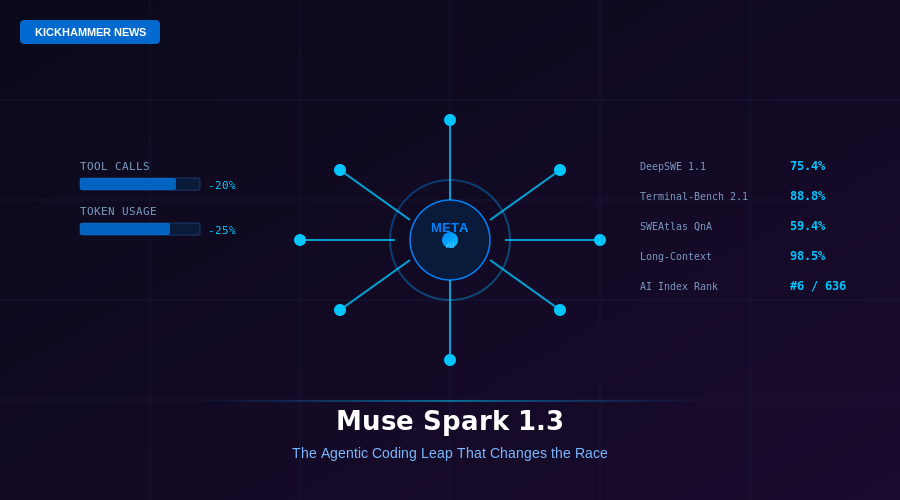
On paper, the headline numbers are impressive. Muse Spark 1.3 achieves 75.4% on DeepSWE 1.1, Meta’s chosen benchmark for end-to-end agentic software engineering. It hits 88.8% on Terminal-Bench 2.1, and 59.4% on SWEAtlas CodeBase QnA — a notoriously difficult evaluation that requires deep understanding of unfamiliar codebases. Long-context retrieval sits at 98.5% across a 1 million token context window.
Those are top-tier numbers. But the more interesting story is efficiency.
Meta’s engineers say Muse Spark 1.3 completes the same coding work as its predecessor using roughly 20% fewer tool calls and 25% fewer tokens. In a world where AI coding agents can rack up enormous API costs through repetitive probing and redundant context re-reads, that compression matters enormously. For enterprise developers running agents at scale, Muse Spark 1.3 doesn’t just work better — it costs less to operate.
The model also improves on long-horizon task sustaining. Previous Muse Spark versions would sometimes lose coherence or context during extended, multi-file coding sessions. According to Meta AI Research’s official launch post, 1.3 is designed to “better sustain longer-horizon work by collaborating with users and juggling multiple workflows in a single, long thread.” In practice, this means agents built on the model should be able to take on more complex engineering tasks — refactors, debugging chains, architecture migrations — without the drift that plagued earlier versions.
Multimodal Inputs, Agentic Output
Muse Spark 1.3 accepts text, images, and video as input — the same multimodal baseline now expected of any frontier model. What sets it apart is the output focus. Unlike models optimized for conversation or summarization, Muse Spark 1.3 is explicitly trained toward agentic software tasks: writing code, executing commands, interpreting test output, and iterating without constant user intervention.
This design philosophy aligns with the broader industry shift toward software engineering agents that can operate autonomously over multi-hour windows. GitHub Copilot Workspace, Devin, and Claude Code have been the dominant names in this space. Muse Spark 1.3 enters the conversation as a genuine competitor — and with a pricing structure that undercuts several of them.
The Pricing Structure Is Provocative
Muse Spark 1.3 ships with two pricing tiers, and the gap between them is eyebrow-raising.
The standard endpoint costs $1.25 per million input tokens and $4.25 per million output tokens on the highest quality tier. That’s competitive but not exceptional — roughly in line with comparable frontier models.
The “contributor” endpoint is another matter entirely. At approximately $0.10 per million input tokens and $0.20 per million output, it’s 10 to 20 times cheaper than the standard tier. The catch: Meta trains on your traffic. Developers who opt into the contributor tier are, in effect, helping Meta improve future versions of the model.
This is a bet that Meta is willing to make publicly. It’s also an acknowledgment that data — not compute — is the constraint Meta is most focused on solving. Many enterprise developers will refuse the contributor tier on principle or policy grounds. But for startups, researchers, and solo developers building on a budget, the math is compelling: near-frontier coding performance at a fraction of the cost, in exchange for data that Meta would likely get some version of anyway.
Where It Sits in the Race
The Artificial Analysis Intelligence Index places Muse Spark 1.3 at number six of 636 tracked models — a strong showing, and a significant improvement over where Muse Spark 1.2 landed at launch.
What that ranking doesn’t capture is the model’s positioning relative to specific use cases. On raw reasoning or scientific tasks, models like GPT-6 Astra and Claude Fable 5.1 likely maintain leads. But for the narrow, high-value category of agentic software engineering — the task of actually building and fixing code autonomously — Muse Spark 1.3 has made a credible claim on the top tier.
Bloomberg, covering the release, noted that Meta is “edging closer to OpenAI and Anthropic” — a framing that undersells the picture somewhat. Meta isn’t just closing a gap. It’s found a lane where efficiency and long-horizon coherence matter more than peak benchmark scores, and it’s executing there with unusual precision.
What This Means for Developers
For developers evaluating AI coding tools right now, Muse Spark 1.3 is worth a serious look — particularly if you’re building agent pipelines where per-call cost compounds quickly.
The model is available via Meta’s API and will roll out to users across Meta’s platforms, including Instagram and Facebook, over the coming weeks. Meta AI’s research blog has detailed documentation on the contributor tier terms, context window behavior, and benchmark methodology.
It’s not the splashiest launch of the week. But when the dust settles on September’s model wave, Muse Spark 1.3 may turn out to be one of the most consequential releases for the developers actually building things — the people for whom efficiency, context, and cost aren’t abstract concerns but daily constraints.
The AI race in 2026 isn’t just about who has the smartest model. It’s about who has the most useful one. With Muse Spark 1.3, Meta is making a serious argument for itself.
Sources: Meta AI Research, Bloomberg, MarkTechPost, Benchlm.ai


