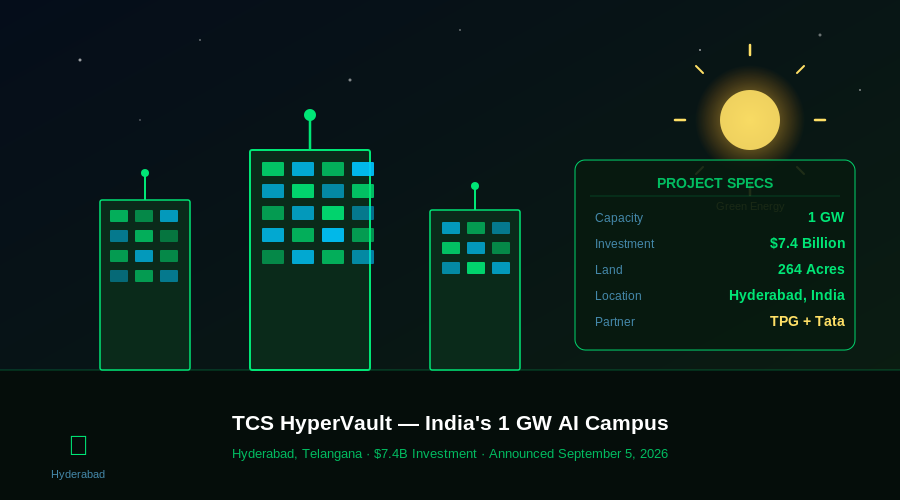
India is making its most ambitious move yet into the global AI infrastructure race. On September 5, Tata Consultancy Services announced that HyperVault, its newly formed data center subsidiary, has signed a memorandum of understanding with the state government of Telangana to develop a purpose-built AI campus of up to one gigawatt capacity in Hyderabad. Total investment is expected to reach ₹70,000 crore — roughly $7.4 billion — placing this project in the same league as the largest AI infrastructure investments being made anywhere in the world.
The announcement positions India as a serious contender in the global data center buildout, at a moment when the United States, the European Union, Saudi Arabia, and China are all racing to lock up AI compute capacity before the next wave of model training demand arrives.
What One Gigawatt Actually Means
A gigawatt of data center capacity is a number that can be hard to contextualize. To put it in perspective: a single gigawatt is enough to power roughly 750,000 average American homes. In data center terms, it represents a facility large enough to host hundreds of thousands of high-density GPU or XPU nodes simultaneously — the kind of infrastructure required to train frontier AI models, run large-scale inference for enterprise customers, and support the agentic AI workloads that analysts expect to dominate enterprise software spending through the end of the decade.
HyperVault has secured 264 acres of land for the campus, which will be developed in phases aligned with customer demand and technology maturity. The first phase is expected to be significantly smaller than the full gigawatt capacity, with the campus scaling as committed tenants — primarily frontier AI companies and hyperscalers — bring on new workloads.
The project is backed by TPG as a strategic partner, giving it access to private capital at scale alongside the Tata ecosystem’s engineering and operational resources. TCS has been building and managing enterprise technology infrastructure for decades; HyperVault is its bet that the next phase of that business requires owning the physical substrate of AI compute, not merely operating it on behalf of clients.
Why Hyderabad?
Hyderabad is a calculated choice. The city already hosts significant technology infrastructure for Google, Microsoft, Meta, and Amazon, giving HyperVault access to an established ecosystem of power procurement, fiber connectivity, and technology talent. Telangana’s state government has been aggressively courting data center investment with land availability, infrastructure commitments, and expedited permitting — the MoU signed with HyperVault reportedly includes government support for land acquisition, power connectivity, and water supply, all of which are typical bottlenecks for large-scale data center projects.
Power availability and pricing are central to the economics of AI data centers. Hyderabad has access to both thermal and renewable energy at scale. The HyperVault campus is designed around green energy and water-neutral principles — a requirement that has become non-negotiable for hyperscale customers with public net-zero commitments. Water-neutral design is particularly notable: it means the campus will recycle and offset all water consumed in cooling, addressing one of the most persistent criticisms of large-scale AI infrastructure.
India’s electricity costs are also substantially lower than those in the United States or Western Europe, creating a structural cost advantage for inference workloads that don’t require geographic proximity to US customers. As AI inference shifts from a high-latency, US-centric operation to a globally distributed, latency-sensitive service, having gigawatt-scale capacity in a cost-efficient location becomes strategically valuable.
India’s AI Infrastructure Moment
The HyperVault announcement is the largest single data center commitment India has seen, but it’s part of a broader wave. Microsoft committed $3 billion to Indian AI infrastructure in late 2025. Google has expanded its Mumbai and Pune regions. Amazon is accelerating its India infrastructure spend ahead of what it expects to be substantial demand from Indian enterprises adopting AI agents for back-office automation.
The Indian government’s India AI Mission, launched in 2024 with $1.25 billion in initial funding, has been quietly building out sovereign compute capacity in parallel. The Hyderabad campus will likely interact with that mission — TCS is one of the government’s most significant technology partners, and there is a logical alignment between HyperVault’s commercial objectives and India’s interest in having domestic AI training and inference capability.
What makes the HyperVault announcement distinctive is its scale and its explicit targeting of frontier AI companies and hyperscalers. Previous India data center announcements have focused primarily on enterprise cloud services. HyperVault is pitching high-density GPU deployments for AI training — the most compute-intensive and strategically sensitive workload category, typically reserved for US and European facilities.
The Global Race for Compute Sovereignty
The HyperVault project reflects a geopolitical reality that is reshaping technology infrastructure planning: nations and regions want sovereign AI compute capacity. The ability to train and run frontier AI models within a country’s borders — subject to its own laws, accessible to its own enterprises without cross-border latency or legal exposure — has become a priority for governments ranging from France to Saudi Arabia to India.
For AI companies operating globally, India’s scale — 1.4 billion people, a large English-speaking technology workforce, and the world’s largest addressable market for AI-powered services — makes it a critical geography. HyperVault’s one-gigawatt campus, if it builds out on schedule, would give those companies a place to put their India-facing workloads at AI training scale, not just inference scale.
The timeline matters. Global demand for AI compute is expected to dramatically outpace supply through at least 2028. Projects that can credibly deliver gigawatt-scale capacity within that window — and HyperVault’s phased approach is designed to do exactly that — are positioning themselves for a supply-constrained market where long-term capacity commitments carry substantial premium.
What Comes Next
HyperVault has not disclosed which specific hyperscalers or frontier AI companies are anchor tenants for the campus, but the involvement of TPG as a strategic partner suggests at least some committed demand. Pure speculative builds at this scale are rare; the economics require take-or-pay agreements with creditworthy tenants before ground breaks.
Construction timelines for projects of this complexity typically run 18-36 months from land preparation to initial power-on. If HyperVault breaks ground in early 2027, the first phases of the campus could be operational by late 2028 — precisely when the AI compute crunch is forecast to be most acute.
India is not the only country making moves of this scale. The United Arab Emirates, Saudi Arabia, and Indonesia have all announced comparable commitments in the past twelve months. What makes the Hyderabad project notable is that it’s backed by one of the world’s largest enterprise technology companies, with decades of project execution experience and a customer base that spans every major global corporation operating in India.
The question is no longer whether India will be a major AI infrastructure location. It’s whether HyperVault can execute at the speed the market requires.
TCS HyperVault’s announcement was made on September 5, 2026, through an MoU signed with the Government of Telangana.


