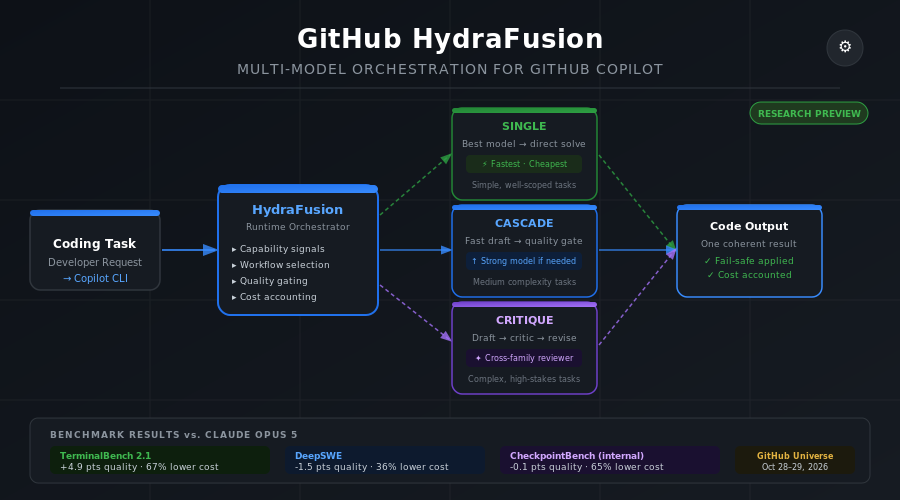
GitHub has launched Project HydraFusion, a research preview that fundamentally changes how GitHub Copilot approaches complex coding tasks. Rather than routing every request to a single AI model, HydraFusion dynamically assembles a workflow on the fly — choosing from models across multiple providers, mixing and matching based on the nature of each task. The result, according to GitHub’s internal benchmarks, is frontier-quality code at dramatically lower cost: up to 67% less expensive than running Claude Opus 5 alone.
The announcement, published September 4, 2026, represents a significant shift in how AI coding assistants are designed. Where the industry has spent years competing on which single model is best, HydraFusion bets the next leap will come from how models are combined — not just which one you pick.
From Model Selection to Model Orchestration
GitHub laid the groundwork for HydraFusion earlier this year with Auto model selection, which analyzed incoming tasks and matched them to the most suitable model. HydraFusion takes that idea several steps further: instead of picking one model and running with it, the system constructs a complete execution plan before a single token is generated.
For each incoming request, HydraFusion evaluates capability signals across reasoning, code generation, debugging, and tool use — then selects one of three execution patterns:
Single. When a task is well-scoped and one model can handle it cleanly, HydraFusion routes directly to that model. No overhead, no extra calls.
Cascade. An efficient, lower-cost model gets the first attempt. A quality gate evaluates the output. If it clears the bar, the response is returned. If not, the task escalates to a stronger model. The cascade pattern keeps costs low on easy tasks while ensuring harder ones get the horsepower they need.
Critique. A drafting model produces an initial solution. A second model from a different model family — with no access to tools or the ability to modify the repository — reviews the work as an independent critic. The drafting model then revises based on that feedback. This pattern mirrors how experienced developers work: write first, get a second opinion, then refine.
The key word is selectivity. HydraFusion doesn’t always invoke all three patterns. It chooses the least complex workflow expected to meet the quality bar for each specific task. Additional model calls are only made when they’re likely to improve the result.
The Benchmarks
GitHub published detailed results across three agentic coding benchmarks, comparing HydraFusion against Claude Opus 5 and GPT-5.6 Sol baselines. The findings are compelling — if nuanced.
On TerminalBench 2.1, which tests complex multi-step coding tasks in terminal environments, HydraFusion outperformed Opus 5 by 4.9 percentage points on verified task quality while reducing estimated workflow cost by 67%. This is HydraFusion’s strongest result: simultaneously better and substantially cheaper.
On DeepSWE, a more demanding benchmark covering repository-level software engineering tasks — navigating large codebases, understanding cross-file dependencies, producing end-to-end bug fixes — HydraFusion came within 1.5 percentage points of Opus 5 at 36% lower cost. The quality gap is narrow; the cost savings are material.
On CheckpointBench, GitHub’s internal benchmark built from real Copilot coding sessions anchored to specific public repositories and immutable commits, HydraFusion matched Opus 5 to within 0.1 percentage points at 65% lower estimated cost. This benchmark is significant because it’s designed to mirror actual production workloads rather than synthetic tasks.
GitHub is careful to frame these as controlled offline evaluations using specific benchmark revisions, model pools, and pricing assumptions. The research preview is, in part, a mechanism to validate whether these results hold in real-world developer workflows. That honesty about the limits of benchmark data is worth noting — and the numbers are still striking enough to warrant serious attention.
Engineering Discipline Behind the Preview
One of the more interesting aspects of HydraFusion is the operational rigor GitHub has built into its architecture. Multi-model orchestration sounds appealing in theory, but in practice it introduces complexity: costs spread across multiple invocations, intermediate states that could corrupt a codebase if applied prematurely, and review steps that need to stay truly independent.
GitHub addressed these risks through five explicit operating principles. Complete accounting ensures every leg of a workflow — draft, critique, revision, escalation, retry, fallback — is included in cost and usage reporting. Bounded execution gives each leg explicit timeouts and cancellation behavior so costs don’t spiral. Isolated review runs critic models in sandboxed, tool-less contexts so they assess code independently without touching the repository. Fail-safe application means no patch is ever applied if the workflow is cancelled or fails validation. Validated routing verifies all workflow definitions and model availability before execution begins.
For enterprise teams, the fail-safe and isolated review principles are particularly meaningful. A code assistant that partially applies a change because an orchestration step failed is worse than one that returns nothing. GitHub appears to have thought carefully about what “safe” means in a multi-model workflow context.
What Developers Can Try Today
HydraFusion is available now to all GitHub Copilot subscribers through the `/experimental` flag in GitHub Copilot CLI. To enable it, developers run `/update` to install the latest CLI version, then `/experimental on`, then select HydraFusion from the `/model` menu. Usage is billed at each underlying model’s standard token rate — meaning costs depend on which models the orchestration layer invokes for a given task.
GitHub is targeting VS Code and the Copilot app as fast-follow surfaces after the CLI preview. The current preview is best suited to substantial, well-scoped, single-prompt coding tasks handed to Copilot in autopilot mode. Multi-turn performance — longer, iterative sessions — is the stated next development priority.
The Broader Implication
The economics underlying HydraFusion point toward something important for how enterprises will think about AI coding tools going forward. As AI adoption scales, the per-seat cost of Copilot licenses is only part of the equation — token consumption at scale is the other variable that procurement and engineering leaders are starting to scrutinize.
A system that can deliver Opus-5-level quality on most tasks at 65% lower cost isn’t just an engineering curiosity. It’s a meaningful lever for organizations running hundreds or thousands of active Copilot users. If HydraFusion’s preview results translate to production workloads, the “which model should we pay for” conversation in enterprise software may shift toward “which orchestration layer manages our model spend most intelligently.”
GitHub Universe 2026, scheduled for October 28–29 in San Francisco, is likely to be the venue for further HydraFusion announcements as the preview matures. For now, the CLI preview gives developers an early look at what GitHub is calling “the next real gain in coding agents” — moving from selecting the best model to dynamically constructing the best way to solve each task.


