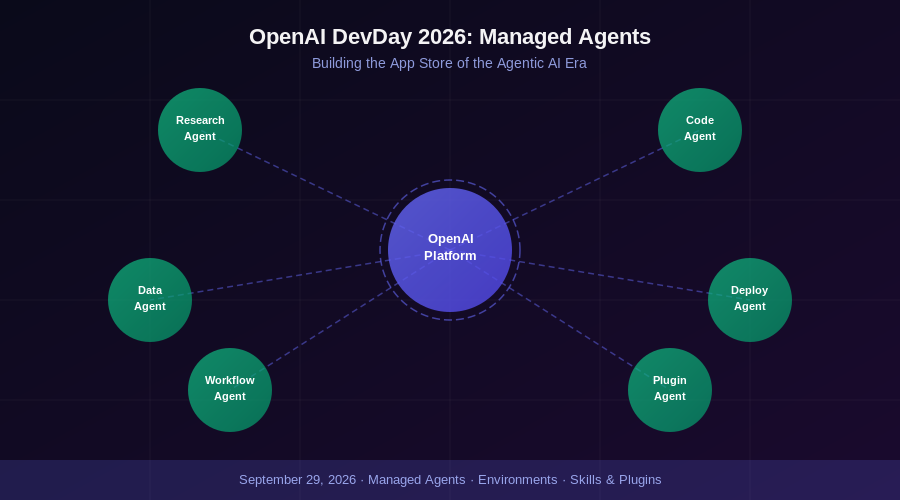
OpenAI is gearing up for what promises to be its most consequential developer event yet. DevDay 2026, scheduled for September 29, will serve as the launch pad for Managed Agents — a new platform capability that lets developers and enterprises build, configure, and deploy AI agents with customizable environments, skills, and plugins, all hosted and orchestrated directly through the OpenAI Platform.
If the name sounds familiar, it should. OpenAI has been steadily telegraphing this move for months, and sharp-eyed developers noticed references to “Managed Agents,” “Environments,” and “Agent Sessions” buried in the company’s own codebase long before any official announcement. Now the company is making it official, with Sam Altman set to deliver the opening keynote via livestream before hands-on sessions and technical deep dives open to attendees.
What Are Managed Agents, Exactly?
At their core, Managed Agents represent OpenAI’s answer to a problem that has become painfully familiar to anyone who has tried to deploy AI agents in production: the infrastructure overhead is enormous. Today, if you want a reliable, scalable AI agent that can run multi-step tasks, remember context across sessions, access tools safely, and recover from failures gracefully, you have to build most of that scaffolding yourself. That means custom sandboxing, state management, error handling, logging, and security controls — none of which are small engineering efforts.
Managed Agents abstract all of that away. Developers will be able to create Agents, configure their Environments (the sandboxed context in which an agent operates), and spin up Agent Sessions directly through the OpenAI Platform dashboard or API. The agent runs in OpenAI’s infrastructure, with built-in scaling, persistence, and security handled behind the scenes.
Think of it as the difference between managing your own servers and using a cloud hosting platform. Managed Agents are OpenAI’s equivalent of cloud hosting for autonomous AI workflows.
Why This Matters More Than You Think
The timing of this announcement is not accidental. Over the past year, a fierce competition has erupted around who owns the infrastructure layer for AI agents. Anthropic has expanded its Claude agent capabilities, Google has pushed Gemini’s agentic features deeper into Workspace and cloud products, and a wave of startups — from LangChain to AutoGen to newer entrants — have built entire businesses around making agent deployment more manageable.
OpenAI has watched this ecosystem grow up around its models and is now moving to capture more of that value directly. By offering Managed Agents as a first-party platform service, OpenAI can keep developers building on its infrastructure rather than routing around it with third-party orchestration layers.
For enterprises, the appeal is obvious. Security, compliance, and reliability concerns have been among the biggest brakes on large-scale AI agent adoption. When agents are running on OpenAI’s own managed infrastructure, with the company’s enterprise data agreements, SOC 2 controls, and SLA guarantees in place, many of those conversations become much easier to have in the boardroom.
Skills and Plugins: The Agent Marketplace Angle
One of the most intriguing elements of Managed Agents is the integration of customizable skills and plugins. OpenAI appears to be building toward an ecosystem model where agents can be extended with pre-built capabilities — connecting to third-party APIs, enterprise data sources, or domain-specific knowledge bases — through a standardized plugin interface.
This echoes, to some extent, the original ChatGPT plugin store, but with a crucial difference: those plugins were designed for human-facing conversations. Skills and plugins for Managed Agents are designed for autonomous, multi-step workflows where the agent, not the user, is the one deciding which tools to call and when. That’s a meaningfully different product, and it opens the door to a potentially rich marketplace of agent capabilities built by third-party developers.
If OpenAI can pull this off, it could position the company as the App Store of the agentic AI era — collecting a cut of the value created every time an agent reaches for a third-party capability to complete a task.
What Developers Need to Know
Details on pricing for Managed Agents have not yet been announced, but the model is expected to build on OpenAI’s existing usage-based pricing, with additional costs for compute and storage associated with running persistent agent environments. Developers interested in getting early access have been encouraged to register through the DevDay 2026 page.
For teams already building on the Assistants API or using OpenAI’s tools within existing orchestration frameworks, Managed Agents will likely offer a smoother path to production with less custom plumbing required. Teams using competing infrastructure will need to weigh the lock-in trade-offs carefully.
The technical deep dives scheduled for DevDay should reveal the extent of portability — whether agents built on Managed Agents can be migrated, exported, or run in hybrid configurations — which will be a critical question for risk-averse enterprise buyers.
The Bigger Picture
Managed Agents are part of a broader strategic bet that OpenAI is making on the agentic future. The company has been investing heavily in the idea that the next wave of AI value won’t come from smarter chat interfaces but from autonomous agents that can complete long-horizon tasks with minimal human supervision.
That bet is increasingly looking like the right one. Across the enterprise software landscape, companies are discovering that the most transformative AI deployments are not those that help humans write better emails or generate images faster, but those that actually eliminate entire workflows — automating research, analysis, code review, data processing, customer outreach, and more at a scale and consistency that human teams simply cannot match.
OpenAI wants to be the platform where those workflows live. DevDay 2026 is the opening move in that campaign.
September 29 cannot come soon enough.


