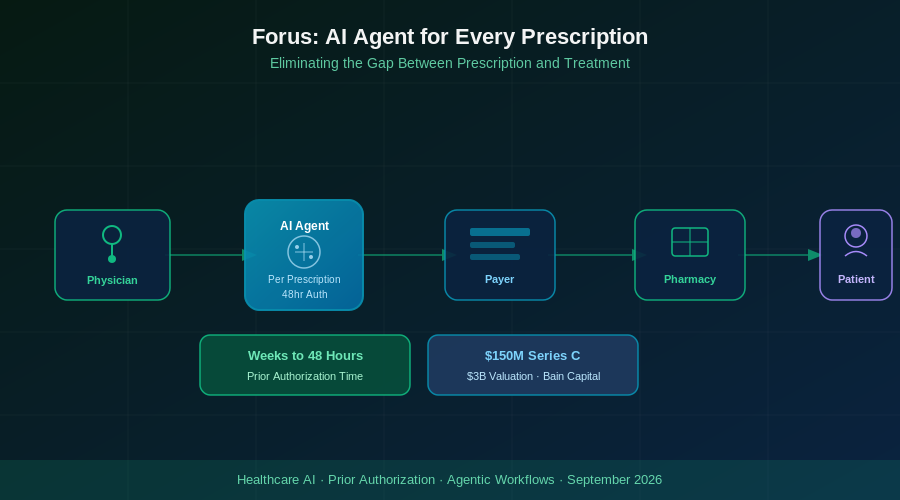
The gap between a doctor writing a prescription and a patient actually receiving the medication is one of healthcare’s most stubborn and costly inefficiencies. Prior authorizations stall. Specialty pharmacies lose paperwork. Payers deny claims on technicalities. Patients give up. Forus, a three-year-old startup that has quietly built an AI network to close that gap, just raised $150 million in a Series C round at a $3 billion valuation — and its investors are betting that the company has cracked one of the hardest problems in health tech.
The round was led by seed-stage backer Bain Capital Ventures in a rare insider-led growth round, with 100% reinvestment from existing institutional backers including Thrive Capital, General Catalyst, Accel, Redpoint, BoxGroup, Pear VC, Avra, Human Capital, Neo, Vast Ventures, and SV Angel. The deal tripled Forus’s valuation in less than a year, pushing cumulative equity financing past $300 million.
The Problem Forus Is Solving
To understand why Forus is generating so much investor enthusiasm, it helps to understand just how broken the prescription fulfillment process actually is.
When a physician prescribes a specialty medication — think biologics for rheumatoid arthritis, cancer therapies, or complex neurological treatments — the journey from that prescription to the patient’s hands typically involves a maze of phone calls, faxes, insurance verification steps, prior authorization requests, appeals, copay assistance applications, and pharmacy coordination. The average prior authorization for a specialty drug takes two to six weeks. About 30% of prescriptions for specialty medications are abandoned before the patient ever receives the drug, according to industry estimates. In oncology and rare disease, the stakes of those delays can be measured in outcomes.
This isn’t a technology problem that has been ignored. It’s one that has resisted technology because it sits at the intersection of three industries — healthcare providers, insurance payers, and pharmaceutical manufacturers — each with incompatible systems, incentives, and data formats. Past attempts to automate it have generally resulted in software that handles the easy cases and punts the hard ones back to human staff.
Forus’s Approach: One Agent Per Prescription
Forus was founded in 2023 by Sahir Jaggi with a fundamentally different architecture. Rather than building a centralized workflow automation tool, Forus assigns a dedicated autonomous AI agent to each qualifying prescription. That agent is embedded directly into clinical electronic health record workflows — the physician never has to leave their EHR interface — and it immediately begins reasoning across the patient’s medical records, insurance coverage rules, and available financial assistance options to map out the fastest path to fulfillment.
The agent handles prior authorization requests, monitors approval status, files appeals if denied, identifies manufacturer copay assistance programs the patient qualifies for, and coordinates with the appropriate pharmacy. Prior authorization timelines that previously averaged weeks are being cut to under 48 hours on the Forus platform, the company says.
Critically, Forus offers its platform free to providers and patients. The company’s revenue comes from biopharma manufacturers and specialty pharmacies that pay for access to Forus’s network and the fulfillment certainty it creates. That free-to-provider model has been central to the platform’s rapid adoption — physicians face no purchasing hurdle and no change management process; the tool simply appears inside workflows they already use.
Why the Timing Is Right
The Series C comes at a moment when the ingredients for Forus’s model have finally come together at scale.
Large language models capable of reasoning over complex, unstructured clinical and insurance documents have only matured sufficiently in the past 18 months. The interoperability standards that allow Forus’s agents to read data from multiple EHR systems — enabled by regulations that forced payers and providers to open their APIs — are now broadly implemented. And the past two years of agentic AI development have produced the orchestration frameworks and tool-use capabilities that make it possible for an AI agent to reliably navigate multi-step processes that previously required skilled human case managers.
Forus’s timing is also favorable in the competitive landscape. The startups that tried to automate prior authorization in the 2018–2022 wave mostly built rule-based systems that couldn’t handle the edge cases where the real cost and delay live. Forus’s generation-three approach, using genuinely capable AI agents with reasoning ability, is different enough that it isn’t simply competing with those earlier efforts — it’s replacing them.
Expanding the Network
The $150 million raised will be used to expand Forus’s network of connected providers, payers, and pharmacies; to grow the biopharma relationships that underpin the company’s revenue model; and to deepen the AI capabilities of the agents themselves.
On the product side, the company is pushing toward agents that can handle post-fulfillment tasks as well — adherence monitoring, refill coordination, outcome tracking — essentially following a patient’s therapy journey for its full duration rather than just getting the first prescription filled. That longitudinal view, if realized, would give Forus and its biopharma partners data about real-world drug performance and patient adherence at a level of granularity that has historically been impossible to gather systematically.
The Broader Implications
Forus is part of a generation of healthcare AI companies that are moving beyond the AI-as-diagnostic-assistant model that dominated the first wave of health tech and into the territory of AI as operational infrastructure — handling the administrative, logistical, and financial plumbing of healthcare at a speed and scale humans cannot match.
The addressable market here is staggering. U.S. healthcare administration costs exceed $800 billion annually, with prior authorization and specialty pharmacy coordination representing some of the most labor-intensive and error-prone components. If Forus’s agents can reliably take that work off clinician and pharmacy staff plates — while simultaneously improving patient outcomes by reducing treatment delays — the company’s $3 billion valuation may look modest in retrospect.
For now, Forus is focused on execution. With $300 million raised, heavyweight investors fully committed, and a model that is genuinely free to the physicians and patients it serves, the company has the runway to find out just how large the opportunity really is.


