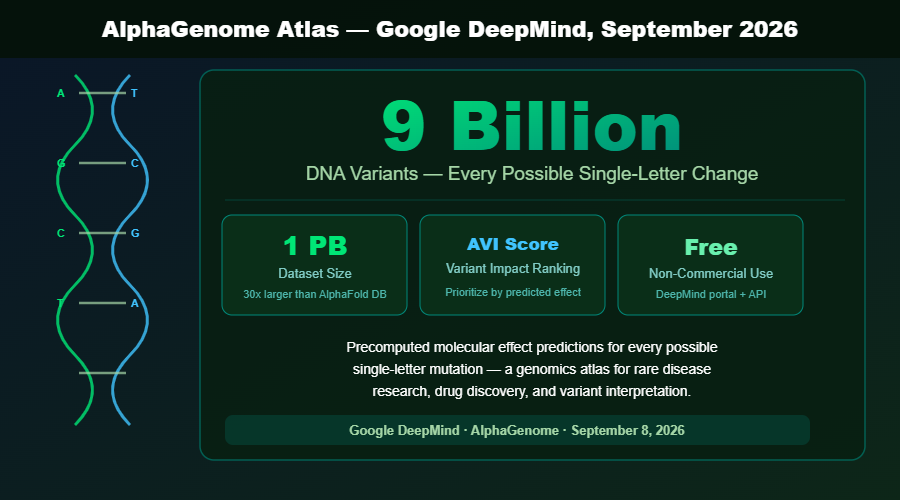
Two days ago, Google DeepMind quietly released what may be the most comprehensive biological reference dataset ever assembled: a precomputed map of the predicted molecular effects of all 9 billion possible single-letter changes to the human genome. The resource, called AlphaGenome Atlas, is free for non-commercial research use and arrives alongside a new variant-ranking score designed to help scientists prioritize which mutations deserve the closest examination.
The scale is almost difficult to contextualize. The human genome contains roughly 3 billion base pairs. Each position can theoretically be changed to any of four possible nucleotide letters, meaning the complete space of single-letter variants is approximately 9 billion entries. Until now, evaluating even a subset of those variants required running computationally intensive models one variant at a time. AlphaGenome Atlas precomputes all of them.
How the Atlas Works
AlphaGenome Atlas is built on top of AlphaGenome, DeepMind’s sequence-to-function model that predicts how changes to DNA affect gene expression, epigenetic marks, and other molecular readouts. Rather than requiring researchers to run that model interactively for each variant they care about, DeepMind ran it across the entire genome in advance, stored the results, and made the full dataset available as a single queryable resource.
The resulting dataset runs to approximately one petabyte — more than 30 times larger than the AlphaFold Database that DeepMind expanded in 2022. That comparison is intentional. AlphaFold’s structural predictions transformed how the scientific community approached protein research by making precomputed answers available for problems that had previously required months of experimental work. DeepMind is explicitly positioning AlphaGenome Atlas as a similar inflection point for genomics.
Alongside the dataset, the lab introduced the AlphaGenome Variant Impact score, or AVI score, which ranks mutations by their predicted biological effect. The practical intent is to help researchers prioritize: the 9 billion variants are not equally interesting, and a score that surfaces the highest-consequence mutations first significantly reduces the manual triage problem.
Access is available through the AlphaGenome Atlas website, the AlphaGenome API, and a skill within Google Antigravity, the company’s agentic development platform released earlier this year. DeepMind has indicated that commercial access through Google Cloud is coming soon, and the AVI score static download is permissively licensed for both commercial and non-commercial use.
The Science Behind the Claim
The foundation for this work is AlphaGenome, which DeepMind trained to predict what it calls “sequence-to-function” relationships — the molecular consequences that follow when a specific DNA sequence is read and processed by cellular machinery. Gene expression levels, the presence or absence of epigenetic marks, the accessibility of regulatory regions: these are the downstream effects that a single-letter DNA change can alter, sometimes profoundly, sometimes negligibly.
The challenge in genomics has long been distinguishing which variants matter from which variants are benign passengers. The human genome harbors millions of natural variants between any two individuals, most of them with no detectable effect on health or biology. A small subset drive disease risk, alter drug response, or affect fundamental cellular processes. Identifying that subset — particularly for rare variants that appear in only a handful of people worldwide — has required either years of experimental follow-up or statistical methods that only work when a variant appears in large enough populations.
AlphaGenome Atlas’s AVI score attempts to shortcut that triage. By predicting the molecular consequences of every possible variant computationally, the Atlas can flag variants that affect gene expression or regulatory function even before those variants have been observed in a patient population. For researchers studying rare diseases caused by ultra-rare or novel mutations, this represents a fundamentally different kind of starting point.
Important Limitations
DeepMind is careful to constrain what the Atlas can be used for, and the limitations are significant. The resource predicts molecular effects — changes in gene expression, chromatin accessibility, epigenetic marks — but does not predict clinical outcomes or disease risk directly. The distance between “this variant changes expression of gene X by 40 percent” and “this variant causes disease Y” is often large and requires additional experimental validation to cross.
The authors state explicitly in the accompanying technical paper that AlphaGenome Atlas and AVI scores are research tools that can serve only as part of the evidence chain leading to clinical diagnoses, not as sufficient evidence on their own. DeepMind’s disclaimer adds that AlphaGenome has not been validated or approved for any clinical use.
These are the right caveats. The history of genomics is littered with predictive tools that overpromised clinical utility, and the regulatory and ethical stakes for any tool that could influence medical decisions are high. What DeepMind is offering here is a research acceleration tool — one that might take a problem from “start screening 9 billion possibilities” to “start screening the 50,000 most likely candidates” — not a clinical diagnostic system.
Why This Matters Beyond Research
The broader significance of AlphaGenome Atlas may be less about any individual scientific application and more about what it signals for how biological research is conducted. The AlphaFold comparison DeepMind draws is not just marketing. When AlphaFold made predicted protein structures available for hundreds of millions of proteins, it changed the default workflow for structural biology: researchers stopped treating structure prediction as a bottleneck and started treating it as a starting point.
If AlphaGenome Atlas performs similarly for variant interpretation, the effect on genomics research could be comparably transformative. Drug discovery teams screening for genetic risk factors, researchers studying the regulatory genome, clinical genetics programs trying to interpret variants of uncertain significance in rare disease patients — all of these workflows currently involve significant manual curation and triage. A precomputed, ranked database of predicted variant effects does not eliminate experimental biology, but it substantially changes where researchers spend their time.
The one-petabyte scale also signals a shift in how AI outputs are distributed. The AlphaFold precedent established that it can be more valuable to precompute and share AI model outputs than to require every user to run inference themselves. As biological AI models grow more capable and more computationally demanding, this model — run it once, distribute the results — may become the standard for research datasets, lowering the barrier for institutions that lack the GPU resources to run frontier biological models themselves.
Timing and Context
The AlphaGenome Atlas release comes at a moment when the relationship between AI and biology is evolving rapidly. Earlier this year, Claude solved a long-standing open conjecture in algebraic geometry, and OpenAI’s agentic system cracked the Navier-Stokes Millennium Prize problem — demonstrations that AI systems are beginning to operate at the frontier of formal scientific reasoning, not just pattern-matching across existing literature.
AlphaGenome Atlas represents a different mode of impact: rather than solving a single hard problem, it provides infrastructure that makes thousands of individual research projects faster and cheaper. The combination of problem-solving AI and research-accelerating AI datasets may define how the relationship between artificial intelligence and scientific progress develops over the next decade.
The dataset is live now at DeepMind’s research portal, and the technical paper is available for those who want to examine the methodology. For genomics researchers, the first practical question is how AVI scores compare to existing variant prioritization tools in head-to-head studies. Those comparisons will take months to accumulate. The resource, however, is available today.


