When you ask an AI agent to book a flight, order groceries, or renew your software subscriptions, a question immediately follows: how does the airline, the grocery store, or the software vendor know it’s really you authorizing the transaction — and not a rogue bot draining your account? Until this week, there was no agreed answer. On September 10, 2026, three of the largest players in global payments announced they are building one together.
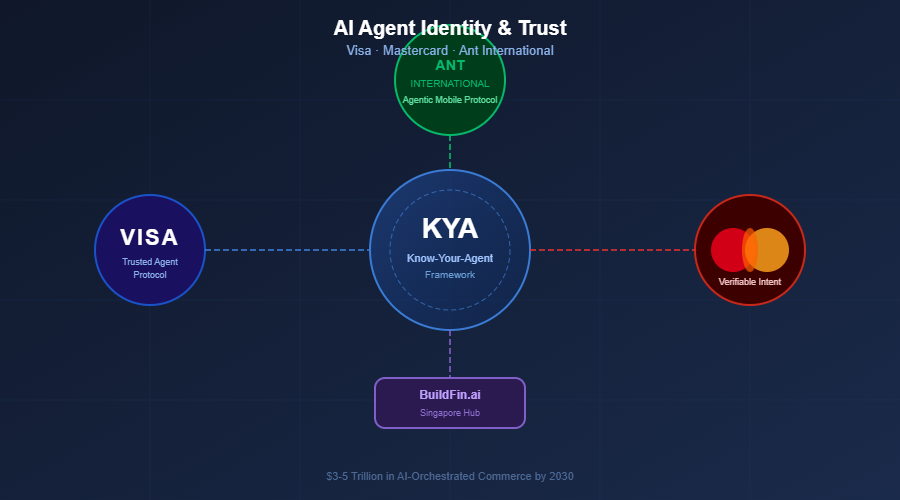
Ant International, Visa, and Mastercard have unveiled a joint initiative called the Know-Your-Agent (KYA) interoperability framework, channeled through Singapore-based fintech BuildFin.ai. The goal is deceptively simple: give AI shopping agents a trusted identity that payment networks can verify without requiring every merchant, wallet provider, and card network to build their own competing systems from scratch.
Why AI Agents Need Identity
The timing is not accidental. AI agents are rapidly evolving from making recommendations to completing purchases autonomously. By 2030, analysts project that AI agents will orchestrate between $3 trillion and $5 trillion of global consumer commerce annually. That scale creates an immediate and serious problem: the existing payments infrastructure was built to authenticate humans, not software.
When you pay with a card, the system verifies that the card is yours, that your bank recognizes the transaction, and that your spending behavior matches historical patterns. But when an AI agent acts on your behalf — perhaps operating from a cloud server in another country, executing dozens of micro-transactions per minute — none of those signals translate cleanly. The agent looks, to traditional fraud systems, like a sophisticated attack.
The three companies have been running their own competing approaches. Visa developed the Trusted Agent Protocol, which establishes a cryptographic identity layer for agents transacting on its network. Mastercard built Verifiable Intent, which focuses on proving that an agent is acting within the scope of user-granted permissions. Ant International created the Agentic Mobile Protocol, optimized for the high-volume, low-value micropayment flows that dominate Asian digital commerce.
None of those systems talked to each other — until now.
What KYA Actually Does
The KYA framework does not replace any of the three underlying protocols. Instead, it acts as a translation and certification layer, built on three central pillars.
The first is Cross-network Operator Traceability. An AI agent operating in one ecosystem — say, an Alipay wallet on Ant’s network — can now present verifiable credentials that Visa’s network recognizes when the agent makes a purchase at a European retailer. The certificate contains a cryptographically signed declaration of the agent’s origin, its authorized scope, and the human principal who delegated authority to it.
The second pillar is Shared Certification Requirements. Under KYA, any platform that wants its agents recognized across all three networks must meet a common baseline: the agent must have a documented principal identity, the principal must have completed standard KYC verification, and the agent’s permission scope must be explicitly bounded and cryptographically attested. These requirements are designed to be achievable without eliminating commercial differentiation — networks can add layers on top, but all must clear the floor.
The third is Continuous Transaction Monitoring. Rather than a one-time identity check at enrollment, KYA mandates ongoing behavioral monitoring that is shared across networks via a privacy-preserving protocol. If an agent begins behaving anomalously on Mastercard’s network — executing purchases outside its declared scope, at unusual frequencies, or through merchants that match known fraud patterns — that signal can propagate to Visa and Ant in near real time, without exposing the raw transaction data of the individual user.
The Stakes for Global Commerce
The announcement landed at a pivotal moment. The agentic commerce wave is already building. OpenAI’s Agents API, which opened to public beta on September 10, allows any developer to deploy persistent cloud agents with tool access and autonomous execution loops. Amazon’s Rufus shopping agent now completes purchases without human confirmation for pre-authorized merchants. Google’s Gemini AI handles travel bookings, bill payments, and subscription management for tens of millions of users.
Each of those agents needs to spend money. And every merchant, airline, hotel, and utility that accepts payment from an agent is taking on new fraud risk if they cannot verify who — or what — is on the other side of the transaction.
The KYA framework directly addresses this risk. A merchant who receives a payment from a KYA-certified agent can know, with a level of certainty backed by the joint certification of Visa, Mastercard, and Ant, that the agent is operating within its principal’s sanctioned scope. That shifts liability in ways that matter commercially: currently, most agents transact under the consumer’s card credentials, and any fraud falls on the card network. With KYA certification, the platform deploying the agent takes on a share of the liability — which creates powerful incentives to keep agents well-behaved.
What Critics Are Saying
Not everyone is celebrating. Consumer advocates have noted that the KYA framework is, for now, an industry self-regulatory initiative, not a government mandate. The European Central Bank has already indicated it intends to incorporate AI agent payment identity into its digital euro framework, and the framework may not align with the ECB’s approach.
Privacy researchers have flagged the Continuous Transaction Monitoring pillar. The cross-network behavioral sharing protocol relies on cryptographic aggregation to protect individual user data, but the technical specifics have not yet been published. Until independent cryptographers can audit the implementation, the privacy-preservation claims remain unverified.
There is also the question of exclusion. The framework currently covers Visa, Mastercard, and Ant — which together represent a substantial majority of global card and digital wallet volume. But American Express, JCB, and UnionPay’s vast Chinese domestic network are not yet participants. Agents operating in ecosystems outside the three founding networks will remain unauthenticated, creating a two-tier system that could complicate international commerce.
What Happens Next
The three organizations have set a target of open access for agent developers in the first quarter of 2027, with a pilot program through BuildFin.ai beginning in late 2026. Developers who want their agents to carry KYA certification will need to register their platforms, attest to their identity management practices, and agree to the shared monitoring protocol.
For the payment industry, KYA represents something rare: the three largest players in a competitive sector agreeing on a shared standard before a crisis forced their hand. The history of payment standards is littered with attempts that failed because no single actor had enough leverage to impose a solution. KYA succeeded in preliminary form, apparently, because all three networks recognized that without a shared trust layer, the agentic commerce wave would arrive as a fraud wave instead.
For AI developers, the framework signals the direction of the next compliance frontier. Building agents that can spend money autonomously is increasingly possible. Building agents that can do so within the accountability structures that global commerce requires is becoming the differentiating challenge — and the KYA framework is the beginning of what that accountability will look like.


