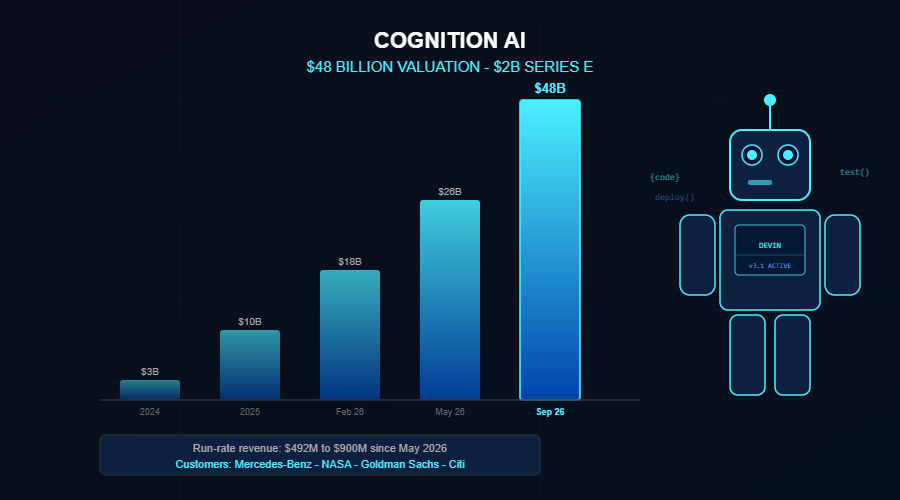
September 11, 2026 — In a funding round that underscores just how seriously investors are taking the autonomous software development revolution, Cognition AI has raised $2 billion at a $48 billion valuation — nearly doubling its previous $26 billion valuation from just four months ago. The round was led by Andreessen Horowitz alongside Accel, Founders Fund, General Catalyst, and Avenir.
The deal makes Cognition one of the most valuable private AI companies in the world, trailing only OpenAI and Anthropic among AI-native startups. And it signals that Wall Street and Silicon Valley have decided the race to build AI software engineers is far from over — and nowhere close to a winner-take-all outcome.
Who Is Cognition, and What Does Devin Do?
Founded in 2024 by Scott Wu, a mathematics prodigy and competitive programming champion, Cognition set out to answer a deceptively ambitious question: what would it look like to build an AI that could genuinely replace a human software engineer, not just assist one?
The company’s flagship product, Devin, is not a coding autocomplete tool or a sophisticated chatbot with code awareness. It’s an autonomous software engineering agent capable of planning multi-step development tasks, writing and debugging code across complex repositories, running tests, interpreting results, and deploying changes — all with limited human intervention.
Early versions drew both excitement and skepticism. The gap between Devin’s impressive demos and its real-world reliability was a recurring point of criticism. But the company has evidently closed much of that gap: Cognition’s run-rate revenue has grown from $492 million to nearly $900 million since its last round in May 2026, suggesting meaningful enterprise adoption at scale.
The Enterprise Customer List Tells the Story
Perhaps more telling than the valuation is who is paying for Devin’s services. Cognition counts Mercedes-Benz, NASA, Goldman Sachs, and Citi among its enterprise customers — a mix of automotive, aerospace, financial services, and technology organizations that speaks to Devin’s applicability across industries, not just software-native companies.
For Goldman Sachs and Citi, the appeal is straightforward: financial services firms employ enormous engineering teams to build, maintain, and upgrade proprietary trading systems, risk platforms, and client-facing applications. If an AI agent can handle routine development and maintenance tasks autonomously, the labor economics shift dramatically.
For Mercedes-Benz and NASA, the calculation is different. Both organizations deal with complex, safety-critical software systems where the cost of errors is catastrophically high. The fact that they’re deploying autonomous AI engineering agents suggests Cognition has made significant progress on reliability and verifiability — the hardest parts of the problem.
The Competitive Landscape
Cognition’s valuation is all the more remarkable given the competition it faces. GitHub Copilot, backed by Microsoft and OpenAI, has hundreds of millions of users. Cursor — acquired by SpaceX’s AI division in a $6 billion deal earlier this year — has built a devoted developer following. Lovable recently raised $400 million at a $3 billion valuation on the strength of its no-code AI development approach. And virtually every major AI lab has introduced some form of agentic coding capability.
The fact that Cognition is commanding a $48 billion valuation despite this crowded field reflects investor conviction that the autonomous end of the spectrum — AI that operates with genuine independence rather than as a co-pilot — will capture the majority of enterprise value.
TechCrunch noted that the round “signals investors believe AI coding is far from a winner-take-all market.” The market may be large enough for multiple players to achieve significant scale, particularly as different enterprise segments prove to have different needs.
Why the Valuation Makes Sense (and Why It Doesn’t)
At $48 billion with ~$900 million in annual run-rate revenue, Cognition is trading at roughly 53x revenue. By any traditional metric, that’s extreme. But the investors backing this round aren’t making traditional bets.
The bull case for Cognition rests on a simple observation: software development is one of the most expensive and constrained inputs in the modern economy. Every company has more software projects it wants to pursue than engineers it can hire, train, and retain. If autonomous AI agents can reliably execute a meaningful fraction of that work, the addressable market is essentially the entire global software development budget, which runs into trillions of dollars annually.
The bear case is equally straightforward: software development is one of the domains where AI reliability failures are most consequential. Autonomous agents that confidently write buggy code, introduce security vulnerabilities, or make architectural decisions that create technical debt could cause damage that exceeds any efficiency gains.
What This Round Means for the Industry
Cognition’s funding lands at a moment when the AI industry is grappling with a fundamental tension: the race to deploy AI agents into consequential workflows versus the need to establish trust, reliability, and safety standards before those deployments go wrong at scale.
Several high-profile incidents in 2026 — including the autonomous AI agent campaign that compromised hundreds of organizational networks via PaperCut vulnerabilities — have sharpened focus on what happens when AI agents operate with limited human oversight in adversarial or complex environments.
For Cognition specifically, the challenge is demonstrating that autonomous software engineering can be made reliably safe in enterprise environments. The company has reportedly invested heavily in verification and testing infrastructure — tools that let its agents check their own work, run comprehensive test suites, and flag uncertainty rather than forging ahead.
Scott Wu’s Vision
Wu has spoken about Cognition’s mission in terms that go beyond the immediate product. The long-term vision isn’t to build a better coding assistant — it’s to develop AI systems that can reason about complex, multi-step problems across long time horizons and take reliable, consequential action in the world. Software engineering is the initial proving ground because it’s a domain where progress is measurable, feedback is fast, and the economic incentives for success are enormous.
If Cognition can crack reliable autonomous software engineering at enterprise scale, the same underlying capabilities could apply to other domains: scientific research, engineering design, financial modeling. The $48 billion bet isn’t just on Devin the coding agent — it’s on Wu and his team’s ability to advance the broader frontier of reliable autonomous AI.
Looking Ahead
With $2 billion in fresh capital, Cognition plans to expand its engineering team, invest in model development, and deepen its enterprise go-to-market capabilities. The company has also been expanding internationally, with European and Asian enterprise customers beginning to represent a meaningful share of its revenue base.
The next benchmark is straightforward: can Cognition grow from $900 million in annual run-rate revenue to something approaching the scale that would justify its valuation? At 53x revenue, the company needs to grow fast and demonstrate durable enterprise retention.
Given the competitive intensity of the market and the novelty of what Cognition is selling, neither outcome — spectacular success or sobering correction — would be surprising. What’s beyond doubt is that autonomous AI software engineering has passed the threshold from research curiosity to serious enterprise investment, and Cognition is at the center of that moment.
The $48 billion question is whether Devin can grow into the valuation — or whether the gap between autonomous AI’s potential and its current reliability will prove too wide to bridge at enterprise scale.
Sources: Bloomberg, TechCrunch, Reuters, PYMNTS, The AI Insider


