September 12, 2026
Pre-orders for Apple’s iPhone 18 Pro and iPhone 18 Pro Max go live today at 5 a.m. PT, and for the first time in years, the most significant thing about a new iPhone is not the camera, the display, or the price — it is the chip. The A20 Pro, Apple’s first smartphone processor built on a 2-nanometer process, represents a generational leap in what a phone can do with artificial intelligence, and the timing could not be more deliberate.
A Chip Built for the Age of AI Agents
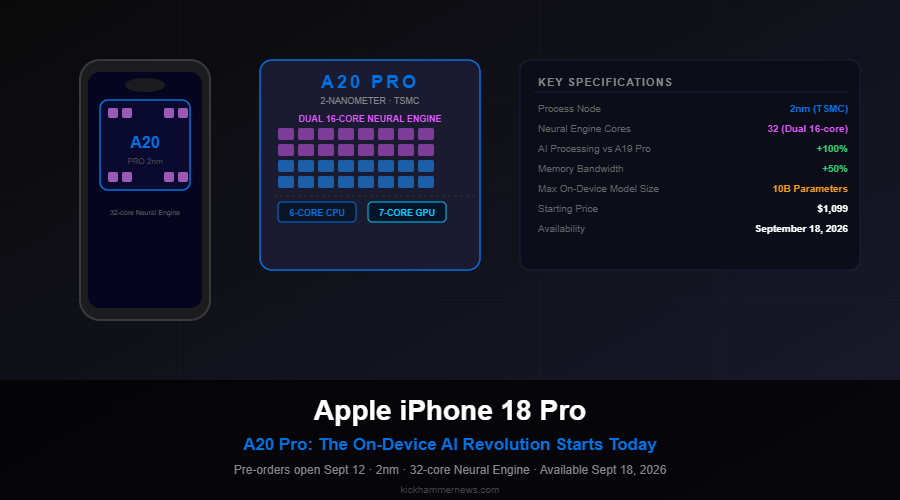
When Apple unveiled the iPhone 18 lineup at its Glowtime event on September 9, the company spent an unusually long time on silicon. That emphasis was intentional. The A20 Pro features a Dual 16-core Neural Engine — thirty-two dedicated AI cores in total — delivering double the on-device AI processing throughput of the A19 Pro that shipped last year. Paired with a 50 percent increase in memory bandwidth, the chip is engineered to run the kind of large, complex models that power modern AI agents and multimodal reasoning — not just in the cloud, but entirely on the device itself.
The CPU configuration is a new 6-core design with two supercores running 20 percent faster than last generation’s best, flanked by four efficiency cores. The GPU adds a seventh core for the first time in the Pro line. And the entire package is fabbed on TSMC’s 2nm node, an industry-first for consumer smartphones, squeezing more transistors per square millimeter while reducing energy consumption at peak load.
For consumers, this translates into responsiveness that feels categorically different. Tasks that previously required an API call to Apple’s servers — transcription, real-time translation, summarization, photo editing, coding assistance — now complete locally in milliseconds. For developers, it opens a new class of application: persistent, private, on-device AI agents that can observe sensor data, react to context, and take action without ever sending sensitive information off the phone.
Apple Intelligence Gets a Major Upgrade
The A20 Pro is the engine underneath a substantially refreshed Apple Intelligence experience in iOS 27. Several features that launched last year as cloud-only — including the deeper Siri reasoning mode and the Writing Tools rewrite capabilities — now run fully on-device on the iPhone 18 Pro and Pro Max.
The Neural Engine gains a new capability Apple is calling Live Context Processing. Rather than handling discrete inference tasks, the chip can maintain a persistent context buffer, allowing on-device models to reason across time. A demo Apple showed at the event involved an iPhone 18 Pro automatically tracking a multi-hour cooking session, surfacing a recipe substitution when it noticed a key ingredient was missing based on camera and audio data — without a single query to the internet.
Apple has also expanded its on-device model capacity. The A20 Pro can hold models with up to 10 billion parameters in resident memory, compared to the 3–4 billion parameter ceiling on the A19 Pro. Third-party developers can now access this capacity through a new API tier in Apple Intelligence, meaning apps from companies like Microsoft, Adobe, and dozens of smaller developers can offload significantly heavier inference workloads to the phone without relying on cloud infrastructure.
The Business Case Behind the Silicon
Apple’s push into AI silicon is not happening in a vacuum. The company has watched a meaningful portion of its services revenue — and mindshare — drift toward AI-first products from OpenAI, Google, and Meta over the past two years. ChatGPT’s presence on iOS remains one of the most-downloaded apps on the App Store. Google’s Gemini partnership with Android has deepened. Meta’s Muse personal AI agent, which launched this week, is explicitly targeting iOS as a primary platform.
Apple’s strategic response is to own the layer beneath all of them. If the on-device hardware is fast enough, and the privacy story is compelling enough, Apple believes developers and users will choose on-device intelligence over cloud-based alternatives wherever possible. The A20 Pro is an argument that the phone itself can be the AI — not just a window to the AI.
Analyst reactions have been broadly positive on this thesis. “Apple is making the hardware the moat,” said one technology analyst at a major investment bank. “The gap between on-device capability on an iPhone 18 Pro and what competitors can run locally on their flagship devices just widened significantly.”
Implications for Privacy and Security
The doubling of on-device processing power has another dimension that Apple was careful to highlight: privacy. Every inference that happens locally is data that never leaves the phone. Apple demonstrated this explicitly with several scenarios — a medical journaling app that analyzes symptoms and flags patterns, an AI-assisted legal document review tool, and a therapy support application — all of which process sensitive information entirely on-device.
This is not merely a marketing point. Regulators in the European Union, under the expanded provisions of the AI Act’s second-phase enforcement that began this summer, are increasingly scrutinizing how personal data flows through cloud AI systems. Apps that can point to on-device processing have a materially simpler compliance path. Apple has been in conversations with European regulators about the A20 Pro’s architecture, and the company expects the on-device processing story to ease approvals for a new category of sensitive-use applications in regulated markets.
What Comes Next
Pre-orders open today for the iPhone 18 Pro starting at $1,099 and the iPhone 18 Pro Max starting at $1,199. Availability begins September 18 in more than 65 countries. The base iPhone 18 and iPhone 18 Plus, powered by the standard A20 chip (which retains a single 16-core Neural Engine), are also available today.
For the AI industry, the arrival of the A20 Pro marks a significant data point: the on-device frontier is moving faster than many predicted. If thirty-two Neural Engine cores are in the pockets of hundreds of millions of consumers by the end of this year, the calculus around where AI runs — and who controls it — shifts meaningfully. Apple has long been comfortable playing a long game. With the A20 Pro, the company is betting that game is now AI, and it is betting it runs on silicon.


