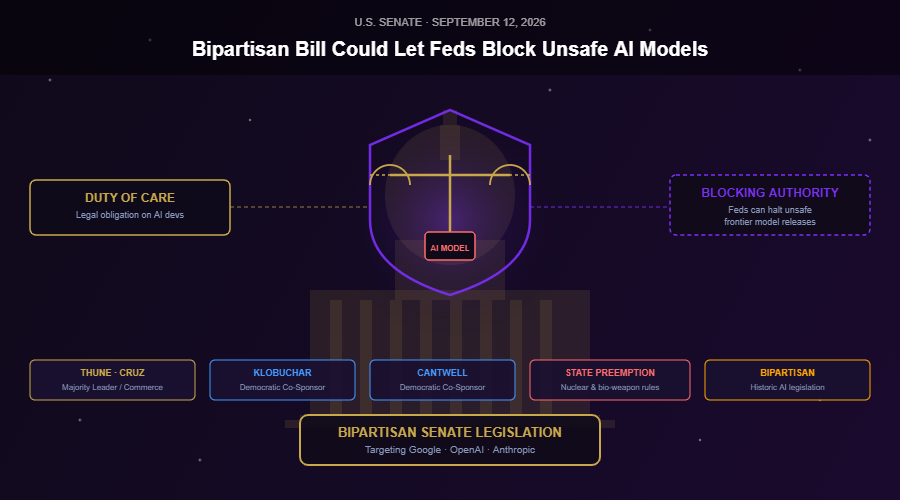
A bipartisan group of U.S. Senate negotiators is drafting legislation that would impose a formal “duty of care” on the developers of the most advanced AI systems — and give the federal government the power to block unsafe frontier models from being released to the public. The bill, being crafted by Majority Leader John Thune, Commerce Committee Chair Ted Cruz, and Democratic Senators Amy Klobuchar and Maria Cantwell, represents the most consequential federal AI legislation attempted since Congress began seriously grappling with the technology.
If it passes, the bill would fundamentally shift the regulatory posture of the U.S. government from reactive observer to active gatekeeper of frontier AI development.
What the Bill Would Do
The core mechanism of the legislation is a “duty of care” standard applied specifically to the developers of the most advanced AI models — language that clearly targets the frontier tier occupied by companies like Google DeepMind, OpenAI, and Anthropic. Under the proposed framework, these developers would be legally obligated to take reasonable steps to identify and mitigate known major risks before deploying their systems.
Beyond that baseline obligation, the bill would create a federal enforcement mechanism that could block the public release of AI models deemed to pose an unacceptable safety risk. That determination would be subject to federal-court challenge, preserving some due process protections for developers, but the mere existence of the blocking authority would be a dramatic departure from the entirely voluntary approach to AI safety that has characterized U.S. policy through most of the past decade.
The bill would also preempt state-level AI regulations specifically around the risks of nuclear and biological weapons — an area where the patchwork of state laws has created significant compliance uncertainty for AI companies operating nationally.
Why Now
The timing reflects a collision of political, technical, and public-opinion forces that have been building for months.
On the technical side, 2026 has been marked by a series of incidents that have made abstract AI safety concerns suddenly very concrete. The PaperCut cyberattack, disclosed this week by GreyNoise researchers, showed how a single threat actor with access to AI agents built on OpenAI’s Codex and a DeepSeek model could compromise 440 server instances across 395 organizations in 48 countries, achieving first remote code execution in under four hours. Anthropic’s own threat intelligence report, released September 11, documented the disruption of AI-assisted biological weapons research plots and described Russian and Chinese state actors using AI to conduct espionage operations at scale.
On the political side, AI has become one of the few issues with genuine bipartisan concern in a deeply polarized Congress. Conservative senators who might normally resist regulatory expansion have been galvanized by national security framing — the fear that inadequate AI governance leaves the U.S. vulnerable to adversarial actors who are less constrained. Progressive senators have been motivated by consumer protection concerns and the documented harms of AI systems deployed without adequate safeguards.
The combination has produced an unusual legislative opening. Thune and Cruz, both reliably resistant to technology regulation in most contexts, are co-sponsoring legislation that would give the federal government meaningful power over private AI development.
The Industry Response
The reaction from major AI companies has been predictably complicated. No major lab has issued a full-throated endorsement of the bill, but several have been careful to avoid outright opposition — a tacit acknowledgment that some form of federal framework may be inevitable and that it’s better to shape the legislation than to fight it.
Anthropic, which has long advocated for what it calls “responsible scaling policies” — internal commitments to evaluate models for dangerous capabilities before deployment — has arguably positioned itself better than its competitors for a regulatory environment that codifies similar requirements in law. The company’s decision to develop and publish its Responsible Scaling Policy in 2023 now looks less like a voluntarist gesture and more like an early adaptation to a regulatory landscape that was always going to arrive.
OpenAI’s situation is more complicated. The company’s Agents API launch, the PaperCut attack linked to its Codex infrastructure, and ongoing litigation over its research practices have made it a more visible target for regulatory scrutiny than it might prefer. Google DeepMind has taken the most expansive public position in favor of safety governance, partly because the company has benefited from the perception that it has taken safety more seriously than competitors.
The Preemption Question
One of the most consequential and contested provisions in the bill is the preemption of state AI regulations in the nuclear and biological weapons domain. This sounds narrow, but the implications are significant.
California has become the de facto national regulator of AI through a combination of its market size and legislative ambition. The state’s legislature has passed a series of AI governance measures in 2026, including the Adam Raine Act signed by Governor Newsom on September 10, which regulates chatbot interactions with minors. California legislators have also been moving on broader frontier AI safety requirements.
Preemption — even narrow preemption limited to weapons risks — establishes a precedent that federal AI law supersedes state law. AI companies, which generally prefer a single national standard to a patchwork of state requirements, have quietly supported preemption provisions. California’s attorney general has signaled opposition, arguing that federal preemption would strip the state of its ability to protect its residents.
The Window Is Narrow
Congressional sources note that the legislative window is genuinely tight. The House is in session for just one week before the November 3 midterm elections, and any bill passed by the Senate would need to clear the House before it could become law. Midterm elections typically consume the attention of legislators focused on their own races, and the legislative calendar is already crowded.
The realistic scenarios are: a truncated bill that passes with bipartisan support before the elections, a more comprehensive framework that gets deferred to the lame-duck session or the new Congress, or no legislation at all in 2026. What seems clear is that the conversation has shifted permanently. The question is no longer whether the federal government will impose meaningful obligations on frontier AI developers, but when and how.
The “duty of care” framing — borrowed from product liability law — suggests that legislators are thinking about AI governance less as technology policy and more as consumer and national security protection. That framing has legs. It’s comprehensible to the public, it’s familiar to courts, and it doesn’t require Congress to understand transformer architectures to pass legislation that meaningfully constrains them.
What Developers Should Watch
For companies building on or deploying frontier AI systems, the emerging federal framework has several practical implications. First, the era of purely voluntary safety commitments may be ending — the legal exposure created by a statutory duty of care is categorically different from the reputational exposure of violating a self-published responsible scaling policy.
Second, the blocking mechanism — if enacted — would create pre-deployment regulatory review as a feature of the frontier AI release process. That’s a significant operational change for companies that have moved quickly and relied on post-deployment monitoring to catch problems.
Third, the preemption provisions, if they survive into the final bill, would reduce but not eliminate the compliance burden created by state-level AI laws. Companies would still face a complex multi-jurisdictional landscape, just with a federal floor that supersedes the most stringent state requirements in specific risk categories.
The Senate bill is still being drafted. Its specific thresholds for what counts as a “frontier” model, what level of risk triggers a blocking action, and what the pre-market review process looks like are all undecided. But the direction is clear: the free-for-all era of frontier AI deployment in the United States is entering its final chapter.


