OpenAI has made its most ambitious move yet in the AI image generation race, releasing GPT Image 2.5 — a two-variant system that splits the difference between speed and precision with startling results. Named Flare and Sunburst, the new models landed on September 8, 2026, and within days had claimed the top two positions on Artificial Analysis’s image leaderboard, sending ripples through the creative, advertising, and developer communities alike.
This is not just an incremental update. GPT Image 2.5 represents a fundamental rethinking of how AI image tools should work — and for the first time, it gives professional users a genuine choice between two distinct performance profiles under the same model family.
Two Models, One Vision
The dual-model architecture at the heart of GPT Image 2.5 reflects a hard-won lesson from OpenAI’s experience with language models: a one-size-fits-all approach rarely serves anyone optimally. Flare and Sunburst carve out their own lanes and stay in them.
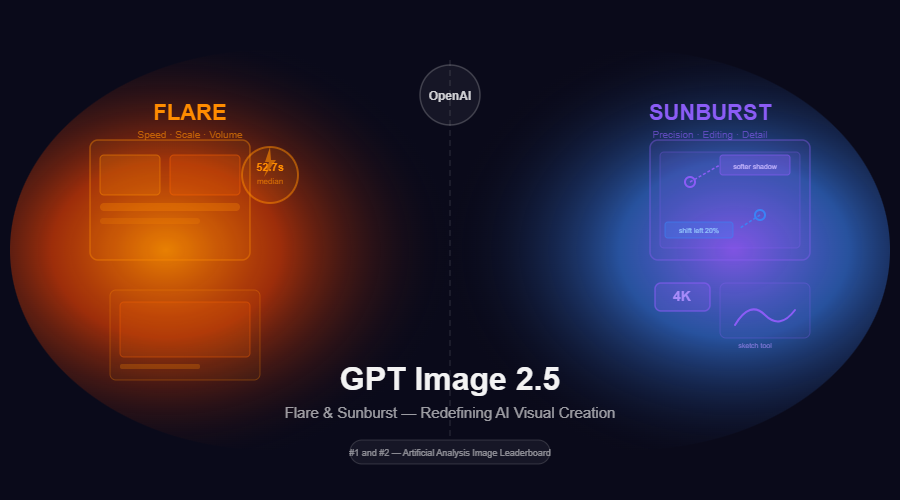
Flare is the speed tier. Built for high-volume workflows where iteration matters more than fine-grained control, Flare posts a median generation time of just 52.7 seconds — a 63% reduction compared to its predecessor, GPT Image 2. That is not a rounding-error improvement; it is the kind of performance delta that changes whether a creative team can realistically run twenty variations of a campaign asset in a morning or has to plan it across two days. Flare handles everything from social media content and rapid prototyping to product-level visual search, and it does so at a pace that starts to feel genuinely practical in production environments.
Sunburst is the precision tier. Where Flare races, Sunburst deliberates. Its generation times are slower — deliberately so — and the payoff is exacting fidelity, particularly in editing workflows. Sunburst excels at multi-turn editing scenarios where the model must carry context from one revision to the next, preserving subject identity while applying new instructions about lighting, composition, or background. For production-ready campaign creative or polished product imagery destined for print or large-format display, Sunburst is the model OpenAI intends you to reach for.
The distinction matters commercially. Flare is priced for scale; Sunburst carries a premium that reflects its compute overhead. Both models sit inside the same API, accessible via the endpoints gpt-image-2.5-flare and gpt-image-2.5-sunburst, making it trivial for developers to route requests dynamically based on deadline, budget, or quality requirements.
What’s Actually New Under the Hood
Beyond the dual-model structure, GPT Image 2.5 introduces three capabilities that hadn’t appeared in previous iterations:
The Sketch Tool. Users can now draw rough shapes or annotate existing images and submit those drawings as compositional instructions. The model treats the sketch as a guide — preserving spatial layout while rendering photorealistic or stylized output on top of it. This closes a significant gap that creative teams had been working around with Photoshop intermediary steps. Designers who spoke to industry outlets in the days after launch consistently flagged the sketch tool as the feature that most changed their workflow.
Comment-Based Editing. Rather than retyping full prompts each time a revision is needed, users can now leave inline comments on an existing generated image — “make this shadow softer,” “shift the product left by 20%” — and the model applies targeted edits while leaving the rest of the composition intact. It is not unlike track-changes in a document editor, ported to a visual medium. For collaborative creative workflows where art directors, copywriters, and brand managers all have opinions, this is a meaningful quality-of-life upgrade.
4K Output. Both Flare and Sunburst now support output resolution up to 4K — 3840×2160 pixels — which finally pushes AI-generated imagery into territory usable for broadcast, high-DPI print, and large-format digital signage without post-production upscaling artifacts. This brings GPT Image 2.5 into direct contention with Midjourney and Adobe Firefly for professional production work.
Reference Fidelity and the Identity Problem
Perhaps the most technically consequential improvement in GPT Image 2.5 is what OpenAI describes as enhanced “reference fidelity.” Previous image models — including GPT Image 2 — struggled to maintain consistent subject identity when transforming a person or object across different scenes, styles, or lighting setups. Feed in a photo of a product, ask the model to place it on a beach at sunset, and the result might look right at a glance but fail under scrutiny: the product’s texture reads slightly wrong, the logo proportions shift, the color temperature drifts.
GPT Image 2.5 corrects this meaningfully. Lighting and textures now feel more natural, and subjects look more recognizable when placed in new contexts. For e-commerce applications — where a retailer might need to show the same product across dozens of lifestyle settings — this improvement alone justifies the model upgrade. It reduces the manual retouching workload that has, until now, kept human artists in the loop on AI-generated product shots.
Availability and Ecosystem Reach
GPT Image 2.5 is available immediately across ChatGPT tiers, including ChatGPT, ChatGPT Work, and Codex. The API endpoints are live, and the models have been integrated into the fal.ai inference platform for developers who prefer a third-party serving layer. OpenRouter lists Sunburst with pricing aligned to premium API access, while Flare sits at a lower cost-per-image tier suited to batch operations.
The launch timing is notable. OpenAI is releasing this at a moment when Google, Stability AI, and Adobe are all pushing hard on image generation quality — and doing so within months of image generation becoming a core feature rather than a novelty in business software. By fielding two specialized models rather than one general-purpose one, OpenAI is making a bet that the market has matured to the point where buyers are sophisticated enough to select the right tool for the right task.
The Creative Industry Response
Initial industry reaction has been swift and largely positive, with reservations concentrated on specific use cases rather than the system overall. Motion designers report that the sketch tool dramatically accelerates pre-visualization work. E-commerce teams are testing Sunburst for product catalog generation at a scale previously impossible without large photography budgets.
Some video production studios have flagged that the 4K output, while impressive for still images, remains a distant relative of what top-tier diffusion-based video tools can now produce frame by frame. That is a different market, however, and one OpenAI has not yet entered with a flagship product.
What is harder to dispute is the leaderboard data. Flare and Sunburst occupying the top two positions on Artificial Analysis’s image benchmark — a widely tracked independent evaluation — is not a marketing claim. It is a measurable signal that whatever OpenAI built into these models is working as intended.
What Comes Next
Industry observers are watching two dynamics closely. First, whether Google’s competing image tools — deeply integrated with Gemini and Workspace — can close the quality gap that GPT Image 2.5 has now widened. Second, whether the comment-based editing capability signals OpenAI’s intention to build a more comprehensive collaborative creative platform — something that could eventually challenge Adobe’s dominance in the professional creative suite market.
For now, Flare and Sunburst are the clearest signal yet that the era of one-model-fits-all image generation is ending. The next wave of AI creative tools will be purpose-built, profiled, and priced accordingly. OpenAI has just drawn the new map.


